Winston Churchill was born at Blenheim Palace in 1874, died at 28 Hyde Park Gate, Kensington, in 1965, and spent the ninety years in between making London his stage. He held seven Cabinet posts under five monarchs, was First Lord of the Admiralty twice, sat for five constituencies across two parties, and led the United Kingdom through the most dangerous five years in its modern history from a bunker eight metres below the Treasury. The London he lived in is still walkable. Four sites cluster within a triangle bounded by Westminster, Pimlico, and Kensington, each with a piece of the Churchill story and most of them with a plaque or a monument that names him. This is the guide that connects them.
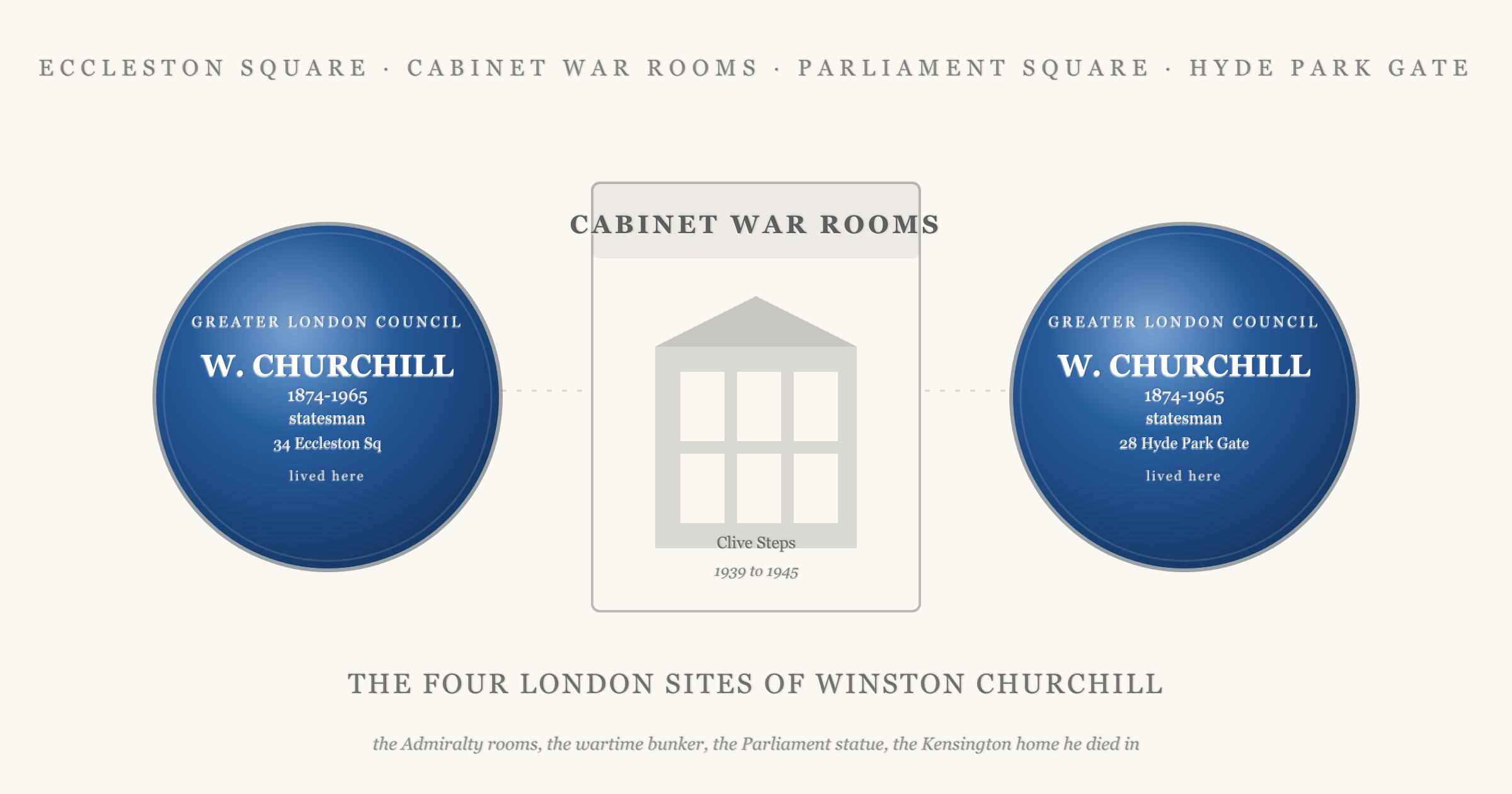
Churchill's London is small geographically but tells the whole life. Two English Heritage blue plaques mark his actual residences: 34 Eccleston Square in Pimlico, where the young Liberal Cabinet minister lived from 1909 to 1913 and prepared the Royal Navy for the First World War, and 28 Hyde Park Gate in Kensington, where he lived from 1945 and died in January 1965. The Cabinet War Rooms beneath the Treasury, now the Churchill War Rooms museum, was the underground bunker from which he ran the Second World War. The Parliament Square statue, unveiled in 1973, faces the Palace of Westminster where he spoke as a backbencher, a Cabinet minister, the Prime Minister, and finally, in his eighties, again as a backbencher. Walked in chronological order, the four sites trace a life from rising politician to wartime leader to elder statesman. If you want to follow the route, the Legacy app maps every London plaque associated with Churchill and gives you the inscription text plus the historical context for each one.
Why Churchill Has Two Blue Plaques
The English Heritage scheme limits a subject to a single plaque at their most significant surviving address, and Churchill is one of the rare exceptions. He has two London plaques because both addresses survive, both are unambiguously associated with him for sustained periods of national significance, and the scheme made an exception in his case. 34 Eccleston Square marks the rise. 28 Hyde Park Gate marks the long aftermath. The bracketing addresses sandwich a working life that mostly happened in Westminster and Whitehall, where Churchill rented short-term, lived above the shop at 10 Downing Street, or occupied service apartments at the Admiralty. The plaque scheme rewards residency; Churchill's most consequential years were lived in official accommodation, which is why the two plaques sit at the edges of the political career rather than the centre.
The Cabinet War Rooms (now the Churchill War Rooms, opened to the public in 1984 and expanded as a museum in 2005) is the workplace marker of the wartime years. The Parliament Square statue, sculpted by Ivor Roberts-Jones and unveiled by Clementine Churchill in 1973, is the public memorial. Together, the four sites are the closest London comes to a single coherent walking tour of the man.
Stop One: 34 Eccleston Square (1909 to 1913)
A short walk from Victoria Station, on the south side of Eccleston Square, the English Heritage blue plaque at number 34 reads in the standard English Heritage format. Churchill lived here from 1909, the year after his marriage to Clementine Hozier, until 1913, when he took up service accommodation at the Admiralty. The Eccleston Square years are the rising-politician chapter. Churchill was thirty-five when he moved in, President of the Board of Trade in Asquith's Liberal government, and would in those four years become Home Secretary (1910 to 1911) and then First Lord of the Admiralty (1911 to 1915). His son Randolph was born here in 1911. Diana, his eldest, had been born to Eccleston Square the previous year.
The political work of the Eccleston Square period is the work that prepared Britain for the First World War. As Home Secretary, Churchill was the figure at the Sidney Street siege in January 1911, photographed in his Astrakhan-collared coat watching armed police surround a Russian anarchist hideout in Stepney. The press response was mixed (some praised his decisiveness, some called it grandstanding), and the photograph became one of the most-circulated images of his early career. Later in 1911, he was moved to the Admiralty, and the Eccleston Square dining room became the venue for the first naval staff meetings of a programme that would replace coal-burning battleships with oil-burning ones, raise the speed of the Royal Navy, and (in his own later judgement) buy the eighteen months of preparation that mattered when war came in August 1914.
The building is private. The plaque is at ground level, easy to read, mounted in the standard English Heritage pattern. From here, the walk to the Cabinet War Rooms is about twenty minutes through Belgravia and across St James's Park, passing Buckingham Palace and the Mall on the way.
Stop Two: The Cabinet War Rooms (Clive Steps, 1939 to 1945)
Beneath the Treasury building at Clive Steps off Horse Guards Road, the Cabinet War Rooms are the bunker complex from which Churchill chaired the British war effort between 1939 and 1945. The rooms were built in 1938 as a precautionary measure against a German bombing campaign that was correctly anticipated. They were never bombed directly (the Treasury above them took a near-miss in 1940, which redoubled the case for the bunker), and at the end of the war the doors were closed with everything inside left exactly as it was on the day Japan surrendered.
The rooms reopened to the public in 1984 as the Cabinet War Rooms museum, run by the Imperial War Museum, and were renamed the Churchill War Rooms in 2010. The Map Room is the room most photographed, with its pinhole-marked maps of the global theatre and its colour-coded ship-position cards. The Cabinet Room is the room where Churchill chaired 115 meetings of the War Cabinet during the bombing of London, sleeping in the small adjoining bedroom on a single bed under a barrel-vault corrugated-iron ceiling. The Transatlantic Telephone Room (originally disguised as a private toilet for Churchill, with a "Vacant / Engaged" sign on the door) houses the secure scrambled-voice link to Roosevelt in Washington, the world's first long-distance encrypted voice channel.
The museum is paid entry (adult tickets around £30 at time of writing, plan for ninety minutes minimum), and combination tickets with the Imperial War Museum Lambeth give a discount on both. The site does not have a blue plaque (it sits inside an active government building and the plaque scheme does not mark workplaces), but it has its own historic-site signage at the entrance and is included in every credible London-walks guidebook of the wartime period.
Stop Three: The Parliament Square Statue (1973)
Across Parliament Street from the war rooms entrance, the Parliament Square statue of Churchill stands on the north-east corner of the square, facing the Palace of Westminster across Bridge Street. The 1973 bronze, by Welsh sculptor Ivor Roberts-Jones, is the most visited of the eleven statues that ring Parliament Square. Churchill is shown in long overcoat, leaning slightly on a walking stick, gazing toward Big Ben.
Clementine Churchill unveiled the statue at the centenary of her husband's birth, eight years after his death. The commission had been disputed (some of the family preferred a seated figure, in line with the more contemplative Roosevelt statue in Grosvenor Square; Roberts-Jones, the sculptor, argued for a standing figure with the unmistakable stance that the wartime newsreels had made universal). The unveiling drew a crowd in the tens of thousands. The plinth bears only the word "CHURCHILL," in capitals, without dates, ranks, or epitaph; the figure on the plinth carries the explanation.
The statue has been subject to occasional controversy in the past decade over Churchill's record on empire and on race, with the 2020 Black Lives Matter protests producing graffiti that was quickly removed and a temporary protective cordon. The statue remains in place. The square as a whole is an accessible site, open at all hours, and the walk from the war rooms to the statue is two minutes.
Stop Four: 28 Hyde Park Gate (1945 to 1965)
After the July 1945 general election in which the Conservatives lost to Labour despite Churchill's wartime popularity, Churchill and Clementine moved out of 10 Downing Street and into 28 Hyde Park Gate, a Victorian terraced house just east of Kensington Gardens. They lived here for the rest of his life, with a return to Downing Street between 1951 and 1955 when Churchill served his second term as Prime Minister. After 1955, when he retired, Hyde Park Gate was the permanent home. He suffered a series of strokes through the early sixties and died here on 24 January 1965, aged ninety, ninety-one days after his ninetieth birthday.
The English Heritage blue plaque at 28 Hyde Park Gate is the standard "lived here" plaque. The house is privately owned and not open to the public, but the plaque is at ground-floor height and easy to read from the pavement. The state funeral that followed Churchill's death was the largest London had seen since the funeral of the Duke of Wellington in 1852; the procession ran from Westminster Hall (where Churchill lay in state for three days, with 321,000 people queuing to pass the coffin) to St Paul's for the service, then via the Tower of London to Waterloo for the train to Bladon Churchyard in Oxfordshire, where Churchill was buried in the family plot beside his parents and his brother. The Bladon grave is the only major site of Churchill's life outside London; the four London sites cover everything else.
The Walking Route in Practice
The four sites form an L-shaped walk that takes roughly ninety minutes plus the time you spend inside the Cabinet War Rooms. Practical sequencing:
Start at Victoria Station, ten minutes' walk to 34 Eccleston Square. The plaque is on the south side of the square, between Eccleston Square Mews and Belgrave Road. Read the inscription, photograph the plaque, and walk north through Belgravia.
Walk via Belgrave Square and Hyde Park Corner to the Cabinet War Rooms at Clive Steps, twenty-five minutes from Eccleston Square. Book your timed-entry ticket in advance if you can; the museum sells out on weekends and bank holidays. Allow ninety minutes inside.
Exit the war rooms onto King Charles Street, turn right onto Whitehall, and walk south to Parliament Square. The Churchill statue is on the north-east corner. Two minutes from the war rooms entrance.
Take the Jubilee Line from Westminster to Green Park, change to the Piccadilly Line to Knightsbridge, and walk west along Kensington Road to Hyde Park Gate. Twenty-five minutes total. The blue plaque at number 28 is at the eastern end of the cul-de-sac. Read, photograph, and the tour is done.
Add Bladon Churchyard in Oxfordshire (the burial site) as an optional fifth stop if you have a car or are taking the train to Oxford anyway; the village is twelve miles north-west of Oxford and the grave is in the churchyard behind St Martin's Church.
How Churchill's London Connects to the Rest of the Map
The four sites overlap with several other London walks already on this blog. The Cabinet War Rooms and Parliament Square sit within five minutes of the Florence Nightingale plaques in Mayfair and the Mary Wollstonecraft route through Westminster. The Hyde Park Gate plaque is a short walk from the Kensington Albert Memorial and a longer walk from the Freud Museum in Hampstead. The Eccleston Square plaque is a short bus ride from the Bloomsbury Group walking tour of Gordon Square, Tavistock Square, and Fitzroy Square. Bundled together, the routes form a Westminster-and-Kensington half of a fuller London-history walking week.
For a thematic counterpoint to the wartime Prime Minister's London, the Alan Turing London piece covers the codebreaker side of the same war from Maida Vale to Hampton, and the Abbey Road Studios walking tour covers post-war pop-cultural London from the same Westminster anchor.
The Bottom Line
Two English Heritage blue plaques at 34 Eccleston Square and 28 Hyde Park Gate, the wartime bunker beneath the Treasury, and the 1973 statue facing Big Ben. Four sites, one walking morning, ninety years of British political history compressed into a triangle of Westminster, Pimlico, and Kensington. The London Churchill rose in, the London he saved, the London he was memorialised in, the London he died in. The walk is short enough to do in an afternoon and substantive enough to anchor a day. The Legacy app maps the full set and gives you the inscription text plus the historical context for each plaque on the route.