Mary Wollstonecraft died eleven days after her daughter was born. The infant grew up to write Frankenstein. The mother had already written A Vindication of the Rights of Woman, the founding document of modern feminism, in a London that had no idea what to do with her. Two centuries later, three blue plaques mark the addresses she lived at across Hackney, Camden, and Southwark, two more mark the daughter's flats in Bloomsbury and Belgravia, and a startlingly silvered nude statue stands on Newington Green where it all began. This is the walking guide that connects them, the order to do them in, and the story that ties the five plaques together across two generations and one extraordinary inheritance.
Mary Wollstonecraft's London is not a tidy literary tour. It crosses three boroughs, two centuries, and a small revolution in how the western world thought about women, education, and the rights of human beings. But the plaques are real, the streets are walkable, and the story compounds at every stop. If you want to follow it, the Legacy app maps every London plaque on this route and gives you the full inscription text and historical context for each one.
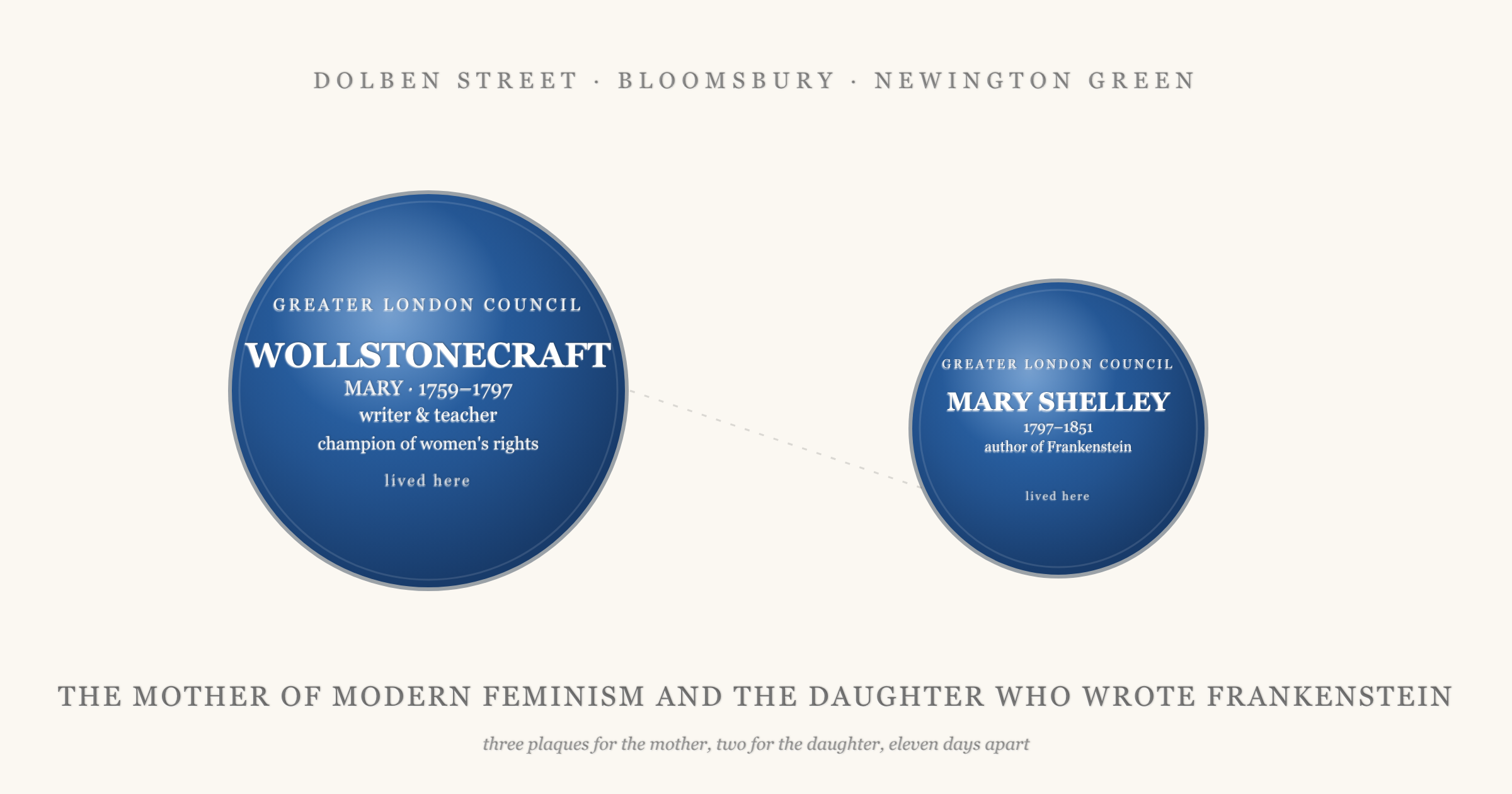
Why Wollstonecraft Has Three London Plaques
Most blue-plaque subjects get one. The English Heritage scheme limits a single official plaque per person, sited at the most significant address that still survives. Wollstonecraft has three, because none of her London buildings survive intact, and because the boroughs of Hackney, Camden, and Southwark have each chosen to mark a different chapter of her short life.
Hackney marks her childhood and her first period of independent residence at Hoxton, where she spent her teenage years and where her early intellectual formation took place. Camden marks her time near Somers Town, where she lived during her most productive writing years and where she first met William Godwin. Southwark marks the Dolben Street years, where she returned after her near-fatal first attempt at suicide, and where she began the relationship with Godwin that would produce her daughter and end her life.
Three plaques, three boroughs, three chapters. Together they map a London that no longer exists architecturally but that still produced one of the most consequential pieces of writing in English political philosophy. Walked in order, they sketch a life.
Plaque One: 373 to 375 Mare Street, Hackney
The earliest of the three London plaques. A brown plaque (Hackney's local scheme rather than English Heritage's blue) on the front of a row of shops in The Narroway, the southern stretch of Mare Street. The inscription reads:
Mary Wollstonecraft 1759 to 1797. Author of "A Vindication of the Rights of Woman". Pioneer of women's rights and mother of Mary Shelley. Stayed in a house on this site in 1784 and lived early years in Hoxton.
The plaque marks an absence. The house Wollstonecraft stayed in was demolished long ago, and the current row of shops occupies the site. What the plaque commemorates is the period of Wollstonecraft's life that historians often skip past: the Hoxton-Hackney years, when she was in her teens and early twenties, reading her way out of a difficult childhood and working out what she thought.
Hoxton in the 1770s was a literary corner of London. The Newington Green Unitarian Church, where Wollstonecraft would soon teach, sat a short walk to the north. Richard Price, the radical preacher whose sermons Edmund Burke would later attack and Wollstonecraft would defend, was the Newington Green minister. The cluster of dissenting intellectuals in this part of north and east London was the milieu that formed her, and the Mare Street plaque is the one that captures the formation.
If you start the walk here, you are starting where she started. Mare Street to Newington Green is a 25-minute walk through London Fields and across to Stoke Newington. The Newington Green Unitarian Church still stands, and the controversial 2020 Maggi Hambling silvered-bronze statue of Wollstonecraft (a small, naked, abstracted figure on a tall pedestal) sits on the green itself. Whether you find the statue brilliant or frustrating, it is a stop, and it sits exactly where Wollstonecraft would have walked between her teaching post and her Hoxton lodgings.
Plaque Two: Oakshott Court, Werrington Street, Camden
The Camden plaque, on a 1970s social-housing block in Somers Town, behind St Pancras station. The inscription reads:
In a house on this site lived Mary Wollstonecraft author of A Vindication of the Rights of Woman 1759-1797.
The plaque sits on the modern building that replaced the 18th-century terrace where Wollstonecraft lived during the period that produced her most consequential book. A Vindication of the Rights of Woman was published in 1792, written largely at the Camden address (then numbered as part of Store Street). The book was an immediate succès de scandale across Europe, attacked by Horace Walpole as the work of "a hyena in petticoats" and read in translation across Germany, France, and the United States within five years.
The Camden years are the writing years. Wollstonecraft was in her early thirties, financially independent for the first time, working as a translator for the publisher Joseph Johnson and writing political philosophy in the evenings. Johnson's circle (William Godwin, Joseph Priestley, Thomas Paine, William Blake) met regularly for dinner, and Wollstonecraft was the only woman in the room.
The Vindication is sometimes read in the 21st century as a clean feminist tract. It is not. It is a chaotic, urgent, sometimes contradictory book that argues women's apparent inferiority is the result of being denied education rather than a fact of nature, that argues marriage as currently practised is a form of legal prostitution, and that argues a republic without educated mothers cannot raise educated citizens. It is the founding document of modern feminism in the same way the Declaration of Independence is the founding document of modern democracy: imperfect, partial, but the thing everything afterwards has to argue against or with.
The Camden plaque is the one that marks the writing of it.
Plaque Three: 45 Dolben Street, Southwark
The third plaque, on a quiet residential street near the south end of Blackfriars Bridge. Southwark Council put it up. The inscription reads:
Mary Wollstonecraft 1759 to 1797. Writer, teacher and champion of women's rights.
Dolben Street marks the late period: the brief, intense, and ultimately fatal years of her relationship with William Godwin and the birth of their daughter. Wollstonecraft moved to Dolben Street after her near-fatal 1795 suicide attempt at Putney Bridge (she had thrown herself into the Thames after being abandoned by Gilbert Imlay, the American merchant who was the father of her first daughter, Fanny). Godwin found her in this period, courted her in his characteristically philosophical way (their correspondence reads like two political theorists trying to argue each other into being in love), and married her in March 1797.
Wollstonecraft was already pregnant. The daughter she carried, Mary, would be born in August 1797 at the Polygon, a now-demolished circular tenement in Somers Town a short walk from the Camden plaque. Wollstonecraft developed septicaemia from a retained placenta and died eleven days later, on 10 September 1797, aged 38.
The Dolben Street plaque is the one that marks the relationship that produced Mary Shelley. Standing in front of it, the next stop on the walk reveals itself.
Plaque Four: 87 Marchmont Street, Bloomsbury (Mary Shelley)
The first of the daughter's two London plaques, on a row of houses in Marchmont Street, the same street as the British Museum's southern edge. The inscription reads:
Percy Bysshe Shelley 1792-1822 poet and radical thinker and Mary Shelley 1797-1851 author of Frankenstein lived in a house on this site 1815-16.
The plaque marks the year Frankenstein was conceived. Mary Wollstonecraft Godwin (she was not yet Mary Shelley; the marriage came later) was 18, living with the still-married Percy Bysshe Shelley, scandalising literary London, and reading her dead mother's books. The 1815-16 winter was spent here in Bloomsbury, the summer of 1816 in Geneva at the Villa Diodati with Byron and Polidori (where the famous ghost-story competition produced Frankenstein and the Vampyre), and the autumn of 1816 back in Bath, where the novel was largely written.
The Marchmont Street plaque is the literary inheritance made architectural. Three plaques east and north for the mother's writing, one plaque on the same Bloomsbury terrace for the daughter's. The walk between Dolben Street and Marchmont Street is about 25 minutes, across Blackfriars Bridge and up through Holborn.
Plaque Five: 24 Chester Square, Belgravia (Mary Shelley)
The English Heritage plaque on Chester Square, the formal late-life address. The inscription reads:
Mary Shelley 1797-1851. Author of Frankenstein. Lived here 1846-1851.
This is the official English Heritage blue plaque, and it marks the last five years of Mary Shelley's life. By 1846 she was a widow (Percy had drowned in 1822), her son Percy Florence had inherited the Shelley baronetcy, and the family had settled into respectable Belgravia. The fierce, pursued, scandal-trailed young woman of Marchmont Street had become a careful editor of her dead husband's poetry and a quietly successful novelist on her own account.
Chester Square is the closing parenthesis. From the Hackney brown plaque marking Wollstonecraft's teenage Hoxton years to the Belgravia blue plaque marking Shelley's late-life Chester Square years is roughly 80 years and seven miles. Two generations, five plaques, one continuous argument about what a woman could do with a life and a London.
The Walking Route, in Order
The route works best done over two days, but it can be compressed into one long walk if the legs are willing.
Day one (or morning): Start at 373 to 375 Mare Street, Hackney. Walk west to Newington Green (25 minutes) for the Hambling statue and the Unitarian Church. Continue south through Islington to King's Cross (35 minutes). Stop for coffee.
Day two (or afternoon): Resume at Oakshott Court, Werrington Street, behind St Pancras (10 minutes from King's Cross). Walk south through Bloomsbury to Marchmont Street (15 minutes), pause at the Mary Shelley and Percy Shelley plaque. Continue south to Holborn and across Blackfriars Bridge to 45 Dolben Street (25 minutes). The Tate Modern is a short walk east if you want to extend.
The Belgravia coda: Chester Square is a separate trip on the other side of central London. Pair it with a Pimlico or Belgravia walk on a different day. The 24 Chester Square plaque is on a quiet, expensive square; the Shelley flat is now a private residence.
What the Five Plaques Together Tell You
Five plaques, two women, one inheritance. The story that emerges from walking them in order is not the story you get from the textbook biography. The textbook gives you A Vindication and Frankenstein and the dates and the lineage. The plaques give you the addresses, and the addresses tell a different story: the geographical compression of a literary revolution.
Wollstonecraft's three London chapters happen within a five-mile triangle. She is not a touring intellectual, criss-crossing Europe (although she did, briefly, in the 1790s). She is a London writer, working in walking-distance neighbourhoods, embedded in dissenting communities that themselves were a walking-distance affair. The Newington Green dissenters, the Joseph Johnson circle in St Paul's Churchyard, the Bloomsbury and Camden literary set: all of them were the same circle of people, meeting in the same houses, walking the same routes.
Mary Shelley extended the geography slightly (Marlow, Geneva, Pisa, Bath) but came back to it. Bloomsbury and Belgravia are her London chapters, and they sit just south and west of her mother's. The same five-mile triangle.
The walk is, in effect, a guided tour of the geography of one of the most consequential literary inheritances in English history. You can do it in a day. The plaques have been quietly waiting for you to notice the route.
Visit, Walk, Mark
The five plaques are mapped in the Legacy blue plaques app, which gives you the full inscription text, the precise location, and the photographic record for each one. If you are putting together a walking day, the alternative walking tour of London routes work well as supporting material, and the Keats House Hampstead guide covers the literary cluster a few miles north for a Romantic-poetry follow-up day. For a sense of what other female-author plaques London holds (and the surprising scarcity of them), the complete blue plaques guide has the full picture.
Mary Wollstonecraft died eleven days after her daughter was born. The daughter wrote the novel that defined modern science fiction. Five plaques mark the geography of an inheritance that has shaped two centuries of literature, philosophy, and the language we use to talk about women. The plaques are quiet. The walk between them is anything but.