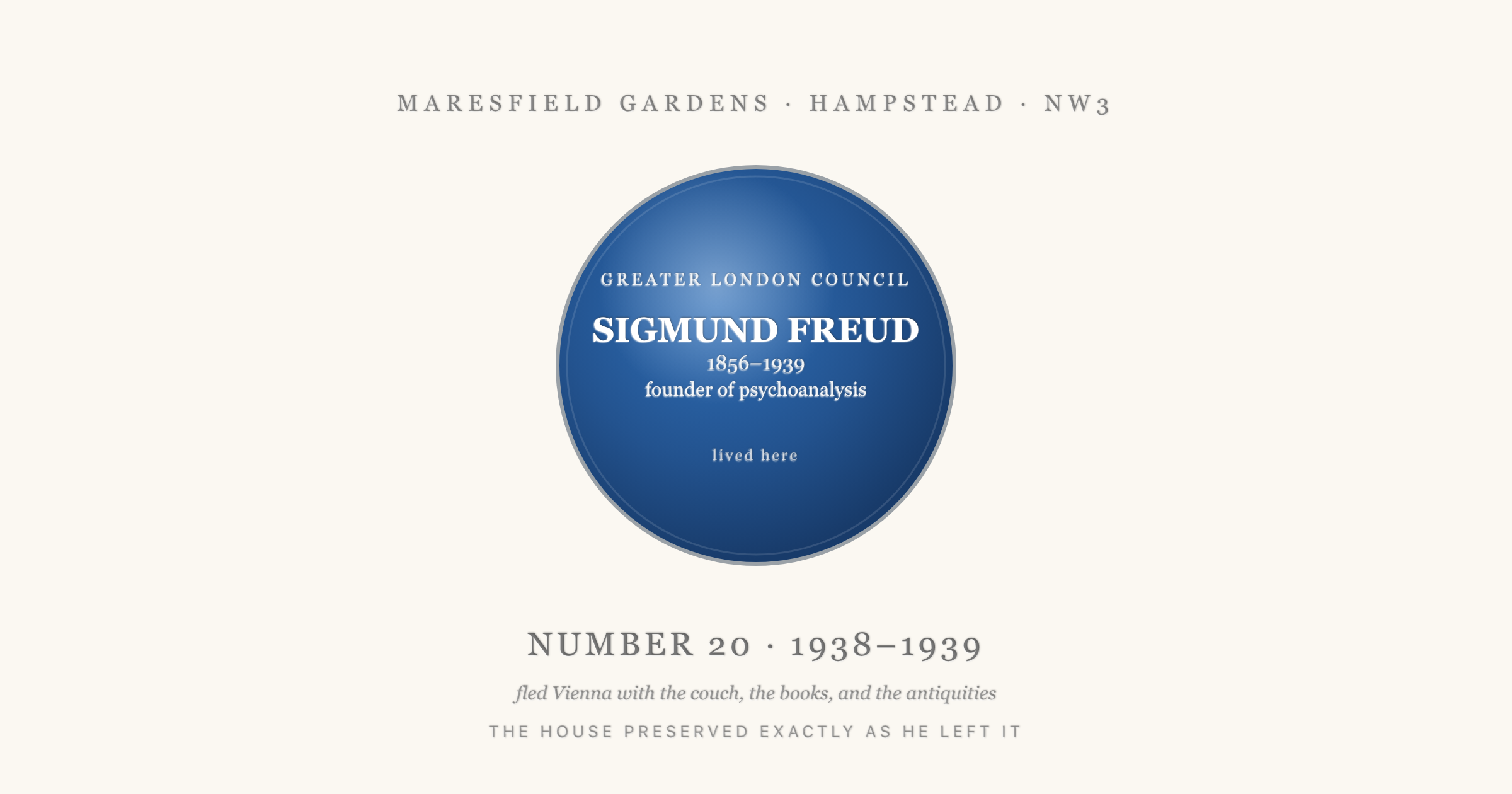
The Freud Museum London is at 20 Maresfield Gardens, in Hampstead, ten minutes' walk from Finchley Road tube. It is a slightly austere, slightly ordinary red-brick suburban house that you could walk past on a quiet Tuesday morning without noticing, and on the wall outside it there is a blue plaque that says SIGMUND FREUD LIVED HERE. The detail the plaque does not have room for is that he lived there for almost exactly one year, from late September 1938 to 23 September 1939, having arrived in Britain at the age of 82 with cancer of the jaw and the entire contents of his Vienna consulting room in crates. The other detail the plaque does not have room for is that Anna Freud, his youngest daughter, lived there for forty-four years after his death and is the reason the house is now a museum. Most of what we now associate with "Freud's house" is hers. She kept it.
The Freud Museum London is the only address Freud lived at in this country. Everything else (the lectures, the schools of thought, the volumes of correspondence translated into English) happened somewhere else, mostly Vienna. The house is the single physical anchor for an extraordinary year that closed Freud's life and opened psychoanalysis's English-speaking century. This is the story of the address, the plaque, and what is preserved inside.
How Freud Got to Hampstead
The road to 20 Maresfield Gardens runs through the Anschluss. On 12 March 1938, German troops crossed into Austria. Within days the Nazi regime had absorbed the country. Vienna's Jewish population (almost 200,000 people, of whom Freud was the most internationally celebrated) faced systematic persecution, expropriation, and increasingly the threat of deportation. Freud, then 81, had lived at Berggasse 19 in Vienna for forty-seven years. He had built psychoanalysis in that apartment. He did not want to leave.
His daughter Anna was arrested by the Gestapo on 22 March 1938 and held for a day. The arrest persuaded him. The Berggasse apartment was searched; the family's bank accounts were frozen; the publishing house that produced his books was seized. Even then, leaving Austria as a Jew in 1938 required Nazi permission, exorbitant exit taxes (a so-called Reichsfluchtsteuer), and a sponsoring country willing to take him.
Three networks made the escape possible. Ernest Jones, the British psychoanalyst and Freud's biographer-in-waiting, lobbied the British government. Marie Bonaparte, the French Princess, psychoanalyst, and former patient, paid the exit taxes the Freuds could not. William Bullitt, the American ambassador in Paris, applied diplomatic pressure on Vienna. The American consul in Vienna, John Cooper Wiley, signed exit papers. The Freuds, with the family doctor Max Schur, his wife Martha, his sister-in-law Minna Bernays, and Anna, were finally permitted to leave on 4 June 1938, after Freud was forced to sign a declaration that he had been treated correctly by the Nazi authorities. The story goes that he added in his own hand a sentence saying he could heartily recommend the Gestapo to anyone, a sentence so dryly subversive that historians have argued for decades over whether it was real (most recent scholarship says yes, with caveats).
He arrived at Victoria Station on 6 June 1938. The first London address was 39 Elsworthy Road in Primrose Hill, on a short lease, while the family searched for somewhere permanent. Anna found 20 Maresfield Gardens, a 1920s detached house with a south-facing garden, and the family moved in on 27 September 1938. They had been refugees for less than four months.
The Plaque, the Inscription, and the Hampstead Cluster
The English Heritage blue plaque on the front of 20 Maresfield Gardens marks Sigmund Freud as "founder of psychoanalysis" and notes the address as the place he lived. It is a single-line summary of a life that contained three or four other plausible single-line summaries, but English Heritage plaques are a constrained format and the founder-of-psychoanalysis line is the one that holds. Anna Freud, who lived in the house considerably longer than her father, has her own commemoration inside the museum and on the building.
What the plaque does very well is anchor the address. Hampstead in the late 1930s and early 1940s became one of the most extraordinary intellectual neighbourhoods in modern European history precisely because of refugee arrivals, and Freud was the most famous arrival but not the only one. The neighbourhood absorbed Ernst Gombrich, Stephen Spender, the painters Oskar Kokoschka and Lucian Freud (Sigmund's grandson), the architect Erno Goldfinger, and a dozen psychoanalysts who had trained in Vienna and Berlin and now had to reconstitute the field in English. The cluster is one of the densest concentrations of émigré thought in any London postcode, and walking the streets around Maresfield Gardens with the Legacy app open turns it from a quiet residential area into a kind of open-air biography of the 1930s diaspora.
A practical walking note: 20 Maresfield Gardens is fifteen minutes from Keats House Hampstead, and the two together make an easy half-day. Hampstead Heath sits between them. The contrast is sharper than it looks: Keats writing under the plum tree in 1819, Freud watching the chestnut tree in 1939. The same suburb, the same kind of preserved house, two completely different relationships to it.
Inside the House: What Was Saved
The most remarkable single fact about the Freud Museum London is that the consultation room at 20 Maresfield Gardens contains, almost intact, the furniture and objects from Berggasse 19 in Vienna. The couch is the couch. Marie Bonaparte arranged for the contents of the Vienna apartment to be packed and shipped to London ahead of the family's arrival, and Paula Fichtl, the family's housekeeper, who had come with them from Vienna, unpacked it all in roughly the configuration it had occupied in Austria. When the consulting room was finally arranged, in the autumn of 1938, it looked, by all accounts, eerily like the room patients had walked into in Vienna, except now it was in Hampstead.
What the museum preserves, in concrete terms:
The couch. Covered in a Persian rug that has been on it since the 1890s. The couch is the couch on which the foundational case studies of psychoanalysis were conducted, and on which Freud continued to see a small number of patients in London until weeks before his death. It is at the centre of the consultation room exactly as it was in Vienna.
The desk and the antiquities. Freud collected antiquities (Egyptian, Greek, Roman, Chinese, Etruscan) for forty years. When he had to leave Vienna, the question of whether the collection would be allowed out hung in the balance for weeks. Marie Bonaparte and Anna catalogued every piece. The Nazis demanded duties; the duties were paid. Most of the collection arrived in London. Today it sits on Freud's London desk and on shelves around the consultation room, in the same arrangements he used in Vienna. Two thousand-plus objects, in a small room, looking like the working library of someone who had clearly not finished thinking.
The library. Roughly 1,600 of Freud's books survived the journey. The translations he marked up, the German originals of Goethe and Schiller, the case-study volumes, the early correspondence with Fliess and Jung. What did not survive was the rest: a much larger library that had been seized and dispersed in Vienna in 1938 and was never reassembled. The library at the museum is what remained, not the whole.
Anna Freud's office on the upper floor. Anna ran her child psychoanalysis practice from a separate room upstairs, and after her father's death she continued to live and work in the house for another forty-four years. Her office is preserved as well, with the loom on which she wove (psychoanalytic colleagues in the post-war period describe her weaving while listening to case discussions), her desk, and the handwritten notes from the Hampstead Clinic she founded.
The visit, if you take it slowly, is roughly two hours. It is small for a museum, large for a single house. The audio tour is the underused asset; many visitors skip it and miss roughly half the context.
The Last Year: What Happened in This House
Freud lived at 20 Maresfield Gardens for nearly twelve months. The cancer of the jaw he had been diagnosed with in 1923 had progressed, and during the London year he underwent a final round of surgery that left him in serious pain. The diary entries from this period (Anna kept them) are short, factual, sometimes one-line.
What he did do, between May and August 1939:
- Saw a small number of patients (six or eight, by various accounts), mostly in the mornings.
- Finished the manuscript of Moses and Monotheism, the book on Jewish identity and religion he had been writing in Vienna and which he completed in London. It was published in 1939 in German and English.
- Wrote An Outline of Psychoanalysis, an unfinished primer, intended as a summation, that he was working on when he died. It was published posthumously and is essentially a 90-page sketch of the entire field as Freud wanted to leave it.
- Received visitors. H.G. Wells, Salvador Dali, Stefan Zweig, Virginia Woolf and Leonard Woolf, the Princess of Greece. The Woolfs visited on 28 January 1939, and Virginia recorded the visit in her diary: an aged man, very alert, who handed her a narcissus.
- Walked in the garden. The chestnut tree he wrote about in his last surviving letters is still there.
He died on 23 September 1939 at 20 Maresfield Gardens. Three weeks earlier, Britain had declared war on Germany. The cancer had become unbearable; with his consent, Max Schur administered a fatal dose of morphine. He was 83. His ashes are at Golders Green Crematorium, three miles north, in a Greek vase that Marie Bonaparte had given him in 1931.
Anna Freud, Forty-Four Years Later
The reason the house is a museum is Anna. She was 43 when her father died and she lived in the house, mostly continuously, until her own death on 9 October 1982 at the age of 86. Two ways of looking at the house overlap in those forty-four years.
The first is the ongoing work of psychoanalysis. Anna was the most influential figure in twentieth-century child psychoanalysis. From the upper rooms at 20 Maresfield Gardens she founded and ran the Hampstead War Nurseries (1940-45, caring for children whose parents were killed or absent in the Blitz), the Hampstead Child Therapy Clinic (1952), and a global training programme that shaped how children's mental health was understood from the 1950s onwards. The house worked as a clinical and intellectual base for almost half a century.
The second is the preservation. Anna did not modernise. She did not redecorate. She kept her father's consulting room exactly as it had been on the day he died. She kept his desk, his books, his rugs, his antiquities. She kept the small objects (the cigar holder, the magnifying glass, the reading lamp) in the same positions. By the late 1970s the house had become a kind of working time capsule: a daughter's home that was also a precise restoration of her father's last working environment, maintained for decades by the daughter herself.
When Anna died in 1982, the will turned the house over to a trust to be operated as a museum. The Freud Museum London opened to the public in July 1986. Almost everything you see when you visit was placed by Anna; the curatorial decision was largely to keep what she had kept.
Visiting: A Small Practical Guide
The museum is open Wednesday to Sunday, with current hours and ticket pricing on the Freud Museum London's official site. Tickets are typically around £14 for an adult; concessions for students and seniors. Plan ninety minutes inside; longer if you take the audio tour.
Three suggestions if you go.
Start in the consultation room. Most visitors do, but the room rewards a longer pause than it usually gets. The configuration of objects on the desk is not random; it is the configuration Freud worked in, and the longer you sit in front of the couch, the more the room behaves like a piece of evidence rather than a museum exhibit. Spend ten minutes there before the rest of the house.
Take the audio tour. It is included in the ticket and most visitors skip it. The audio includes excerpts of Anna's voice, recordings of Freud's grandchildren describing the house, and detail on individual antiquities that the wall labels cannot fit.
Walk to Keats House afterwards. If the day is good, take the route across Hampstead Heath. The two houses (one cottage, one suburban semi-detached, both preserved) are the closest thing London has to a paired biography of literary and psychological imagination, separated by 120 years and a mile of grass. We covered the Keats House Hampstead route in detail; pair it with the Freud Museum and you have a complete Hampstead literary day.
If you are working through London's blue-plaque map more systematically, the area around Maresfield Gardens has half a dozen others within ten minutes' walk: refugee arrivals from the same period, painters, writers, conductors. The Legacy app shows them all on a single map; the cluster is one of the strongest in north-west London, and visiting Freud's house in isolation misses the wider story of what happened in this neighbourhood between 1938 and 1945.
The Plaque Survives What Vienna Did Not
The Berggasse 19 apartment in Vienna is also a museum today. Sigmund Freud Privatstiftung restored it in the 1970s and reopened it after a major refurbishment in 2020. But Berggasse 19 is, in the precise sense, a reconstruction. The contents went to London. The Vienna museum holds the rooms; the London museum holds the things.
This is what makes the Freud Museum London quietly extraordinary, and what the blue plaque outside is gesturing at. The address marks the year and the founder, in a Greater London Council format that has marked thousands of London buildings. What the plaque does not say is that 20 Maresfield Gardens is also the place where the contents of psychoanalysis's birthplace were physically rehoused after the discipline's Vienna birthplace was taken from it. The address is, in a fairly literal sense, the only continuous physical link between Freud's working life in Vienna and the post-war development of psychoanalysis in English. That continuity sits in one Hampstead suburban house, behind one round blue ceramic disc, on a street most tourists have never heard of.
Worth the half-day. Worth it again on the second visit, when you spend the time you missed in the consulting room. If you want to find every other plaque in walking distance, open the Legacy app and start from Maresfield Gardens; the Hampstead density rewards the wander.