The Bloomsbury Group lived, slept, painted, wrote, argued, and quite often slept with each other inside one square mile of London bordered, roughly, by Gower Street to the west, Russell Square to the south, Tavistock Square to the north, and the British Museum reading room to the east. They were never a movement, never a manifesto, never a school. They were a friendship group that took itself seriously enough that two generations of literary historians could not stop writing about it. The blue plaques scattered across three Bloomsbury garden squares mark the addresses where most of that work happened. This is the walking guide that links them, the order to do them in, and the story that ties seven plaques together in a couple of afternoons of comfortable strolling.
The Bloomsbury Group is a tour you can do on foot in three hours, with stops for coffee, the Cartoon Museum, and the British Museum if you want them. It crosses three garden squares (Gordon, Fitzroy, Tavistock) and ends at a small bronze bust under a plane tree. If you want the full plaque text and the precise location for every stop, the Legacy app maps every London plaque on this route. The article below gives you the chronology, the addresses, and the connective tissue.
Who the Bloomsbury Group Were
The group's nucleus formed in 1905. Thoby Stephen, a young man from a literary family (son of Leslie Stephen, the founding editor of the Dictionary of National Biography, brother of Vanessa and Virginia), began hosting Thursday evening conversations at 46 Gordon Square. He invited his Cambridge friends. They sat up late. The conversations were unusually free for the period: about painting, sex, religion, philosophy, money, the Empire, and what people ought to do with their lives.
When Thoby died of typhoid in 1906, the conversations did not stop. They moved with the group as members married, broke up, set up new households, and rearranged themselves across the Bloomsbury squares. By the end of the First World War the group had a name, a public profile, and an entirely undeserved reputation for being either bohemian dilettantes or world-shaking aesthetes, depending on whose memoir you were reading.
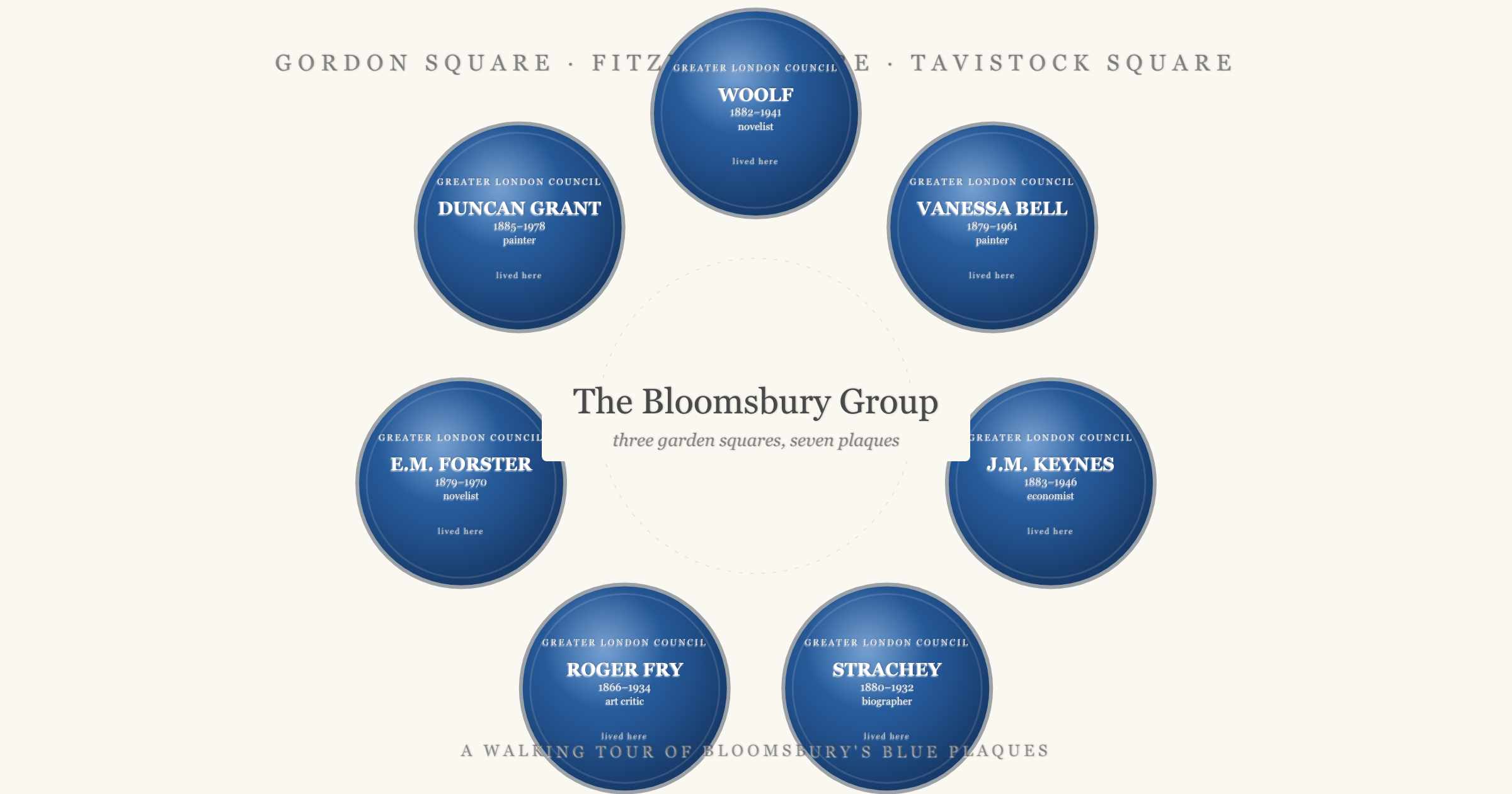
The seven core members, the ones with surviving London plaques and the ones who define the group in standard accounts:
- Virginia Woolf (1882 to 1941). Novelist. To the Lighthouse, Mrs Dalloway, Orlando, A Room of One's Own. Three London addresses across Bloomsbury, two of them with English Heritage blue plaques.
- Vanessa Bell (1879 to 1961). Painter. Virginia's older sister, the visual artist of the family, the steady one who held the household together at 46 Gordon Square and later at Charleston in Sussex.
- John Maynard Keynes (1883 to 1946). Economist. The Economic Consequences of the Peace, The General Theory. Lived at 46 Gordon Square from 1916 onward, marking the second great phase of the house.
- Lytton Strachey (1880 to 1932). Biographer. Eminent Victorians (1918), the book that made debunking the Victorians a genre.
- Roger Fry (1866 to 1934). Art critic. The man who introduced Cezanne, Matisse, and the post-Impressionists to a London public that was not asking for them. Founder of the Omega Workshops at 33 Fitzroy Square.
- E.M. Forster (1879 to 1970). Novelist. Howards End, A Passage to India. Bloomsbury-adjacent more than Bloomsbury-central, but indispensable to the surviving correspondence.
- Duncan Grant (1885 to 1978). Painter. Vanessa Bell's lifelong partner from around 1914 onward.
Around them: Leonard Woolf (Virginia's husband, publisher, political theorist), Clive Bell (Vanessa's husband, art critic), Adrian Stephen (the third Stephen sibling, psychoanalyst), David Garnett, Saxon Sydney-Turner, the philosopher G.E. Moore (intellectual godfather), the painter Dora Carrington (who lived with Strachey for years), and a wider penumbra of friends.
That is the cast. The plaques are the geography.
Stop One: 46 Gordon Square (Multiple Lives of One House)
Begin at the south side of Gordon Square, where the eastern end of the terrace turns the corner. Number 46 carries an English Heritage blue plaque to John Maynard Keynes. It is not the only plaque the house deserves.
In 1904, after Leslie Stephen died, his four children (Vanessa, Virginia, Thoby, Adrian) sold the family home in Hyde Park Gate and moved to 46 Gordon Square. This was already an unconventional decision. Bloomsbury at the time was a respectable but not fashionable district, full of doctors and barristers, on the wrong side of Tottenham Court Road for the addresses a young woman of Virginia's class was supposed to want. The Stephens chose it precisely because it was outside the social circuit of their dead father's circle.
The Thursday evenings that became the Bloomsbury Group started in the first-floor drawing room here. Thoby brought his Cambridge Apostles friends (Strachey, Keynes, Sydney-Turner, Leonard Woolf). Vanessa and Virginia, against the conventions of the time, sat in on the discussions and led them.
In 1907, Vanessa married Clive Bell. Virginia and Adrian moved out. Vanessa and Clive stayed at 46. The house's second phase, as the Bell household, ran until around 1916.
In 1916, John Maynard Keynes took over the lease. He lived at 46 Gordon Square as his London base for the next thirty years, while doing the Treasury work that produced The Economic Consequences of the Peace, the King's College Cambridge work that produced The General Theory, and the wartime work that produced the Bretton Woods system. The English Heritage plaque marks this period.
The house, in other words, is three lives stacked on the same plaque. Read the inscription, which mentions Keynes only, and then look at the doorway and remember that Virginia Woolf wrote her first novel up those stairs.
Stop Two: 51 Gordon Square (Lytton Strachey)
Walk along the eastern side of Gordon Square. Number 51 carries the English Heritage blue plaque for Lytton Strachey, who lived here from 1909 to 1924. Eminent Victorians, published in 1918, was written largely in this house.
Strachey is the Bloomsbury figure most likely to surprise a modern reader. Tall, weak-voiced, eccentric, openly gay in a period when the Labouchere Amendment was still in force, he wrote the book that taught a generation of British readers it was permissible to laugh at General Gordon, Cardinal Manning, Florence Nightingale, and Thomas Arnold. The cumulative effect of Eminent Victorians on English biography is hard to overstate. Almost every modern biographer who lets character flaws into a portrait owes Strachey a debt.
The house at 51 sits across Gordon Square from 46. The two plaques are visible from each other if you stand in the gardens between them. That visual line between the buildings, in the autumn when the plane trees are bare, gives you the geographic compactness of the group at a glance. They lived across a garden from each other. The conversations did not require travel.
Stop Three: 50 Gordon Square (The Bell Household, Later)
Number 50 carries plaques to Vanessa Bell and Clive Bell, marking the Bell household after the move from 46. The walls are quieter here, but the household behind them ran one of the more durably bohemian arrangements of early-twentieth-century London. Clive and Vanessa stayed legally married while Vanessa lived openly with Duncan Grant, Clive moved between London and the country, and Roger Fry passed through the household for years as Vanessa's earlier lover and lifelong friend.
The point is not the gossip. The point is that the practical experiment of the Bloomsbury Group, the thing they did rather than wrote about, was inventing a domestic life that the Edwardian world did not have categories for. The triangulated households of Gordon Square were the laboratory.
Stop Four: 29 Fitzroy Square (Virginia Woolf, the Younger Years)
Walk west out of Gordon Square, across Tottenham Court Road, into Fitzroy Square. Number 29 carries an English Heritage blue plaque for Virginia Woolf, who lived here from 1907 to 1911 with her brother Adrian after Vanessa's marriage forced the move out of Gordon Square.
The Fitzroy years are the period before Virginia married Leonard Woolf, before her first novel, before the Hogarth Press. They are the years when she was writing reviews for the Times Literary Supplement, learning her trade, and recovering between bouts of mental illness. The Thursday evenings continued here, transplanted from Gordon Square. Henry James called on her once, found her too modern, and went away.
The same house carries an earlier blue plaque for George Bernard Shaw, who lived at 29 Fitzroy Square from 1887 to 1898, two decades before Virginia. Two plaques, one building, two writers separated by a generation. It is one of the densest single doorways in London for literary blue plaques.
Stop Five: 33 Fitzroy Square (The Omega Workshops)
A short walk around the corner of the square. Number 33 carries a plaque to the Omega Workshops, founded by Roger Fry in 1913 and run until 1919, in collaboration with Vanessa Bell, Duncan Grant, and a rotating cast of artists.
The Omega's project was domestic. Fry believed that the post-Impressionist aesthetic he had spent the previous five years championing in his Grafton Galleries exhibitions belonged on furniture, fabric, ceramics, and rugs as much as on canvas. The Omega designed and produced household objects in deliberately bright, planar, formally daring patterns. Many of the surviving pieces are now in the Courtauld Gallery and the V&A. The workshops failed commercially after the First World War, but their visual language ran straight into the post-war modernism of the 1920s.
Stand outside 33 and you are looking at the Bloomsbury Group's only attempt at a public-facing institution. Most of what they made was private (a novel, an essay, a painting hung on a friend's wall). The Omega was their bid at design, at industry, at putting the look of post-Impressionism into the houses of the London middle class.
Stop Six: Tavistock Square Garden (Virginia Woolf's Bust)
Walk back east, across Tottenham Court Road, into Tavistock Square. The square is dominated, at its centre, by a statue of Mahatma Gandhi (who passed through Bloomsbury in his student years), but tucked away on the northern side under a plane tree is a bronze bust of Virginia Woolf, sculpted by Stephen Tomlin in 1931 and installed in the gardens in 2004.
The bust marks the address that no longer exists. Virginia and Leonard Woolf lived at 52 Tavistock Square from 1924 to 1939, ran the Hogarth Press from the basement, and published the first English editions of T.S. Eliot's The Waste Land, Sigmund Freud's collected works (Leonard was Freud's English publisher), and Virginia's own novels from Mrs Dalloway onward. The house was destroyed by German bombs in 1940. There is no plaque for the building because there is no building. The bust stands in for the missing inscription.
This is the longest of the three squares for Virginia Woolf. The Fitzroy Square plaque marks the apprenticeship years. The Tavistock Square address (now lost) is where she wrote Mrs Dalloway, To the Lighthouse, Orlando, The Waves, and A Room of One's Own. If there is one stop on this tour to sit at, it is here.
Stop Seven: 25 Brunswick Square (The Earlier Shared House)
If you have time, finish at 25 Brunswick Square, a short walk southeast of Tavistock Square. The house carries a plaque to John Maynard Keynes for his time at the address from 1909 to 1916, before he moved to 46 Gordon Square. It is a footnote in the geography, but a useful one: from 1911 to 1912 the house was a shared household, with Keynes, Adrian Stephen, Virginia Stephen (not yet Woolf), and Leonard Woolf all in residence. It is the address where Leonard, recently returned from seven years in the Ceylon civil service, courted Virginia. They married in 1912.
Brunswick Square closes the route at the moment the next phase of the group's history begins. From 1912 onward Bloomsbury would expand outward, into Sussex (Charleston, Monk's House, the country wing of the group), and the London squares would settle into the addresses described above.
How the Three Squares Connect
The geography of the Bloomsbury Group is small. Gordon Square, Fitzroy Square, and Tavistock Square sit within ten minutes' walk of each other. Brunswick Square is another five minutes south. The whole tour, with stops, takes a comfortable afternoon.
What the geography teaches you is that the group was a face-to-face society in a way that requires more effort to recreate today. Strachey could walk to Vanessa's house in five minutes. Keynes could be at 29 Fitzroy Square fifteen minutes after dinner. The Thursday evenings were not a calendar item; they were a five-minute walk.
Read the plaques in this order and the chronology lines up: 46 Gordon Square (1904 to 1916, the founding house) → 51 Gordon Square (Strachey, 1909 to 1924) → 29 Fitzroy Square (Virginia Stephen, 1907 to 1911) → 33 Fitzroy Square (the Omega, 1913 to 1919) → Tavistock Square bust (Virginia Woolf, 1924 to 1939, the lost house) → 25 Brunswick Square (1911 to 1916, the bridge house). The seven plaques map the whole arc, from the Thursday evenings of 1905 to the bombed-out address of 1940.
Where to Go After the Bloomsbury Group
Two literary walks pair naturally with this one. The Mary Wollstonecraft London plaques cover the proto-feminist tradition that Virginia Woolf inherited and reframed, with three plaques across Hackney, Camden, and Southwark and the secondary Mary Shelley plaques in Bloomsbury and Belgravia. The Keats House Hampstead guide covers the earlier London-Romantic literary cluster (Keats, Constable, the Heath circle) that the Bloomsbury Group was rebelling against and quietly admiring.
Together, these three walks cover most of literary London above ground: the proto-feminist tradition, the Romantic cottage and Heath, and the Bloomsbury Group's three garden squares. The Legacy app maps every plaque on every walk and gives you the inscription text, the year, and the surrounding cluster of less-famous plaques you would otherwise walk past.
The Bloomsbury Group did not invent modernism. They did invent a particular London neighbourhood as a place where serious thinking and serious living could happen at the same time. Seven plaques. Three garden squares. One afternoon, if you walk steadily, or two if you stop for tea.