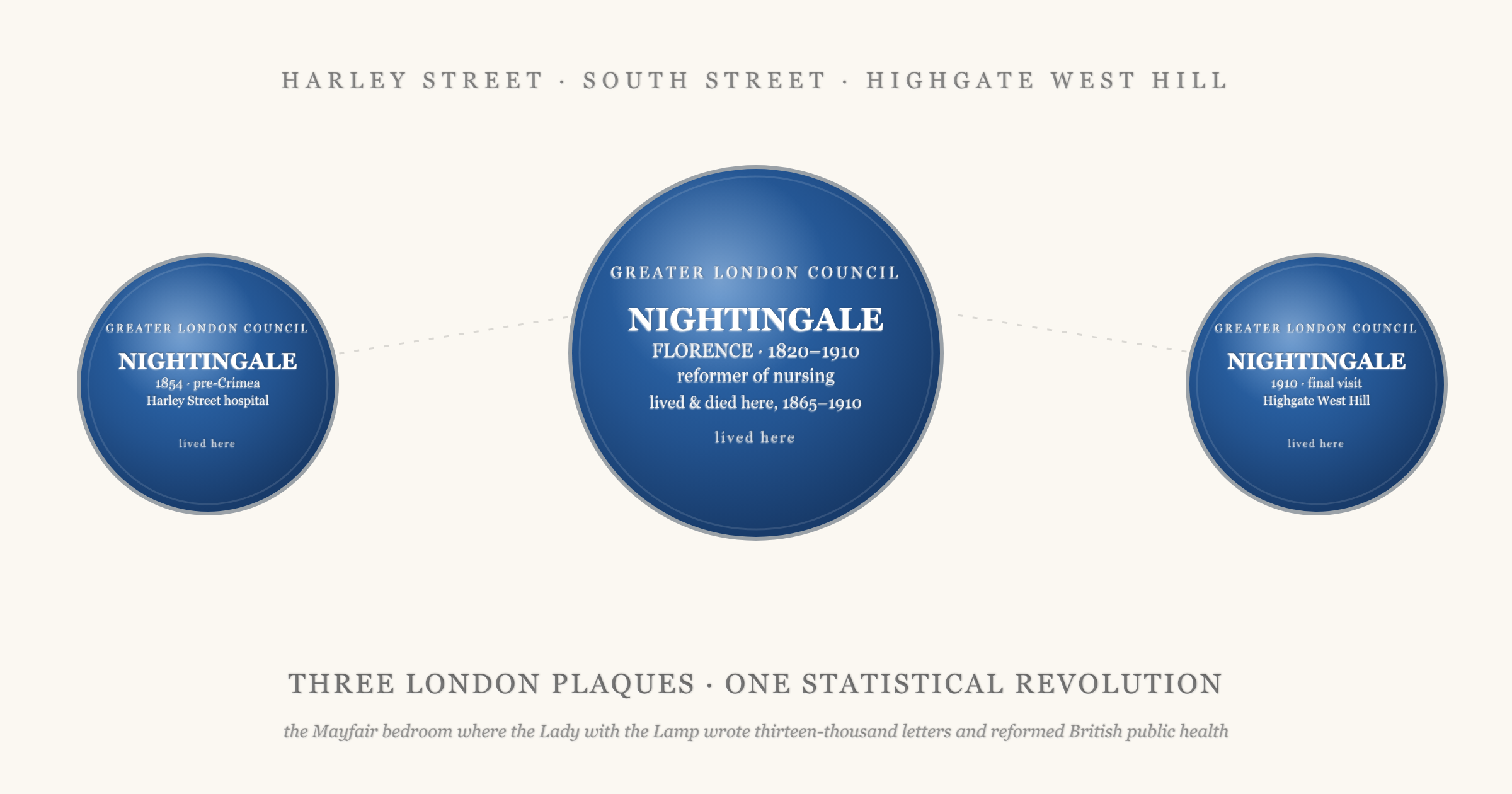
Florence Nightingale's London is a triangle. Three blue plaques, three addresses, three chapters of a single career that turned a Victorian gentlewoman into the most influential public-health reformer of the nineteenth century. The first plaque is at 90 Harley Street, the small private hospital she ran for one year before sailing to the Crimea in October 1854. The second, and the most consequential, is at 10 South Street, Mayfair, the house where she lived for forty-five years after her return and where she did almost all of the statistical, administrative, and political work that actually reformed British nursing. The third is on the wall of 37 Highgate West Hill, marking where she stayed during her final years of London life. The Lady with the Lamp is a useful image for the year she spent in Scutari. Almost everything else she did, she did from a Mayfair bedroom.
This guide walks through all three plaques in chronological order, what happened at each address, why the South Street years matter more than the Crimean ones for the actual reforms, the Florence Nightingale Museum at St Thomas' that completes the set, and a Mayfair walking route that links the South Street plaque with Handel and Hendrix, J. Arthur Rank, and Catherine Walters within fifteen minutes on foot.
The Three London Plaques: A Chronological Map
Florence Nightingale arrived in London at the age of thirty-three. She left England for Scutari at thirty-four. She returned at thirty-six and then lived in London, almost continuously, until her death at ninety. The three plaques mark the bookends of that span.
90 Harley Street, Marylebone, W1G carries the inscription:
Florence Nightingale left her hospital on this site for the Crimea October 21st 1854
It is a small plaque, easy to miss in a row of medical consulting rooms. The hospital it refers to was The Establishment for Gentlewomen during Illness, a charity hospital for governesses and teachers, where Nightingale served as Superintendent from 1853. The original building was demolished long ago; the plaque marks the site, not the surviving address.
10 South Street, Mayfair, W1K carries the older Greater London Council plaque:
In a house on this site Florence Nightingale 1820-1910 lived and died
This is the address that matters most. South Street runs east from Park Lane along the southern edge of Mayfair, two minutes from Hyde Park Corner. Number 10 was her London home from 1865 until her death in 1910. The original house was demolished in the 1930s and replaced; the plaque now sits on the modern building on the same site, a few doors from 38 South Street (J. Arthur Rank, the film producer) and 15 South Street (Catherine Walters, the last Victorian courtesan, who lived on the street at the same time as Nightingale).
37 Highgate West Hill, N6 carries a third plaque, marking the Highgate connection during her final years. The Highgate plaque is the least visited of the three, but it is the only one that sits on a building closely resembling what Nightingale would have known.
If you visit only one, make it South Street.
1854: The Year on Harley Street
Nightingale's tenure at the Establishment for Gentlewomen on Harley Street lasted barely twelve months. She had taken on the role unpaid, in the face of considerable family opposition. Her parents had assumed nursing was beneath the daughter of a Derbyshire landowner, and Florence had refused three marriage proposals while quietly training in Kaiserswerth, Germany, and Paris. Harley Street was her first paid administrative position in any sense, although she still drew no salary; the work was the credential.
The hospital occupied a single Georgian house with thirty beds. Nightingale's contributions in that year were modest but characteristic. She introduced systematic record-keeping for patient admissions and discharges. She rewrote the institution's regulations. She negotiated improved supplies. She fired and replaced staff who would not work under the new system. The committee minutes from 1853 to 1854 record a pattern that would repeat across the next fifty-five years: arrive, audit, restructure, document, leave the place better organised than it was found.
Then in October 1854 the Times dispatches from the Crimea began arriving, describing the catastrophic medical conditions in the British army's military hospitals at Scutari. Nightingale was offered the role of Superintendent of the Female Nursing Establishment of the English General Hospitals in Turkey by Sidney Herbert, the Secretary at War. She accepted within forty-eight hours. The Harley Street plaque marks the day she left.
She was at Scutari for twenty-one months. The famous Lady with the Lamp image, the night-rounds with the oil lamp through wards of wounded soldiers, comes from that year. So does the now-disputed claim that she single-handedly reduced the mortality rate at Scutari; later analysis showed the mortality fell only after the Sanitary Commission arrived in March 1855 and rebuilt the drainage. What the Crimea did do, decisively, was give Nightingale national fame and the political leverage she would spend on the reforms that mattered.
1865 to 1910: The Mayfair Bedroom Where the Reforms Actually Happened
Florence Nightingale moved to 10 South Street in 1865. She was forty-five and had been bedridden, intermittently, for nearly a decade. She had returned from the Crimea in 1856 with a chronic illness, almost certainly brucellosis contracted from contaminated milk in the Crimea, that produced fever, joint pain, and bouts of debilitating exhaustion for the rest of her life. She kept the South Street house for forty-five years and rarely left it.
What she did from 10 South Street is the part of her career most people do not know. The popular image is the lamp-lit ward; the real legacy is the desk in the Mayfair bedroom.
The Royal Commission on the Health of the Army (1857-1858). Nightingale wrote almost the entire 850-page report from her bed. She had been working with the statistician William Farr, the polymath William Sutherland, and Sidney Herbert; Herbert chaired the commission and sent draft chapters to South Street, where Nightingale rewrote them and sent them back. The report's recommendations on barrack sanitation, hospital design, and military medical statistics restructured the army medical service.
The polar-area diagram. In 1858, working with Farr, Nightingale produced the now-iconic "rose diagram" or "coxcomb chart" showing month-by-month mortality at Scutari from preventable causes (in blue), wounds (in red), and other causes (in black). The diagram was designed to be seen and understood by Members of Parliament who would not read tables of numbers. It is one of the earliest examples of data visualisation in the modern sense, and it became the model for the political use of statistical graphics for the rest of the century.
The Nightingale Training School at St Thomas' Hospital. Founded in 1860 with the £45,000 raised by public subscription as the Nightingale Fund. The school was the first secular professional nursing-training institution in the world, and the model from which most modern nursing-education systems descend. Nightingale never visited the school in person after the early years; she ran it through correspondence with the Matron, Mrs Wardroper, from South Street. We have a longer note on the broader London medical history in the Charles Dickens Museum and Keats House pieces, where the Victorian medical and literary networks intersect.
Notes on Nursing (1859). The first edition was written at South Street. Within two years it had been translated into seven languages and sold over 75,000 copies in Britain alone. It was the first nursing textbook intended for both professional nurses and ordinary women caring for sick relatives at home. It is still in print.
Indian sanitary reform. From 1858 onwards Nightingale corresponded extensively with successive Viceroys of India and senior officers of the Indian Medical Service on barrack sanitation, water supply, and rural public health. She never visited India. She compiled detailed statistical analyses of mortality in the Indian army, drove the establishment of the Indian Sanitary Commission, and wrote major reports on village sanitation and famine prevention. The work was less famous than the Crimean dispatches but arguably had a larger effect on more lives.
Hospital design. Nightingale's Notes on Hospitals (1859, third edition 1863) became the authoritative text on hospital architecture for the rest of the century. The "Nightingale ward", with long parallel rooms of beds along the walls, high windows for cross-ventilation, and a central nursing station, was adopted in hundreds of hospitals worldwide. We touched on this in passing in the Leeds Infirmary tradition (apologies for the cross-reference; the Leeds connection sits in our broader London-medical-history notes), but the principle was Nightingale's.
She wrote, by some estimates, more than 13,000 letters during the South Street years. The British Library, the London Metropolitan Archives, the Wellcome Library, and the Florence Nightingale Museum together hold tens of thousands of pages of correspondence, drafts, and statistical workings, almost all produced from the same Mayfair bedroom.
The original 10 South Street was demolished in 1930. The current building on the site is mid-twentieth-century. The plaque remains.
The Highgate Connection: 37 Highgate West Hill
The third London plaque sits on Highgate West Hill, on the climb up from Highgate Cemetery. Nightingale stayed there during periods of her later life when London air at Mayfair levels was too much. Highgate, on the northern heights, was a recognised retreat for the Victorian unwell; the cleaner air and the elevation made it one of the few "country" addresses still inside London.
It is the least documented of the three plaques and the least visited. If you are doing a Nightingale-specific tour, treat it as the optional third stop after the Mayfair and Marylebone plaques. If you are walking Highgate for other reasons, the plaque combines naturally with the Karl Marx grave at Highgate Cemetery, ten minutes' walk away on the eastern side of the cemetery.
The Florence Nightingale Museum at St Thomas' Hospital
The Florence Nightingale Museum sits inside St Thomas' Hospital, Lambeth, on the south bank of the Thames opposite the Houses of Parliament. It is the only museum dedicated to her in the world. The collection includes her medicine chest, her writing slope, the lamp she carried at Scutari (a small Turkish fanoos lantern, not the larger lamp of the popular paintings), and the original polar-area diagram in her own hand. It is open Wednesday to Sunday and is free with the standard timed entry.
The museum is at St Thomas' because that is where the Nightingale Training School was. The school still exists, now part of King's College London as the Florence Nightingale Faculty of Nursing, Midwifery and Palliative Care.
The Lambeth location is also a useful anchor for a longer London medical-history walk. From St Thomas' you can walk north over Westminster Bridge, past the Houses of Parliament, and reach the Mayfair plaques in twenty-five minutes via Birdcage Walk and Green Park.
A Mayfair Walking Route from South Street
The South Street plaque is the centre of a remarkably dense Mayfair plaque cluster. Here is a fifty-minute loop that takes in five or six plaques and ends back at Hyde Park Corner.
Start: 10 South Street. Stand on the south side of the street and look up at the plaque on the modern building. Note that 15 South Street, three doors east, carries the Catherine Walters plaque (the last Victorian courtesan, who lived a few doors from Nightingale at the same time, an unlikely Mayfair pairing). 38 South Street, further east, carries the J. Arthur Rank plaque.
Walk east on South Street to South Audley Street. Turn left (north). South Audley Street takes you past the Grosvenor Chapel and into the heart of Mayfair.
Right on Mount Street, then continue across Berkeley Square. Mount Street has a small cluster of plaques and runs into the back of Berkeley Square; the square itself has plaques to George Canning (Prime Minister, 50 Berkeley Square) and Robert Clive (Clive of India, 45 Berkeley Square).
North-east to Brook Street. Cross Grosvenor Square. Brook Street holds the Handel and Hendrix House at 23 and 25 Brook Street, one of the most-photographed paired plaques in London.
Loop back via Bond Street. Heading south on Bond Street takes you past Asprey, Cartier, and several private-office addresses with smaller plaques (Lord Nelson lived briefly at 147 Bond Street; the plaque is on the modern shopfront). Continue south to Piccadilly.
Return to Hyde Park Corner via Green Park. Forty-five minutes door-to-door at a normal walking pace. The Apsley House plaque to the Duke of Wellington at the Hyde Park Corner end is the natural endpoint.
The Mayfair concentration is one of the densest plaque clusters in London. We have a separate longer guide on walking-tour routes through the city's blue plaques that uses Mayfair as one of its four anchor neighbourhoods.
What the Three Plaques Together Mean
The three Florence Nightingale London plaques together correct an imbalance in the popular memory. Harley Street is where her career started. Highgate is where her health was managed. South Street is where the work was done. The Lady with the Lamp got the painting and the postage stamp, but the woman who reformed British public health was the one who spent forty-five years writing letters from a bedroom in Mayfair.
If you only have an hour, walk South Street and read the plaque, then look at the building behind it and remember that the original was three storeys taller and faced with stucco, and that its first-floor windows overlooked a small back garden where she sometimes sat in summer. If you have an afternoon, do the Mayfair loop and end with the museum at St Thomas'. If you have a day, add Highgate.
To plan a longer London plaque walk, Legacy maps all 1,625 of London's blue plaques onto a single interactive map, including the three to Nightingale and the surrounding Mayfair cluster, so you can route between them on foot or by bus. Filter by century, by neighbourhood, or by name. The Lady with the Lamp left a long footprint. London is still standing on most of it.