Abbey Road Studios in London is the most-visited recording studio in the world, and the pedestrian crossing outside it is the most-photographed crosswalk on the planet. Both are at 3 Abbey Road, NW8, in the quiet residential pocket of St John's Wood, ten minutes' walk from St John's Wood tube station on the Jubilee Line. Both are Grade II listed by Historic England (the studios in 2010, the crossing in the same year), and the crossing is the only pedestrian crossing in the United Kingdom that has ever been given listed-monument status. About a million people a year stand on the studios' pavement re-staging the 8 August 1969 album cover, and a much smaller number realise that the studios are still a working facility, that the building was a private nine-bedroom house before it was a studio, and that a five-stop walking route across central London joins the Beatles' studio years to almost every other plaque the band touched.
This article is a visitor's guide to Abbey Road London. It walks through what the studios actually are, the album cover and the listing, the surrounding St John's Wood Beatles addresses, and the wider Beatles London plaque map (3 Savile Row for the rooftop concert, 17 St Anne's Court for Trident Studios, 34 Montagu Square for John Lennon, 94 Baker Street for the Apple Boutique, Sutherland House on Argyll Street for Brian Epstein), with the visitor logistics for each stop. If you want every Beatles plaque pinned on a map you can carry on a walk, Legacy maps all 1,625 of London's blue plaques and lets you collect them as you walk past.
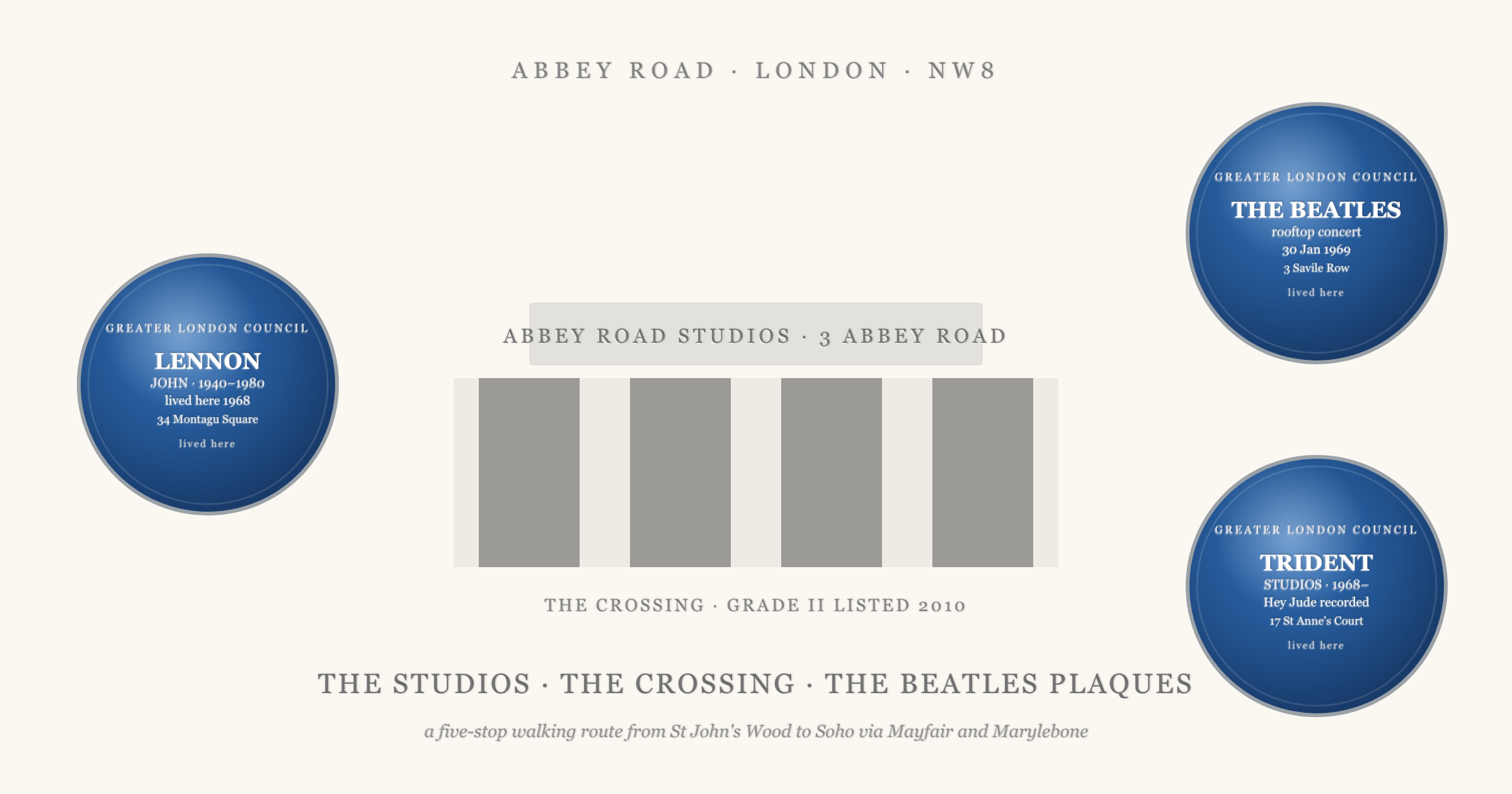
What Abbey Road Studios Actually Is
The building at 3 Abbey Road was built in 1831 as a nine-bedroom Georgian townhouse for a wealthy merchant family. Its long, narrow garden ran back toward Grove End Road, and its proportions (a large central block with smaller wings) made it useful for a purpose its builders never imagined. The Gramophone Company (later EMI) bought the property in 1929 for £100,000, gutted the interior, and rebuilt the back of the building as three purpose-built recording rooms. EMI Studios, as the facility was then called, opened on 12 November 1931 with Edward Elgar conducting the London Symphony Orchestra in the first session in Studio One. That first recording (Elgar's "Land of Hope and Glory" from the Pomp and Circumstance Marches) is preserved in the EMI archive.
Studio One is still the largest recording space in the building (long enough for a full symphony orchestra and a 100-piece choir simultaneously), Studio Two became the room the Beatles used for almost every session from 1962 to 1970, and Studio Three is the smaller third room that George Harrison used for many of his solo sessions and that has hosted everyone from Pink Floyd to Adele. The building was renamed Abbey Road Studios in 1970, after the album of the same name, on the rationale that nobody would ever again refer to the place as anything else. The studios were threatened with sale and conversion to flats in 2010 (EMI was in financial trouble and the building was officially valued at over £30 million as residential property); the campaign to save the studios produced the Grade II listing in February 2010, which made conversion impossible without the kind of planning intervention no developer would survive.
The studios are still operational. They take commercial film-score work (the Star Wars prequels, every Harry Potter film, The Lord of the Rings, Black Panther, the Elgar centenary recordings) and continue to produce pop and classical recordings. They are not generally open to the public, though they run occasional ticketed open-house events and the Abbey Road Studios Shop on the ground floor sells records, books, and merchandise to the people who have made the pilgrimage.
The Beatles recorded essentially every Beatles album there. From "Love Me Do" in September 1962 to "I Me Mine" in January 1970, the band logged something like 700 hours in the building over seven and a half years. Their last session as a four-piece, on 20 August 1969, was the final mixing of "I Want You (She's So Heavy)" for the Abbey Road LP. The album was sequenced at the studio that same week.
The Crossing (and Why It Is Listed)
The cover of the Abbey Road album was photographed at 11:35 a.m. on Friday 8 August 1969 by Iain Macmillan, a freelance photographer the Beatles had used a few times before. Macmillan stood on a stepladder in the middle of Abbey Road and took six exposures with a Hasselblad medium-format camera as the four Beatles walked across the zebra crossing in front of the studio. The fifth frame, with John, Ringo, Paul, and George in their famous diagonal across the stripes (Paul barefoot, the white VW Beetle parked in the background), is the one Paul McCartney picked. The shoot took ten minutes and was reportedly somewhat improvised; the Beatles had originally floated calling the album "Everest" and travelling to the Himalayas to photograph the cover, then thought better of it and walked across the road outside the studio instead.
The crossing has been re-photographed by visitors continuously since the album's release in September 1969. By the late 2000s the crossing was so obviously a pilgrimage site that Historic England, in a slightly unusual decision, granted it Grade II listed status in December 2010 to protect it from "alteration or removal in the wider context of urban development". It is the only pedestrian crossing in the United Kingdom with statutory listed-monument protection. The listing report describes it as "a London landmark of cultural and historic significance" and explicitly cites the album cover as the reason.
A live webcam at the studios has streamed the crossing 24 hours a day since 2011, and Westminster Council has periodically had to repaint the stripes more often than the surrounding road markings because the volume of foot traffic wears them down faster than vehicles do. The crossing is still a working public crosswalk on a still-active road, and visitors should be aware that drivers do have right-of-way until you actually step onto the stripes. The standard ritual is to arrive in groups of four, stage the diagonal walk, and then politely move on.
The Walking Route
The five plaques that map the Beatles' London cluster into a route that takes about three hours on foot at a relaxed pace, including time at each stop. The route is St John's Wood (Abbey Road plus Cavendish Avenue) → Marylebone (94 Baker Street, 34 Montagu Square) → Mayfair (3 Savile Row, Sutherland House on Argyll Street) → Soho (17 St Anne's Court). The Underground network connects every leg if the weather makes the walk less appealing.
Stop 1: 3 Abbey Road (the studios and the crossing)
Allow forty-five minutes. The crossing is a few seconds of pedestrian-action photography; the rest of the time goes to walking around the block, looking at the graffiti wall (the white perimeter wall that Westminster Council repaints quarterly because visitors continue to write Beatles lyrics on it) and visiting the Abbey Road Studios Shop. The shop is open seven days a week, sells limited-edition pressings and Abbey Road merchandise, and has the only public access into the building.
Stop 2: 7 Cavendish Avenue (Paul McCartney's house, no plaque)
A four-minute walk south of the studios. McCartney bought 7 Cavendish Avenue in 1965 and still owns it, so there is no English Heritage plaque here (the rule is the subject must have been dead for at least twenty years). The house is famously unmarked. Look up "1 Cavendish Avenue" instead, the house at the corner of Wellington Place, where there is a London County Council blue plaque to Billy Fury, the British rock-and-roll singer who lived at number 1 between 1972 and his death in 1983. Fury and McCartney were neighbours and friends; McCartney spoke at his funeral.
Stop 3: 94 Baker Street (the Apple Boutique)
Twenty minutes' walk south, or two stops on the Jubilee Line from St John's Wood to Baker Street. There are two plaques here: an English Heritage blue plaque to John Lennon and George Harrison, marking the address as the location of the Apple Boutique, the Beatles-owned psychedelic clothing shop that opened in December 1967 and closed in July 1968 after eight chaotic months. Apple Boutique was the first commercial venture of Apple Corps; the Beatles let employees and the public take the entire stock home for free on the day it closed. The exterior was painted with a giant psychedelic mural by The Fool (the Dutch artists' collective Lennon and Harrison commissioned), which Westminster Council had whitewashed within days of the opening at the request of neighbouring shopkeepers.
Stop 4: 34 Montagu Square (John Lennon and Yoko Ono)
A nine-minute walk through Marylebone. The English Heritage blue plaque, erected in 2010 on the thirtieth anniversary of Lennon's death, marks the basement flat at 34 Montagu Square where John Lennon and Yoko Ono lived in 1968, where they were arrested in October 1968 in the Drugscope raid that became Lennon's first criminal conviction, and where Lennon and Ono photographed the cover of the Two Virgins album (the famous nude-on-the-front, nude-on-the-back album that EMI refused to distribute). The flat has a quietly absurd Beatles density in its history: Ringo Starr originally rented it from 1965, lent it to Paul McCartney for a year (McCartney wrote "Eleanor Rigby" partly there), then to Jimi Hendrix and Chas Chandler in 1966, then to Lennon and Ono in 1968. The plaque is to Lennon specifically because he lived there longest of the four.
Stop 5: 3 Savile Row (the rooftop concert)
A 25-minute walk south through Mayfair, or two stops on the Bakerloo Line from Baker Street to Oxford Circus. 3 Savile Row was the headquarters of Apple Corps, the Beatles' company, from 1968 to 1972. The Westminster City Council blue plaque on the building marks the address as "Apple Records, headquarters of the Beatles". The roof of 3 Savile Row was the site of the Beatles' last public performance, the lunchtime rooftop concert on 30 January 1969, captured by Michael Lindsay-Hogg's cameras and released as the climax of the Let It Be film and (in 2021) Peter Jackson's Get Back docuseries. The forty-two-minute concert (interrupted by the Metropolitan Police, who arrived around the thirty-minute mark in response to noise complaints) included "Don't Let Me Down", "Get Back", and three takes of "I've Got a Feeling". It was the last time John, Paul, George, and Ringo played together publicly. The building is now a Burberry store; the plaque is on the exterior facing Savile Row.
Optional Sixth Stop: Sutherland House, Argyll Street (Brian Epstein)
Two minutes' walk from 3 Savile Row, around the corner past the Liberty store. Sutherland House at 5–6 Argyll Street has an English Heritage blue plaque to Brian Epstein (1934–1967), the Beatles' manager from 1961 to his death in 1967. Epstein's company NEMS Enterprises had its London office on the third floor of Sutherland House from 1964 onwards. Epstein died in his Belgravia flat at 24 Chapel Street in August 1967, but Sutherland House is where he ran the band's affairs.
Optional Seventh Stop: 17 St Anne's Court, Soho (Trident Studios)
Twelve minutes' walk east of Argyll Street, in the back streets of Soho between Wardour Street and Dean Street. The blue plaque to David Bowie and Trident Studios marks the small black-fronted building that was the second home of British rock recording in the 1960s and 1970s. The Beatles recorded "Hey Jude" at Trident in July 1968 (Abbey Road's eight-track machine had not yet been installed; Trident had one, which is why they used it), as well as parts of the White Album and the Magical Mystery Tour sessions. David Bowie recorded Hunky Dory and The Rise and Fall of Ziggy Stardust and the Spiders from Mars there. Queen recorded their first three albums there. The building is no longer a working studio (Trident closed in 1981) but is preserved as a Grade-II-listed contributing structure inside the Soho Conservation Area.
How to Visit (Logistics)
Getting to Abbey Road Studios. The nearest tube is St John's Wood on the Jubilee Line. Exit the station, walk north on Wellington Road, then turn left into Grove End Road. Abbey Road is the second turning on the right. The studios are on the corner, with the crossing immediately in front. Allow ten minutes from station to crossing. Buses 13, 46, 82, 113, 187, and 274 stop near the station. Parking on Abbey Road is restricted; the nearest paid car parks are on Lodge Road and Lisson Grove.
Best time to visit. Early morning (before 9 a.m.) or late evening (after 7 p.m.) is the only window when traffic and crowd density both drop enough to take the photo without queueing. Tourists peak between 11 a.m. and 4 p.m. all year and overflow the pavement in summer.
Crossing etiquette. The crossing is a working road. Wait for traffic to stop, walk normally across, do not loiter on the stripes once vehicles are waiting. Drivers in St John's Wood are exceptionally patient for tourists but the usual UK rule of thumb applies: if you have started crossing, the driver must wait; if you have not, they have right-of-way.
Combining with other London walks. The five-stop Beatles route described above pairs naturally with our Bloomsbury Group walking tour, which covers the literary plaques in Gordon, Fitzroy, and Tavistock Squares (a fifteen-minute walk east from Sutherland House). For a London-of-the-arts day, you can also pair Abbey Road with the Handel Hendrix House Mayfair tour, which is a fifteen-minute walk west from Sutherland House and covers another two-musician London plaque pairing.
What's Inside the Studios (and What You Can Actually See)
The studios are not generally open to the public. The Abbey Road Studios Shop, on the ground floor of the building, is the only part of the facility a visitor can enter without a session booking. The shop is open seven days a week (10 a.m. to 5 p.m., later in summer), sells the official Abbey Road Studios merchandise, limited-edition vinyl, signed prints, and the catalogue of recordings made in the building. The shop occasionally hosts small events with Abbey Road producers and engineers; check abbeyroad.com for current schedule.
Studio One has been opened to the public on a small number of Heritage Open Days (the next one is typically in September each year, but tickets release months in advance and sell within hours). For a more reliable inside view, the Abbey Road Studios website offers an interactive virtual tour that walks through the three studios, the mastering rooms, and the historic photography corridor.
What This Walk Adds Up To
The Abbey Road crossing is famous because of one photograph taken on a hot Friday in August 1969, but the studios that produced the photograph were sixty years old by then and have continued working for fifty-five years since. The walking route across central London that connects the studios to the rooftop concert, to Lennon's Marylebone flat, to the Apple Boutique on Baker Street, and to Trident in Soho, makes visible something the album cover does not: that the Beatles' London was a small, walkable city, that the major creative addresses were within twenty minutes of each other on foot, and that the band was lived as much in cabs and on pavements as in any studio. Five plaques, four neighbourhoods, three hours, and the city the album cover briefly froze.
If you want to keep walking, Legacy maps every blue plaque in London, marks the ones you have walked past, and lets you build your own route around the bands, writers, scientists, and reformers who lived in the same square mile. The Beatles route above is twelve plaques. The full London plaque map is sixteen hundred. Both are walking distance.