Kenwood House sits at the northern edge of Hampstead Heath, a long cream-stuccoed mansion of two storeys facing south over a slope of lawn down to two ornamental lakes. From the Highgate end of the heath you walk up through woodland and the house emerges suddenly: the central block low and pedimented, the Library wing extending east in the rhythm of pilasters, the orangery rising above the trees on the west. There is no ticket office. There is no admission. Walk in through the door and you are looking at Vermeer's Guitar Player and Rembrandt's Self-Portrait with Two Circles, hanging in rooms where the 1st Earl of Mansfield once read his briefs and where Dido Elizabeth Belle grew up.
Kenwood House is one of London's strangest free museums. It is a Grade I-listed Robert Adam interior wrapped around an Iveagh Bequest art collection that would individually count as a top-tier London gallery, it is the house at which the Lord Chief Justice who wrote the 1772 Somerset judgment did his thinking, and it is on the edge of one of the most-loved public parks in the country. This is the guide to what is in it, who has lived in it, the plaques on and around the estate, and the campaign that nearly cost London the whole thing.
Where Kenwood House Is and How to Get There
Kenwood House stands on Hampstead Lane between Highgate and Hampstead, postcode NW3 7JR. It is technically in the London Borough of Camden, on the boundary with Haringey, occupying the high northern edge of Hampstead Heath. The estate covers around 112 acres of woodland, sloping lawn, and ornamental lakes, all of which the public can walk for free; the house itself is also free to enter, with no booking required for general admission. It is managed by English Heritage, which has run it since 1986.
The easiest tube approach is from Archway (Northern line) and a fifteen-minute walk south-west along Hampstead Lane, or from Hampstead (Northern line) east through the heath. Hampstead Heath overground from East Heath Road also works. From central London, the 210 bus runs along Hampstead Lane and stops directly outside the gates. There is small paid parking on the estate.
Kenwood is at its best on a still autumn morning when the lakes are flat and the front lawn is empty. It is at its busiest on bank-holiday afternoons in summer and during the Kenwood concerts on the lakeside, which have been a fixture of London summers since the 1950s. The interior is closed only for occasional private events and a small handful of days a year.
The Building: From Caen Wood to the Mansfield Mansion
The site has been built on for at least four centuries. The original house was a modest brick building called Caen Wood (an old name preserved in the estate's spelling, Kenwood is a corruption) and was tenanted through the seventeenth century by a series of London merchants and gentry. By the 1750s it was a comfortable but unremarkable country villa with a kitchen garden, a small lake, and views south toward London.
The transformation came after 1754, when William Murray, 1st Earl of Mansfield, bought Kenwood. Murray was a Scottish lawyer of formidable ability who had risen to become Solicitor-General, Attorney-General, and finally Lord Chief Justice of the King's Bench from 1756 to 1788. He needed a London residence within reach of Westminster Hall and the courts, and a country retreat that was quiet enough to read briefs in. Kenwood was both: a six-mile drive from the city, set in heath that was rural in feel but legally inside the metropolis.
In the 1760s Mansfield brought in Robert Adam, the most fashionable architect of the period, to remake the house. Adam worked on Kenwood between 1764 and 1779, and the result is one of the finest surviving Adam interiors in England. He kept the basic Caen Wood envelope and added the great Library on the east end, gave the south facade its low pediment and pilasters, refaced the building in stucco, and rebuilt the entrance front on the north side. Inside, the Library is the room everyone comes for: a barrel-vaulted ceiling painted in Adam's pale-green and pink palette, a curved apse at each end behind a screen of columns, plaster decoration in low relief, and a great Aubusson carpet on the floor. It is, more or less, what an aristocratic gentleman of the Enlightenment thought a library should be.
After Mansfield's death in 1793 the title passed to his nephew, the 2nd Earl, who added the south-facing wings (the orangery on the west, the music room and dining room on the east) between the 1790s and 1810s, mostly to designs by George Saunders. The house we walk through today is therefore an Adam Library wrapped in Mansfield extensions, and the symmetry of the south facade comes from the Saunders additions matching the Adam silhouette rather than the other way around.
The Mansfield Judgment: The Decision That Was Lived Out at Kenwood
The most consequential thing that happened inside Kenwood was thought, not built. The 1st Earl of Mansfield, while living here, presided over a string of court cases that bear on what would now be called the legal history of slavery in Britain. The most famous is Somerset v Stewart, decided in 1772, in which Mansfield ruled that an enslaved man, James Somerset, brought to England by his owner Charles Stewart could not be forcibly removed and returned to the colonies. The reasoning was narrow and Mansfield himself was careful about its scope, but the case was widely read at the time and afterwards as establishing that slavery was not supported by English common law on English soil. The often-quoted line that "the air of England is too pure for any slave to breathe" is not Mansfield's, it is the abolitionist William Lofft's later paraphrase, but the underlying decision really did belong to Mansfield and really was thought through, very probably, at his desk in the Adam Library.
The judgment did not abolish slavery in the British Empire; that took another sixty-one years and the Slavery Abolition Act of 1833. It did end the practice of slave-holders walking off ships at Bristol or London with enslaved Africans in tow and simply asserting ownership over them. It also made Mansfield a complicated figure for the abolitionist movement, both an advocate for what looked like the right outcome and a careful, conservative judge who took every later case on its facts.
A second case followed in 1783, Gregson v Gilbert, the action over the Zong massacre, when 132 enslaved Africans were thrown overboard from a slave ship and the owners sought to claim them on the insurance as lost cargo. Mansfield presided. The court ruled against the insurance claim on technical grounds, the decision becoming evidence the abolitionists used to push the case for legal personhood, but Mansfield himself was careful to frame it as a property dispute rather than a referendum on slavery. Both cases sit in the legal-history record beside the personal one inside Kenwood: the great-niece Mansfield was simultaneously raising as a member of his own family.
Dido Elizabeth Belle and the Pink Plaque
Dido Elizabeth Belle was born in 1761, the daughter of Maria Belle (an enslaved African woman) and Sir John Lindsay (a British naval officer, Mansfield's nephew). Lindsay brought Dido to England as a child and entrusted her to his uncle and aunt at Kenwood. She was raised in the house alongside her younger cousin Elizabeth Murray, taught to read and write, given an allowance, and made godfather to Mansfield's affairs in a way that places her well outside the role that a Black woman of her birth would have had in eighteenth-century England.
The visual record that matters most is the 1779 double portrait by David Martin, which shows Dido and Elizabeth together, Elizabeth seated reading a book and Dido standing in turban and silk, carrying fruit, her hand laid affectionately on Elizabeth's shoulder. Dido is not subordinate in the picture; she is co-subject. The painting hung at Kenwood for centuries and is now at Scone Palace in Perthshire, with a high-quality copy on display at Kenwood. For most of the late twentieth century Dido's life was largely invisible outside specialist historical scholarship; the 2013 film Belle, directed by Amma Asante, restored her to a much wider audience and was substantially filmed at Kenwood itself.
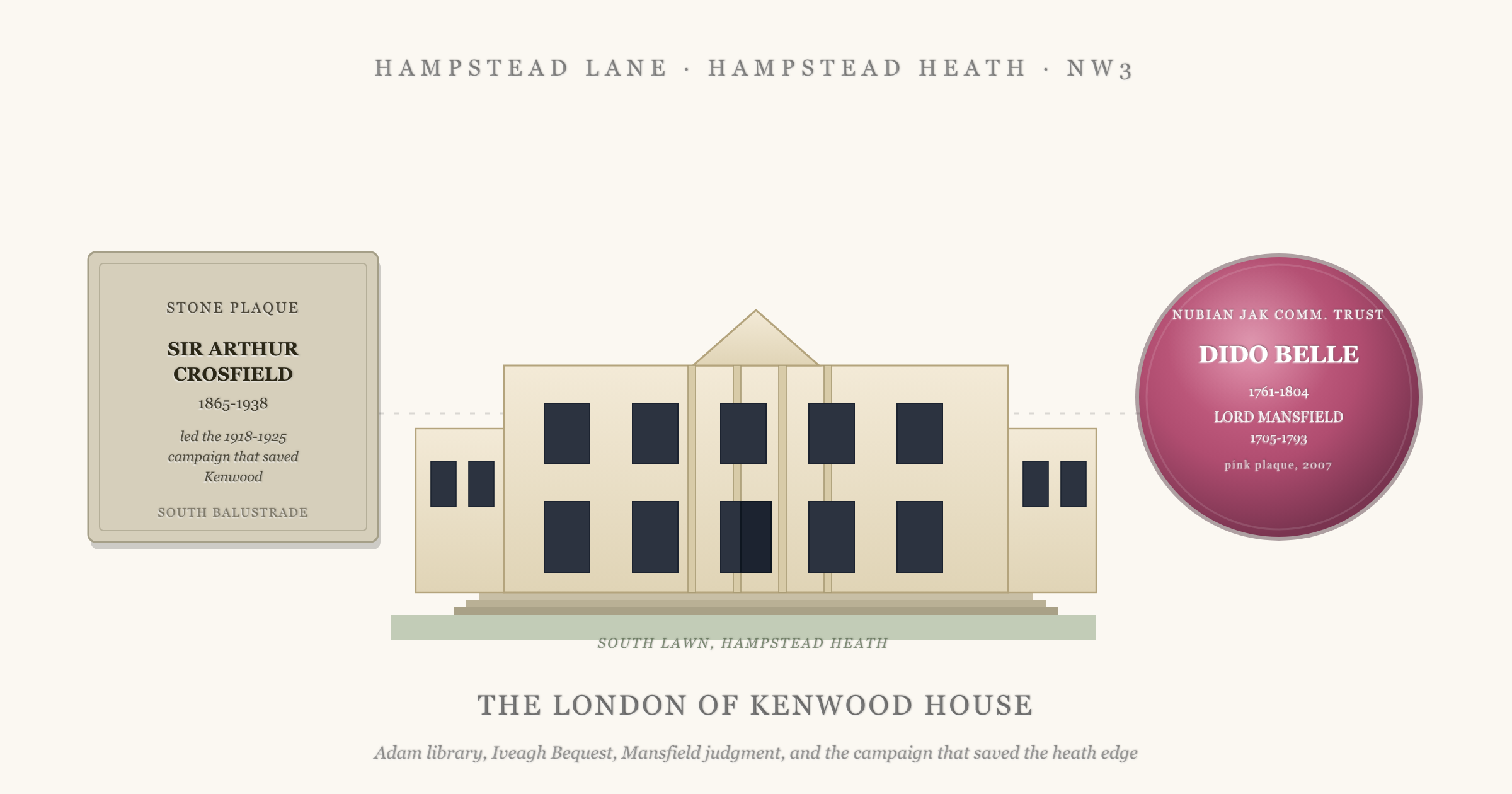
The 2007 pink plaque on the wall of Kenwood House was erected by the Nubian Jak Community Trust, the African and Caribbean heritage commemoration scheme founded in London in 2006 and responsible for many of the city's plaques to Black Britons whose stories the English Heritage scheme had not yet caught up with. The plaque commemorates Dido Belle and William Murray, 1st Earl of Mansfield together, in recognition of the unusual family arrangement that lived inside the house. It is one of the few London plaques that has to do the job of saying two intertwined things at once.
In Mansfield's will in 1793 he confirmed Dido as "born free." He left her a £100 lump sum and £100 a year for life, more substantial than the bequest he made to several other relations. She married a Frenchman, John Daviniere, in 1793, had three sons, and died in Pimlico in 1804 aged 43. Her story sits beside Mary Seacole's London in the wider rebalancing of Black British history that has been a major thread of the last twenty years of plaque-erection in the capital.
The Iveagh Bequest: How a Vermeer Ended Up on Hampstead Heath
In 1922 Kenwood was put up for sale. The 6th Earl of Mansfield had moved the family seat to Scone, the Adam interiors were undervalued by the property market of the early 1920s, and the most likely buyers were speculative developers who saw the 112 acres as building land at the edge of an expanding north London. The threat was real and immediate.
What rescued Kenwood was a bequest. Edward Cecil Guinness, 1st Earl of Iveagh, head of the Guinness brewing dynasty and one of the richest men in Britain, had spent forty years building one of the great private art collections of the late nineteenth and early twentieth centuries. He had bought paintings in the 1880s and 1890s at a moment when British landed aristocracy was forced to sell its old masters to pay death duties, and he had built up a collection of Rembrandts, a Vermeer, a Hals, three Reynoldses, two Gainsboroughs, a Boucher, a Cuyp, a Pieter de Hooch, a Romney, two Turners, and dozens more. He died in 1927, leaving the lot to the nation, plus enough money to buy Kenwood House and the immediately surrounding estate to hang them in. The arrangement was formalised in the Iveagh Bequest (Kenwood) Act 1929, which created the legal framework under which the house operates today.
The result is that Hampstead Heath has a national gallery on its northern edge. The headline works include Vermeer's The Guitar Player (around 1670, one of only 34 surviving Vermeers in the world), Rembrandt's Self-Portrait with Two Circles (around 1665, late, deeply introspective, generally accepted as one of the greatest Rembrandts in any collection), Frans Hals's Pieter van den Broecke, Reynolds's Mrs Musters as Hebe and his Lady Bampfylde, Gainsborough's Mary, Countess Howe, Boucher's Madame de Pompadour, and pieces by Cuyp, Hals, de Hooch, Turner, Romney, and Lawrence. The hang is dense by museum standards (closer to a private collection arrangement than a public-gallery curatorial scheme) which is part of the point: Iveagh built the collection to live with, and Kenwood is the house he chose to put it in.
The Iveagh Bequest is the single biggest reason Kenwood is, as collections go, internationally significant rather than just locally treasured. It is also the reason the entrance is free: the bequest's terms commit the house and its art to public access without charge.
The Crosfield Plaque and the Campaign That Saved the Estate
Walk to the south balustrade above the lawn and you will see a stone plaque set into the parapet, commemorating Sir Arthur Crosfield, 1865-1938, who led the campaign between 1918 and 1925 to preserve the Kenwood estate from development. Crosfield, a Liberal MP and chairman of the Hampstead Heath Extension committee, organised the public subscription that bought the southern part of the estate (the lakeside, the lawn, the parkland) and added it to Hampstead Heath in 1922 and 1924. It was that purchase, more than the Iveagh Bequest, that secured the view: the open south sweep down to the lakes, free of houses, which is what makes Kenwood read as a country mansion in a national park rather than a museum on a building plot.
Crosfield's campaign is one of the great inter-war successes of London preservation, alongside the saving of Hampstead Garden Suburb and the foundation of the London County Council parks portfolio. The stone plaque is unobtrusive enough that most visitors walk past it; it is one of those small commemorations that records the moment a city realised what it had nearly lost. Hampstead Heath's continuity as a contiguous green space owes more to the 1918-1925 campaign than to any other single piece of policy.
What to See Inside the House: A Room-by-Room Quick Guide
The visit is short by museum standards (an unhurried hour is enough for the main rooms) and rewards a slow walk rather than a tick-list.
The Entrance Hall sets the tone with grisaille reliefs above the door cases and a Doric screen at the far end. The architectural language is restrained Adam neoclassicism, more austere than the colourful Library to come.
The Music Room and the Dining Room (Saunders extensions) hold most of the portraits: the Reynoldses, the Lawrence, the Mary, Countess Howe by Gainsborough. The Gainsborough is the picture most people stop in front of. Howe was a society beauty of the 1760s, painted by Gainsborough in his very best swagger mode, and the silver-grey silk and the pink quilted petticoat are unimprovable.
The Library (the Great Room) is the Adam room and the architectural centrepiece. Look up at the barrel vault and the painted ovals (allegorical scenes by Antonio Zucchi, Adam's collaborator on many interiors), look at the apsidal ends behind their column screens, and look at the colour scheme (pale green, pink, terracotta) which is much more daring than the off-white most people picture when they hear "Georgian interior." The room was for Mansfield a working library; it is the room in which the Somerset reasoning very likely took shape.
The Breakfast Room has the Vermeer. The Guitar Player is on the right-hand wall as you enter, small, golden, hung at eye level, a young woman in a yellow jacket strumming and looking off to her left toward a sister or friend who is not in the picture. The painting is roughly 53 by 46 centimetres; you can stand in front of it. It is one of the only Vermeers in London anyone can see for free.
The Vestibule and the staircase landing have the Rembrandt Self-Portrait with Two Circles, which is the painting most students of European art know from reproductions and not many have seen in person, because it has been at Kenwood, behind no glass, since 1927. The two circles on the wall behind him are unexplained (a Renaissance composition rule, a geometric pun, an allusion to perfect form, theories vary). The face is the late Rembrandt face: thickly worked, unflattering, completely present.
The Suffolk Collection rooms upstairs hold the Jacobean portraits, the Larkin set of full-length figures from the 1610s, and rotating displays of works on paper from the Iveagh and English Heritage holdings.
The Outside: The Walks, the Lakes, the Sham Bridge, and the Concerts
Kenwood's grounds are more visited than its interior. The classic walk down from the south door takes you across the lawn to a viewpoint where the trees frame two lakes, the Wood Pond and the Thousand Pound Pond, and beyond them a small white classical structure that looks like a Palladian bridge. The Sham Bridge is exactly what its name says: a 1782 trompe-l'oeil structure designed to look like a bridge from the house but with no actual span; the water visible through it is the same pond on the other side. It is one of the great pieces of eighteenth-century landscape theatre in London, and it works because you walk down toward it and the illusion holds longer than you expect.
The Iveagh Bequest concerts, held in the bowl-shaped lawn on the south side, have been a fixture since the 1950s and remain among the best-known of London's open-air summer music events. The Heath itself extends south from Kenwood through Parliament Hill (the famous view back across central London from the top of the slope) and down to Hampstead Ponds.
A short walk westward through the woodland brings you to the Hampstead bog garden and toward the Keats House Hampstead cluster on the other side of the heath. A short walk southward takes you down through the woods to the Freud Museum at 20 Maresfield Gardens. Kenwood sits between these and is the most natural northern anchor of any Hampstead literary or biographical walk.
A Half-Day Walk: Kenwood, Highgate Cemetery, and the Mansfield Court
If you want to make a day of it rather than a single visit, the natural pairing is Kenwood with Highgate Cemetery, which is twenty minutes east along Hampstead Lane and South Grove. Karl Marx's Grave at Highgate is in the East Cemetery, fifteen minutes' walk from the Highgate Village end of Hampstead Lane. The structural rhyme is satisfying: Kenwood is where one kind of Enlightenment legal thinking was practised in the 1770s; Highgate is where one of the nineteenth century's most consequential critics of the social order that thinking served is buried. The two ends of the same Hampstead Heath ridge, an hour and a half between them.
A longer alternative is to descend south through the heath to the Hampstead Ponds and on to Keats House Hampstead and the Freud Museum for a full literary half-day. Both ends of that walk are signed and on accessible paths.
Why Kenwood Matters in the London Plaque Story
Plaques attach themselves most often to single addresses, single people, single moments. Kenwood is one of the rare London cases where the building has to carry a whole cluster of stories at once: an Adam interior, a Mansfield judicial career, a Belle family upbringing, a turn-of-the-twentieth-century preservation campaign, a Guinness art bequest, and a century as a free public museum. The pink Nubian Jak plaque does a remarkable amount of work for one disc of fired pigment, commemorating two people whose relationship within this house is itself part of why we now talk about Kenwood at all. The Crosfield stone plaque does the quieter job of marking how close the whole estate came to being lost.
The wider London blue plaques scheme tends to commemorate the famous dead at their lived addresses; Kenwood is the case where the house itself is the commemorative object, with its plaques pinned to the surface like footnotes on a book that is also a museum that is also a park. You can read a great deal of London's history without ever leaving the south lawn, and you can do it for free.
If you are planning a Hampstead walk that takes in Kenwood, the Legacy app maps every plaque on and around the estate, including the ones inside Hampstead village to the south and Highgate to the east. Tap any plaque to read its inscription, see archive photos, and trace the connecting biographies. Hampstead Heath turns out to be one of the densest plaque-clusters in London, and Kenwood is the obvious centre of gravity for the northern end of it.