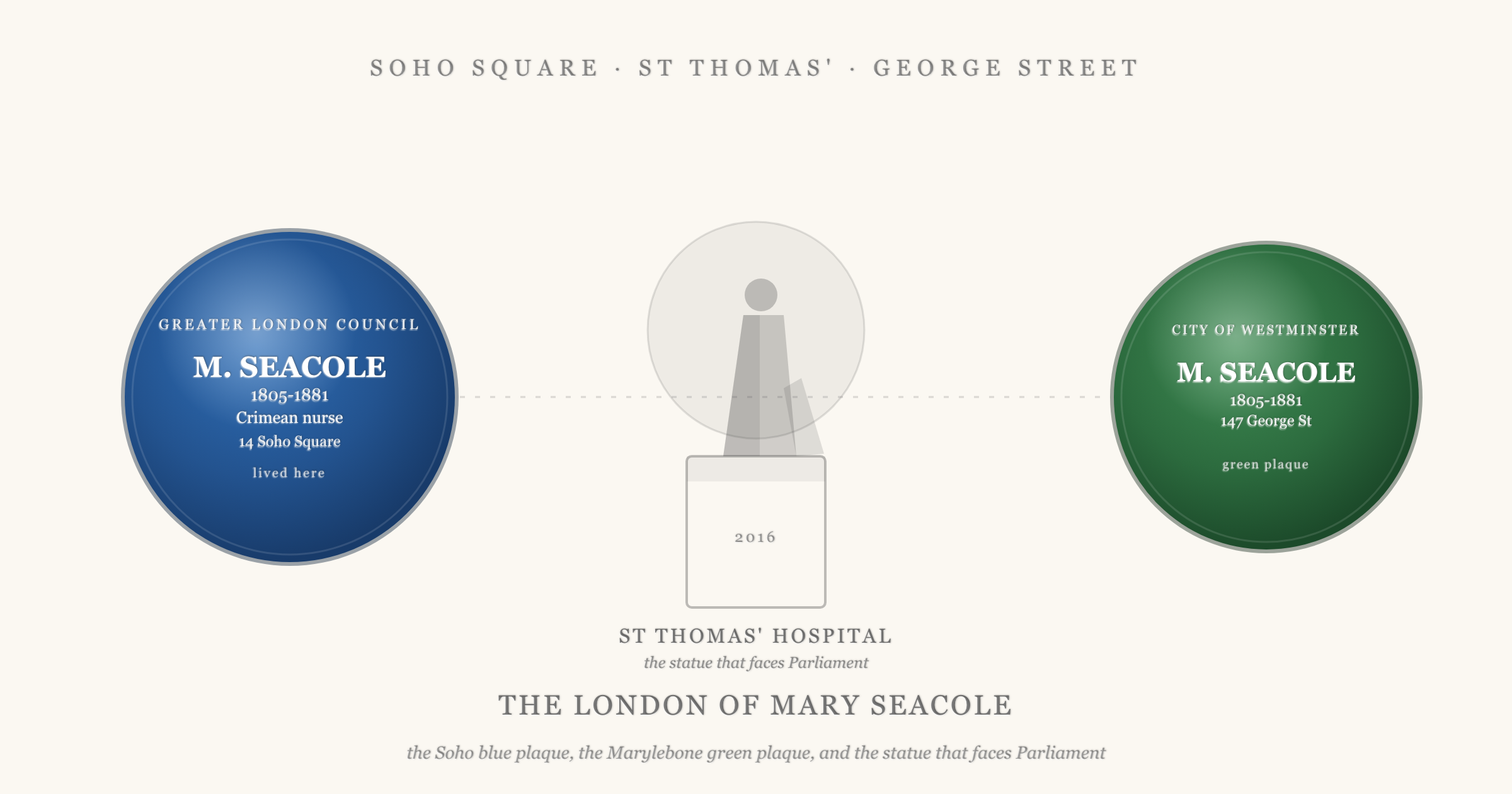
Mary Seacole's London is the story of a reputation lost and recovered. For most of the twentieth century the Jamaican-born nurse who tended British soldiers in the Crimea was almost entirely forgotten, while her contemporary Florence Nightingale became a national saint. Then, slowly, the city began to mark her again. Today three things commemorate Mary Seacole within a few miles of each other: a blue plaque at 14 Soho Square where she lived, a green plaque at 147 George Street in Marylebone, and, since 2016, a bronze memorial statue in the grounds of St Thomas' Hospital that stands taller than life and faces the Houses of Parliament across the river. Taken together they trace one of the most remarkable lives in Victorian London, and one of the longest journeys back from obscurity.
This guide walks through each of the Mary Seacole London sites in turn: the Soho Square blue plaque and what it marks, the life that took her from Kingston to Panama to the battlefields of the Crimea, the Marylebone green plaque, the statue at St Thomas' and why its location matters, her grave at Kensal Green, and the long, contested relationship with Florence Nightingale that the modern city has finally rebalanced.
The Mary Seacole Sites: A Short Map
There is no single Seacole house-museum the way there is a Florence Nightingale Museum, so seeing her London means visiting a small set of markers spread across the centre and west of the city.
- 14 Soho Square, W1 carries the English Heritage blue plaque, erected in 2007, on a building where she lived.
- 147 George Street, Marylebone, W1 carries a green City of Westminster plaque marking another of her residences.
- St Thomas' Hospital, Lambeth, SE1 holds the 2016 memorial statue, the first statue of a named Black woman in the United Kingdom.
- St Mary's Roman Catholic Cemetery, Kensal Green, NW10 holds her restored grave, the focus of an annual memorial service.
If you have only an afternoon, pair the Soho Square plaque with the statue at St Thomas': the two together tell the whole arc, from the woman who lived quietly in Soho to the monument that now looks Parliament in the eye.
14 Soho Square: The Blue Plaque
The blue plaque at 14 Soho Square is the official English Heritage marker, and its inscription is plain:
Mary Seacole 1805-1881 Jamaican nurse heroine of the Crimean War lived here
Soho Square is one of the oldest squares in the West End, laid out in the 1670s and still anchored by a small mock-Tudor garden hut at its centre. By the time Seacole lived nearby it was no longer the aristocratic address it had been in the eighteenth century; it had become a denser, more commercial, more cosmopolitan quarter, which suited a woman who had spent her life among soldiers, sailors, traders, and travellers of every background. The plaque went up in 2007, the bicentenary year of the abolition of the British slave trade, part of a wider effort to mark Black British history in the capital.
It is worth standing under it for a moment, because the word that does the heavy lifting on the plaque is "heroine." Most blue plaques simply record that someone lived or worked at an address. Seacole's names a status, and it does so because for so long the city had refused her one.
Before London: Kingston, Panama, and the Road to the Crimea
Mary Jane Grant was born in Kingston, Jamaica, in 1805, the daughter of a Scottish army officer and a free Jamaican woman who ran Blundell Hall, a boarding house that doubled as a kind of convalescent home for sick soldiers and sailors. Her mother was a "doctress", a practitioner of Caribbean herbal and traditional medicine, and the young Mary learned the trade at her side, treating the tropical fevers that swept through the garrison town. That practical, hands-on medicine, learned in a Kingston boarding house rather than a European hospital, was the foundation of everything that followed.
She travelled widely for a woman of her time and means. She visited London more than once in the 1820s, ran businesses across the Caribbean and Central America, and married Edwin Horatio Hamilton Seacole in 1836 (he died in 1844). In the early 1850s she ran a hotel in Panama and treated victims of a cholera epidemic at Cruces, performing what may have been an autopsy on a cholera victim to understand the disease, and she nursed through a yellow-fever outbreak back in Jamaica in 1853. By the time the Crimean War broke out, she had decades of frontline experience with exactly the epidemic diseases that would kill far more British soldiers than Russian guns.
When she heard that nurses were being recruited for the war, she came to London and applied to join the official nursing contingent. She was turned down, repeatedly, by the War Office and by those organising Florence Nightingale's nurses. Seacole was in no doubt about why, and said so in her memoir: she was a middle-aged Creole woman, and the doors stayed shut. So she funded her own way. With a business partner, Thomas Day, she sailed to the Crimea and built the "British Hotel" near Balaclava, a combination of store, canteen, and refuge for officers and men. From there she rode out to the battlefields, sometimes under fire, carrying food, medicine, and comfort to the wounded, becoming a familiar and beloved figure to the soldiers who called her "Mother Seacole."
147 George Street: The Marylebone Green Plaque
The second marker is less famous and easy to miss. At 147 George Street, in Marylebone, a green City of Westminster plaque records another of her London residences:
Mary Seacole 1805-1881 Jamaican nurse heroine of the Crimean war lived in a house on this site
Westminster's green plaques are the borough's own scheme, distinct from the national blue plaques run by English Heritage, and they tend to mark figures and addresses that the blue-plaque scheme has not reached. That Seacole has both, a blue and a green, is itself a small measure of how the city's memory of her has expanded: two separate commemorating bodies, marking two separate addresses, for a woman who a generation ago had no public marker at all.
The George Street plaque sits in the dense Marylebone grid north of Oxford Street, a short walk from the Soho Square plaque across the West End. The original house on the site is long gone, as is so often the case with London's plaques; the marker records the place, not the building.
The Memorial Statue at St Thomas' Hospital
The most striking of the Seacole sites is the newest. On 30 June 2016, after a long fundraising campaign led by the Mary Seacole Memorial Statue Appeal, a bronze statue by the sculptor Martin Jennings was unveiled in the grounds of St Thomas' Hospital on the south bank of the Thames. It was, and remains, the first statue of a named Black woman in the United Kingdom.
The statue shows Seacole striding forward, coat caught as if in motion, against a large bronze disc that suggests both a sun and the ground of the Crimea. Its placement is deliberate and pointed. St Thomas' is the hospital that houses the Florence Nightingale Museum and that was home to the Nightingale Training School, the institution at the centre of the Nightingale legend. To put a striding Seacole in the same grounds, facing across the river to the Houses of Parliament, is to insist on her place in exactly the national story that had excluded her. The campaign was not without its critics, some of whom argued about the historical comparison with Nightingale, but the statue stands, and it has become a place of pilgrimage for nurses, schoolchildren, and visitors from across the Commonwealth.
It is also, simply, the best place to encounter her in London. The plaques mark where she lived; the statue is where the city decided, at last, to honour her in full.
Seacole and Nightingale: The Two Crimean Nurses
You cannot tell Mary Seacole's London story without Florence Nightingale, because for over a century the two were treated as a hierarchy rather than a pair. Nightingale, the gentlewoman with the lamp, became the founder of modern nursing and a fixture of the school curriculum and the banknote. Seacole, who served the same soldiers in the same war by different means, vanished from the popular record almost entirely.
The relationship between them was real and not warm. Seacole records being turned away when she sought to join the official nurses. Nightingale, for her part, wrote privately and dismissively about Seacole's British Hotel, and the two operated in different worlds: Nightingale ran a disciplined hospital nursing establishment at Scutari and reformed the system from the top down, while Seacole ran an independent canteen-and-refuge near the front and treated men where they fell. Historians still debate the comparison, and some of the loudest modern arguments about Seacole are really arguments about how to weigh the two women against each other.
The honest version is that they were not doing the same job, and the contest between them is largely a later invention. One was an administrator and statistician of genius who reformed public health from a Mayfair bedroom; the other was a frontline practitioner of practical medicine who put herself, repeatedly, in physical danger to comfort soldiers. London now commemorates both, and it is no accident that the Seacole statue stands in the grounds of the hospital most associated with Nightingale. The city is not choosing between them anymore.
Wonderful Adventures: The Memoir and the Long Rediscovery
When the Crimean War ended abruptly in 1856, Seacole was left stranded with a warehouse of unsold stock and returned to England effectively bankrupt. Her plight became briefly famous: in 1857 admirers, including soldiers and officers who had known her at the front, organised a four-day "Seacole Fund" military festival at the Royal Surrey Gardens to raise money for her. In the same year she published her memoir, Wonderful Adventures of Mrs Seacole in Many Lands, one of the earliest autobiographies written by a Black woman in Britain. It is a vivid, funny, and pointed book, and it is the reason we have her own account of being turned away from the official nursing mission.
Then she faded. For most of the twentieth century she was a footnote, if she appeared at all. The recovery came late and fast. Nursing organisations, particularly those connected to Caribbean and Commonwealth nurses, kept her memory alive; her grave was restored in the 1970s; and in 2004 she was voted the greatest Black Briton in a public poll. She was added to the National Curriculum in England, and when a 2013 proposal floated removing her, a public campaign kept her in. The blue plaque (2007) and the statue (2016) are the physical markers of that rehabilitation, a reputation rebuilt within living memory.
Her Grave at Kensal Green
Mary Seacole died in London on 14 May 1881 and was buried at St Mary's Roman Catholic Cemetery in Kensal Green, in the city's north-west, on the Harrow Road. For decades the grave was neglected. It was restored in 1973 through the efforts of the British Commonwealth Nurses' War Memorial Fund and the Lignum Vitae Club, a Jamaican women's organisation, and it is now a listed monument and the site of an annual memorial service each May, attended by nurses and members of the Jamaican and wider Caribbean community in Britain.
Kensal Green is out of the way for a casual visitor, but for anyone making a deliberate Seacole pilgrimage it is the quiet closing stop, the actual resting place behind all the plaques and the bronze.
How to See Mary Seacole's London
A practical route, if you want to do it on foot and by river:
Start at 14 Soho Square. Read the blue plaque, then walk the square and notice how central and how ordinary the setting is: no grand house-museum, just a marker on a working West End building.
Walk north-west to 147 George Street, Marylebone. Around twenty minutes across the West End grid, taking in the change from Soho's density to Marylebone's quieter streets. The green plaque is the borough's own tribute.
Cross the river to St Thomas' Hospital. This is the centrepiece. The statue stands in the hospital grounds facing Parliament; the Florence Nightingale Museum is in the same complex, so the two Crimean nurses can be seen within a few minutes of each other, which is the whole point.
Optional: Kensal Green. For the dedicated, the grave at St Mary's RC Cemetery is the final stop, best timed for the May memorial service.
The Seacole sites do not cluster as tightly as some London plaque trails, but the spread is itself part of the story: a life that crossed continents, marked by a city that took a long time to claim it.
What the Markers Together Mean
The plaques and the statue to Mary Seacole are, in a sense, a correction in bronze and ceramic. A woman who was refused a place in the official record, who funded her own war service because the door was shut, and who then disappeared from memory for a century, is now marked in Soho, in Marylebone, at St Thomas', and at Kensal Green. The most powerful of these, the statue facing Parliament, makes the argument plainly: she belongs in the national story, on the same riverbank, in the same grounds, as the nurse the country never forgot.
To plan a walk that links the Seacole sites with the surrounding plaques, Legacy maps all 1,625 of London's blue plaques onto a single interactive map, so you can route between Soho Square, the Marylebone green plaque, and the St Thomas' statue on foot, and discover what else stands nearby. We also gather the city's women's-history markers and Westminster cluster into a wider alternative walking tour of London. Mary Seacole had to travel a very long way to be seen. In London, at last, she is.