Keats House Hampstead is the small white cottage off Keats Grove where John Keats lived from December 1818 until September 1820, and where he wrote almost everything for which he is remembered. Ode to a Nightingale, Ode on a Grecian Urn, La Belle Dame Sans Merci, To Autumn, the great letters to Fanny Brawne next door: all of it came out of those eighteen months at Wentworth Place. The cottage is now run as a museum by the City of London Corporation, the garden is open in season, and a brown plaque set into the front of the building marks it as a poet's house. It is one of the most concentrated literary addresses in England.
This guide covers what is at Keats House today, the story of those eighteen months in Hampstead, the surrounding cluster of literary blue plaques (Hampstead has more poet, novelist, and intellectual plaques per square mile than anywhere else in London), and a short walking route that takes you from the cottage through the Heath and back to the high street. If you want to plot every plaque against the streets they sit on, the Legacy app maps all 1,625 plaques in London and turns a Hampstead afternoon into a collectable walk.
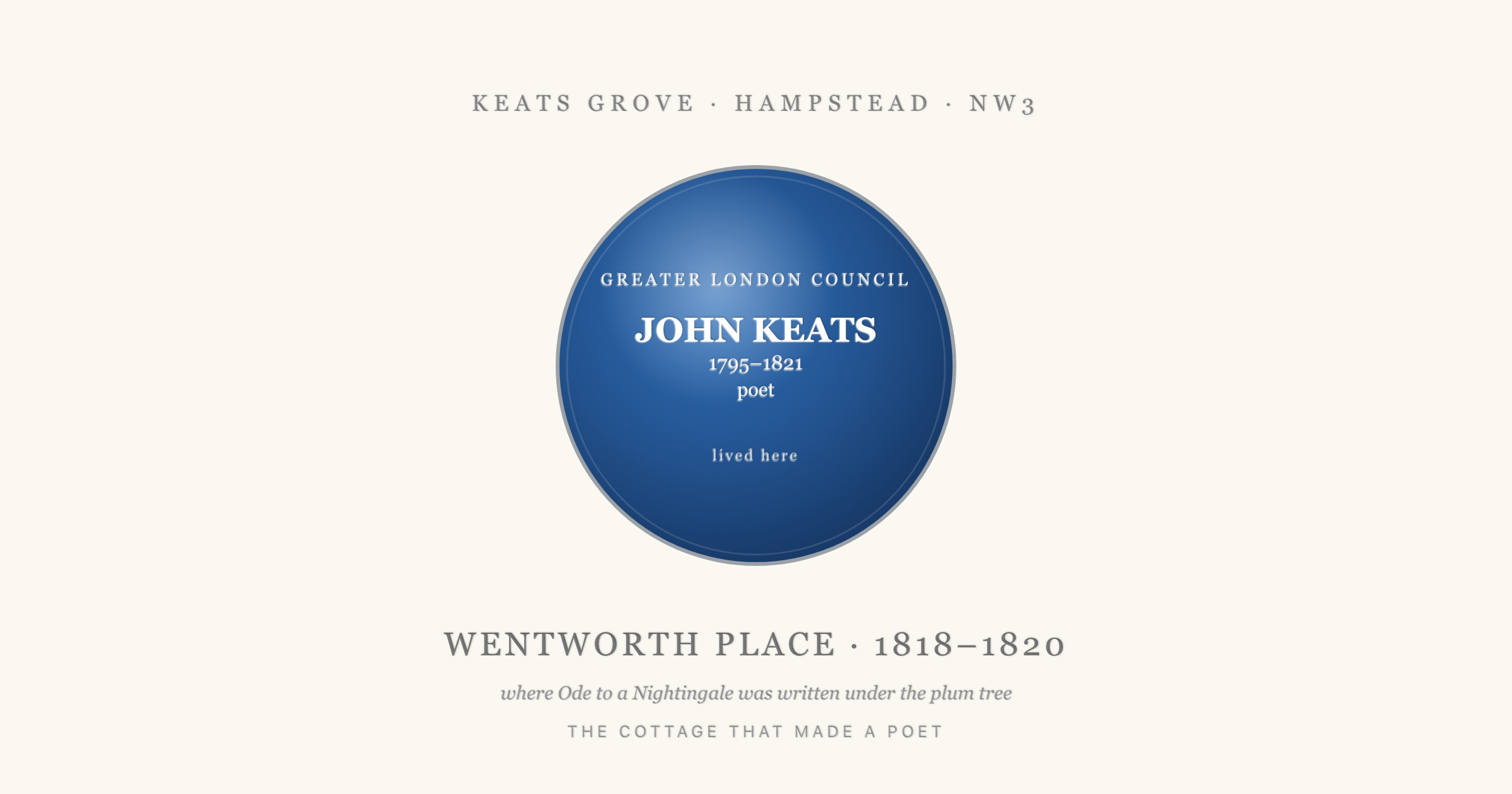
What Keats House Hampstead Actually Is
Keats House sits on a quiet residential lane called Keats Grove, just south of Hampstead Heath and a short walk from Hampstead Heath railway station. The address most often given is 10 Keats Grove, NW3 2RR. The building's contemporary name was Wentworth Place, and that is the name a Keats scholar will use in passing.
The structure is unusual. Wentworth Place is a pair of semi-detached houses built in 1814 and 1815 by two friends, Charles Wentworth Dilke and Charles Armitage Brown, on a strip of land they bought together. From the outside it looks like a single white-stuccoed Regency cottage with a generous garden and a low brick wall, but inside it is two houses sharing a connecting wall. Brown lived in one half. Dilke lived in the other. Keats moved into Brown's half in December 1818 and stayed until tuberculosis forced him to leave for Italy in September 1820.
The brown plaque on the front of the building reads simply that John Keats lived there. There is also a separate English Heritage blue plaque scheme record for the address. (London has multiple plaque schemes; Keats has commemorations in several of them, including the brown plaque visible at the cottage and earlier markers at Moorgate where he was born and at Enfield where he went to school.)
The cottage was nearly demolished in 1920 to make way for flats. A campaign led by Hampstead residents and American admirers of Keats raised the funds to save it. It opened as a public museum in 1925 and has been in continuous public use ever since, currently run by the City of London Corporation through the Keats House Trust.
The Eighteen Months That Made Keats
Keats arrived at Wentworth Place in December 1818 broken-hearted and broke. His brother Tom had just died of tuberculosis in another house in Hampstead. His own publisher had been unable to sell the first volume of his poems. He had abandoned his medical training in Southwark to write full-time, against the advice of nearly everyone, and was already showing the first symptoms of the disease that would kill him.
He moved into Brown's half of Wentworth Place at Brown's invitation, paying a contribution toward the rent. The house had a garden of about half an acre, an orchard with plum and mulberry trees, and a view across to the Heath. Next door, in the other half of the same building, lived the Dilke family. By the spring of 1819, the Brawne family had moved into Dilke's half (Dilke had relocated his family to Westminster), and the eighteen-year-old Fanny Brawne became Keats's neighbour, fiancée in all but legal form, and the recipient of the love letters that established her in literary history.
What he wrote at Wentworth Place between December 1818 and September 1820:
- The great Odes of Spring 1819. Ode to a Nightingale, Ode on a Grecian Urn, Ode to Psyche, Ode on Indolence, and Ode on Melancholy were all composed within a few months. The traditional account, given by Brown in his memoir, places the composition of Ode to a Nightingale on a single morning in May 1819, sitting under a plum tree in the Wentworth Place garden. The plum tree itself is gone, but the spot is marked.
- La Belle Dame Sans Merci (April 1819).
- The Eve of St. Agnes, completed at Wentworth Place after starting it in Chichester.
- Lamia (summer 1819).
- The Fall of Hyperion, his great unfinished revision of his earlier Hyperion fragment.
- To Autumn (September 1819), often cited as the most perfectly realised short poem in English.
- The complete sequence of letters to Fanny Brawne, which together form one of the great epistolary love archives in English literature.
That is roughly the entire mature canon, written in eighteen months in one Hampstead cottage by a man between twenty-three and twenty-four years old, while watching his own death approach.
He left Wentworth Place on 13 September 1820, sailed for Italy in the company of the painter Joseph Severn (also commemorated with a plaque in Rome), and died in Rome on 23 February 1821, aged twenty-five. He never returned. Fanny Brawne wore mourning for six years.
Visiting Keats House Today
The cottage is open to the public most days of the year (closed Mondays and Tuesdays in winter; check the City of London website for current hours). Admission is modest. The interior has been restored to roughly its 1819 layout, with a few key rooms presented as Keats and Brown would have known them.
Six things worth knowing for a visit:
- The garden is the point. The plum tree where Keats wrote Ode to a Nightingale is replaced (the original is long gone) but the same patch of lawn is preserved, and a small carved bench marks the spot. In late spring and early summer, this is one of the loveliest small gardens in London.
- The interior tour is intimate. Wentworth Place is a small house and visitor numbers are kept low. Most days you will see fewer than thirty other people across an hour. The contrast with bigger London literary museums is sharp.
- The collection is small but deep. Original letters, the engagement ring Keats gave Fanny Brawne (made of garnets in a gold setting, returned to her after his death), Keats's life mask, the manuscript of Bright Star, and a strand of his hair preserved in a locket are all displayed in rotation.
- The library and reading room are open. Researchers can request access to the Keats collection by appointment. For non-specialists, the reading room is a quiet place to sit and look across the garden.
- Events run year-round. The house hosts a programme of poetry readings, talks, and a major Keats Day each May, around the anniversary of Ode to a Nightingale. The garden is the venue for most outdoor events.
- It is not a long visit on its own. A thorough hour will see everything inside, plus another half-hour in the garden if the weather cooperates. To make a half-day of the trip, combine it with the Hampstead literary walk below.
A Walking Route From Keats House Through Hampstead
Keats House sits in the densest cluster of literary blue plaques in London. Within roughly twenty minutes' walk in any direction are the former homes of poets, novelists, painters, scientists, and political thinkers commemorated by every plaque scheme to operate in the capital. The route below covers the core of the cluster without crossing the same street twice. Allow ninety minutes at a comfortable pace, two and a half hours if you stop to look properly.
Stop 1: Keats House (10 Keats Grove)
Start here. The garden, the cottage, the walk down the front path is the most famous square metre of literary geography in NW3.
Stop 2: 19 Mount Vernon, Robert Louis Stevenson
Walk up Keats Grove to South End Road, turn left, then up Pond Street and across into Hampstead High Street. From the high street, climb Holly Hill onto Mount Vernon. Number 19 carries a blue plaque to Robert Louis Stevenson, who lodged here in 1873 and 1874 while convalescing. He was twenty-three, the same age Keats was when he moved into Wentworth Place. Stevenson would later write Treasure Island and Kidnapped; here he was still a sickly law student writing essays.
Stop 3: Holly Walk and Holly Bush Hill, Constable and Romney
Continue along Mount Vernon and into Holly Walk. The Watch House plaque on Holly Walk is one of the few non-resident plaques in the area, marking the location of an early-nineteenth-century parish lock-up. From Holly Walk, drop down to Holly Bush Hill where John Constable lived (a plaque marks his last home at 40 Well Walk, slightly further on). The painter George Romney lived at the top of Holly Bush Hill in the 1790s; his house is now a private residence with a discreet plaque.
Stop 4: 28 Hampstead Grove, George du Maurier (New Grove House)
A few yards from the top of Holly Bush Hill is New Grove House, marked with a brown plaque to George du Maurier, the Punch cartoonist and novelist who wrote Trilby. Du Maurier lived in the house from 1874 until his death in 1896. His granddaughter Daphne du Maurier, the novelist who wrote Rebecca, would later visit the house as a child.
Stop 5: Hampstead Heath, Spaniards Inn, and the open ground
Drop down to East Heath Road and walk onto the Heath proper. From the high ground near the Vale of Health (itself the location of plaques to D. H. Lawrence and to the political theorist Leigh Hunt, who introduced Keats to Shelley) you can see across to the City of London. The Spaniards Inn at the top of Spaniards Road is itself a literary landmark: Dickens mentions it in The Pickwick Papers, Keats drank there at least once, and the inn has been in continuous operation since the 1580s.
Stop 6: 7 Well Road, Karl Pearson
Loop back into Hampstead via Well Road. Number 7 is marked with a blue plaque to Karl Pearson, the founding statistician (regression coefficients, chi-squared tests, the Pearson correlation that anyone who has touched a spreadsheet has used). Pearson lived here from 1880 to 1923. His presence among the poets and painters is a reminder that Hampstead's nineteenth and early twentieth century clustered scientists and writers in the same streets.
Stop 7: 16 Bracknell Gardens, the three Huxleys
A slightly longer walk west takes you to 16 Bracknell Gardens, the family home of the Huxleys. The plaque commemorates Leonard, Aldous, and Julian Huxley. Aldous wrote Brave New World; Julian was the first director-general of UNESCO and one of the founders of the modern synthesis in biology; Leonard was the editor and biographer of his own father, T. H. Huxley (Darwin's "bulldog"). Three generations of intellectual heavy lifting in a single semi-detached.
Stop 8: Back to Hampstead Heath station
From Bracknell Gardens, walk back through Hampstead and down to the Heath station, or extend the route by ten minutes to take in the Karl Marx claret plaque at 101 to 108 Maitland Park Road, where Marx lived from 1864 to 1875 (the latter half of his life, including the years when he completed and published Capital).
This is roughly fifteen plaques in a single afternoon, all within the bounds of NW3, and it is not even the complete list. For the full mapped catalogue including the smaller plaques most walks miss, the Legacy app is the only catalogue that includes every scheme (English Heritage, Greater London Council, City of London, the various brown and stone variants).
Why Hampstead Has So Many Plaques
Three forces concentrated literary and intellectual residents in Hampstead in the nineteenth century. First, the elevation. The village was high enough that nineteenth-century medical thinking believed the air to be cleaner and more conducive to recovery from tuberculosis (which is why Keats moved there). Second, the proximity to the Heath. Three hundred and twenty acres of preserved open ground became increasingly precious as London expanded northwards. Third, and perhaps most importantly, the relative cheapness of the housing in the early-to-mid nineteenth century. Wentworth Place was built as a speculative pair of cottages by middle-class friends, not as a grand townhouse. Keats could afford to live there only because it was on the unfashionable edge of London.
By the late nineteenth century, that pricing inversion was complete. Hampstead became one of London's most desirable areas, and the literary residents continued to cluster: D. H. Lawrence, Aldous Huxley, John Galsworthy, Robert Louis Stevenson, Mark Gertler, Edith Sitwell, the Huxley dynasty, Ralph Richardson, William Walton, the Barnetts of Toynbee Hall. The plaques that mark them now are the geological record of two centuries of London intelligentsia choosing the same square mile.
For Keats specifically, the story is different. He chose Hampstead because his brother Tom had died there, because Charles Brown offered him a room, and because he was running out of options. The greatest writing of his life happened by accident of grief and friendship. The address, by accident of preservation, is now one of the few houses in literary Britain where you can stand in the same room and look out the same window as a poet of the first rank.
Practical Notes for Visiting
- Nearest stations: Hampstead Heath (Overground, 8 minutes' walk) and Belsize Park (Northern line, 12 minutes' walk).
- Best time of year: late April to early June. The garden is at its best, and Keats Day in early May is a unique annual event.
- Best time of day: weekday mornings. Weekends in summer are busier but still rarely overcrowded.
- Accessibility: ground-floor rooms are accessible. The first floor is via a narrow staircase only; check the City of London website for current accessibility provision.
- Combining with other plaques: the Hampstead literary plaques walk above pairs naturally with a visit. The alternative walking tour of London covers a different route that includes Hampstead among other plaque-dense neighbourhoods.
The Bottom Line
Keats House Hampstead is one of the small, near-perfect literary museums in England. The cottage is intimate. The garden is the actual ground where Ode to a Nightingale was written. The surrounding streets carry more blue plaques per square mile than any other neighbourhood in London. A morning at Keats House plus an afternoon walking the surrounding cluster is one of the best literary days London offers, and unlike the West End museums it is rarely crowded.
If you are going to make the trip, pair it with an open afternoon. Eat at the Holly Bush or the Spaniards Inn, walk the Heath, then come back to Keats Grove for the late light through the cottage windows. That is roughly the day Keats himself had in mind when he stopped writing letters at four in the afternoon to walk on the Heath with Charles Brown. The best way to see the cottage is the way he saw it.
For the complete map of the 1,625 plaques across London, including every Hampstead resident commemorated in any scheme, the Legacy app catalogues them all and turns the kind of afternoon described above into a collectable walk.