London has more than 1,000 official Blue Plaques, and close to 1,625 historical markers in total when you count the other schemes layered on top. Walk for ten minutes in Mayfair, Bloomsbury or Soho and you will pass at least one — a circular disc of blue enamel on a Georgian facade, commemorating someone who once lived, worked, or died in that exact building. The scheme is the oldest of its kind in the world, older than the London Underground, older than the Royal Albert Hall, and it quietly encodes the city's cultural history into its streets.
This is the complete guide to Blue Plaques in London: the history of the scheme, who qualifies, how to find them, ten of the most famous, a short self-guided walking tour you can do this weekend, and how to turn hunting them down into a long-running personal collection you can actually track.
What Is a Blue Plaque?
A Blue Plaque is an official commemorative marker fixed to a building, recording that a notable person or event was historically connected to that specific address. The plaques are circular, ceramic, about 20 inches across, and unmistakeable — deep cobalt blue with white lettering.
The scheme began in London in 1866, which makes it the oldest historical plaque scheme in the world. The first plaque went up to Lord Byron at 24 Holles Street (the building was demolished long ago, but the scheme survived). Originally run by the Royal Society of Arts, the responsibility passed to the London County Council in 1901, then the Greater London Council in 1965, and since 1986 English Heritage has administered the scheme.
Blue Plaques are the serious ones — the ones you see marked on Ordnance Survey maps and referenced in guidebooks — but they're not the only plaques in the city. Westminster City Council runs its own green plaques. The Corporation of London marks its own history in the Square Mile. Theatres, hospitals, guilds, and borough councils all run smaller schemes. Walk around central London for an afternoon and you'll pass plaques in at least three or four different designs. When this guide talks about "Blue Plaques," we mean the official English Heritage scheme first — but most of what follows applies across the wider ecosystem of historical markers.
Who Qualifies for a Blue Plaque?
The criteria are public, unusually strict, and unchanged for decades. To be considered for an English Heritage Blue Plaque, the candidate must meet all of the following:
- Have been dead for at least 20 years. The 100-year rule was dropped in 2010, but a two-decade waiting period still applies — time for the reputation to settle.
- Be regarded as eminent by a majority of members of their profession — or be recognisable to the well-informed passer-by, or have made an important contribution to human welfare or happiness.
- Have lived or worked in the building for a significant period, or at an important moment in their life.
- The building must still stand and be on the public highway in Greater London. No plaques in gardens, no plaques on replacement buildings.
Only about one in three nominations succeeds. The panel reviews proposals, debates the candidate's historical significance, and — if approved — commissions the plaque and negotiates installation with the current owner of the building. It takes years. The scheme's stinginess is part of why the plaques mean something.
How Many Blue Plaques Are in London?
English Heritage has installed over 1,000 official Blue Plaques across Greater London since 1866. That's the flagship number. But the total universe of commemorative markers in London — counting LCC/GLC plaques still in situ, council plaques, privately installed markers, and the various borough schemes — runs to well over 1,600.
Some concentrations are absurdly dense. Fitzrovia has dozens within a few streets. The stretch of Brook Street in Mayfair contains the world's only two Blue Plaques to musicians who lived as literal next-door neighbours two centuries apart: George Frideric Handel at number 25, and Jimi Hendrix at number 23. Bloomsbury could fill a weekend on its own — every other Georgian terrace has some connection to the Woolfs, the Bells, Keynes, Foster, Eliot, or one of the literary and intellectual circles that clustered around Gordon Square, Russell Square, and Fitzroy Square.
Outside central London, the plaques thin out but still crop up in clusters — Hampstead (Freud, Keats, du Maurier), Chelsea (Whistler, Wilde, Carlyle), Highgate (Coleridge, Priestley), South Kensington (Mill, Fleming, Somerset Maugham). If you want a complete picture of where they are, a map of every plaque in London is the single best way to see the density.
10 of the Most Famous Blue Plaques in London
Some Blue Plaques are pilgrimages. Here are ten that reliably draw people to a specific front door.
1. Jimi Hendrix — 23 Brook Street, Mayfair (W1K 4HA)
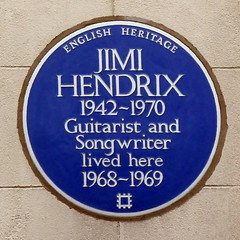
Hendrix lived here from 1968 to 1969. He famously described it as "the first real home of my own." The flat, above a small arcade of shops, is now open to visitors as a museum connected to Handel & Hendrix in London.
2. George Frideric Handel — 25 Brook Street, Mayfair (W1K 4HB)
Literally the building next door. Handel lived here from 1723 until his death in 1759 and composed Messiah on the premises. The juxtaposition — Baroque composer and psychedelic guitarist, one wall apart, separated by two centuries — is one of the most charming coincidences in London.
3. Charles Dickens — 48 Doughty Street, Bloomsbury (WC1N 2LX)
The only surviving London home of Dickens, where he wrote Oliver Twist and completed The Pickwick Papers. Now the Charles Dickens Museum, with much of the interior preserved.
4. Karl Marx — 28 Dean Street, Soho (W1D 3RW)
Marx lived on Dean Street between 1851 and 1856, in grinding poverty, while beginning work on Das Kapital. Three of his children died in the flat. The plaque is tucked above what is now a restaurant.
5. Sylvia Plath — 3 Chalcot Square, Primrose Hill (NW1 8YB)
Plath lived here with Ted Hughes from 1960 to 1961. A second plaque for Plath exists at 23 Fitzroy Road in Primrose Hill, where she died in 1963 — by historical coincidence also a former home of W. B. Yeats.
6. Virginia Woolf — 29 Fitzroy Square, Fitzrovia (W1T 6LG)

Woolf lived here from 1907 to 1911. The same square was also home, at different times, to George Bernard Shaw — a density of Bloomsbury-adjacent talent that rewards slow walking.
7. Wolfgang Amadeus Mozart — 180 Ebury Street, Belgravia (SW1W 8UP)
Mozart composed his first symphony here in 1764 at the age of eight. The plaque is easy to miss on a busy residential street — which is exactly the point.
8. Florence Nightingale — 10 South Street, Mayfair (W1K 1DF)
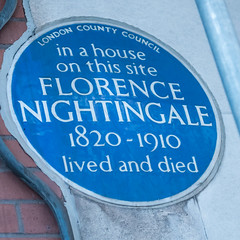
Nightingale lived at this address from 1865 until her death in 1910, continuing to influence public health policy from her bed well into the 20th century.
9. Sigmund Freud — 20 Maresfield Gardens, Hampstead (NW3 5SX)

Freud's final home, where he lived for the last year of his life after fleeing Vienna in 1938. Now the Freud Museum London, with his study preserved as he left it.
10. Winston Churchill — 28 Hyde Park Gate, Kensington (SW7 5DJ)
Churchill lived here from 1945 until his death in 1965. The house is still a private residence, which somehow makes the plaque more affecting than the grander Churchill sites across the city.
A Self-Guided Blue Plaque Walk: Central London in 90 Minutes
If you only have one afternoon, this is the route that packs the most in. It threads together Mayfair, Marylebone and Fitzrovia — arguably the three densest Blue Plaque boroughs in the city — in a loop of roughly three miles and eight to twelve notable plaques depending on your pace.
Start: Bond Street tube station (Jubilee / Central / Elizabeth lines).
- Walk east along Brook Street — Handel (25) and Hendrix (23) within 30 seconds of each other.
- South on Davies Street, west on Grosvenor Street — takes you past several 19th-century political figures.
- North into Marylebone via Wigmore Street — you'll catch Sir Charles Lyell (geologist) and others as you climb Harley Street.
- Cross Marylebone Road into Fitzrovia. Charlotte Street and Fitzroy Square deliver Woolf, Shaw, and a dense cluster of Bloomsbury-adjacent names in a few minutes.
- Finish at Tottenham Court Road station via the southern edge of Fitzrovia, through Rathbone Place and Percy Street.
For a slower version, drop into Wallace Collection or Handel & Hendrix as punctuation points. For a literary-weighted version, start at Russell Square and walk west through Bloomsbury first.
This kind of self-guided walking tour of London is genuinely how the city is best seen — slowly, on foot, with a reason to look up.
How to Find Blue Plaques in London
There is no single "master list" hanging on the wall somewhere. You find Blue Plaques through a few complementary tools:
- English Heritage's online search — authoritative for official Blue Plaques, but limited to the English Heritage scheme.
- Open Plaques (openplaques.org) — an open dataset covering English Heritage, LCC/GLC legacy plaques, and most borough schemes. Broader but less curated.
- Ordnance Survey maps — some paper maps mark the most significant plaques.
- The Legacy interactive map — plots all 1,625+ plaques in the city with search by person, theme, and location. Filter by "within 10 minutes walk" of your postcode and you'll see why London is saturated.
For a specific named plaque — "Jimi Hendrix blue plaque," "Charles Dickens blue plaque" — every search engine now resolves the exact address immediately. The harder questions are the discovery ones: which plaques are near me? and what have I already seen?
How to Track the Blue Plaques You've Visited
Once you start noticing Blue Plaques, you stop being able to stop. The scheme turns ordinary London streets into a game with 1,625 hidden pieces. Most people visit their first few by accident — "oh, look" — and then want a way to keep score.
That's what Legacy is for. It's a phone app that maps every Blue Plaque in London, lets you check them off as you find them, saves photos and notes to your personal collection, and suggests short walking routes from wherever you happen to be standing. If you run or walk in London with any regularity, it converts that time into something additive — you're not just moving, you're slowly building a catalogue of the city you live in.
You can explore the plaques on the web or download Legacy on the App Store to start tracking them on your phone.
The scheme is now in its 160th year. The plaques that went up in the 1870s to people who seemed important then have, in many cases, faded into minor historical curiosity. The plaques that went up last year to people most of us still remember will, in another century, feel the same way. That slow layering of memory — of who a city decides to commemorate, and who it quietly lets go — is one of the things that makes walking past a Blue Plaque feel different from walking past a statue. Start looking, and London gets bigger in every direction.