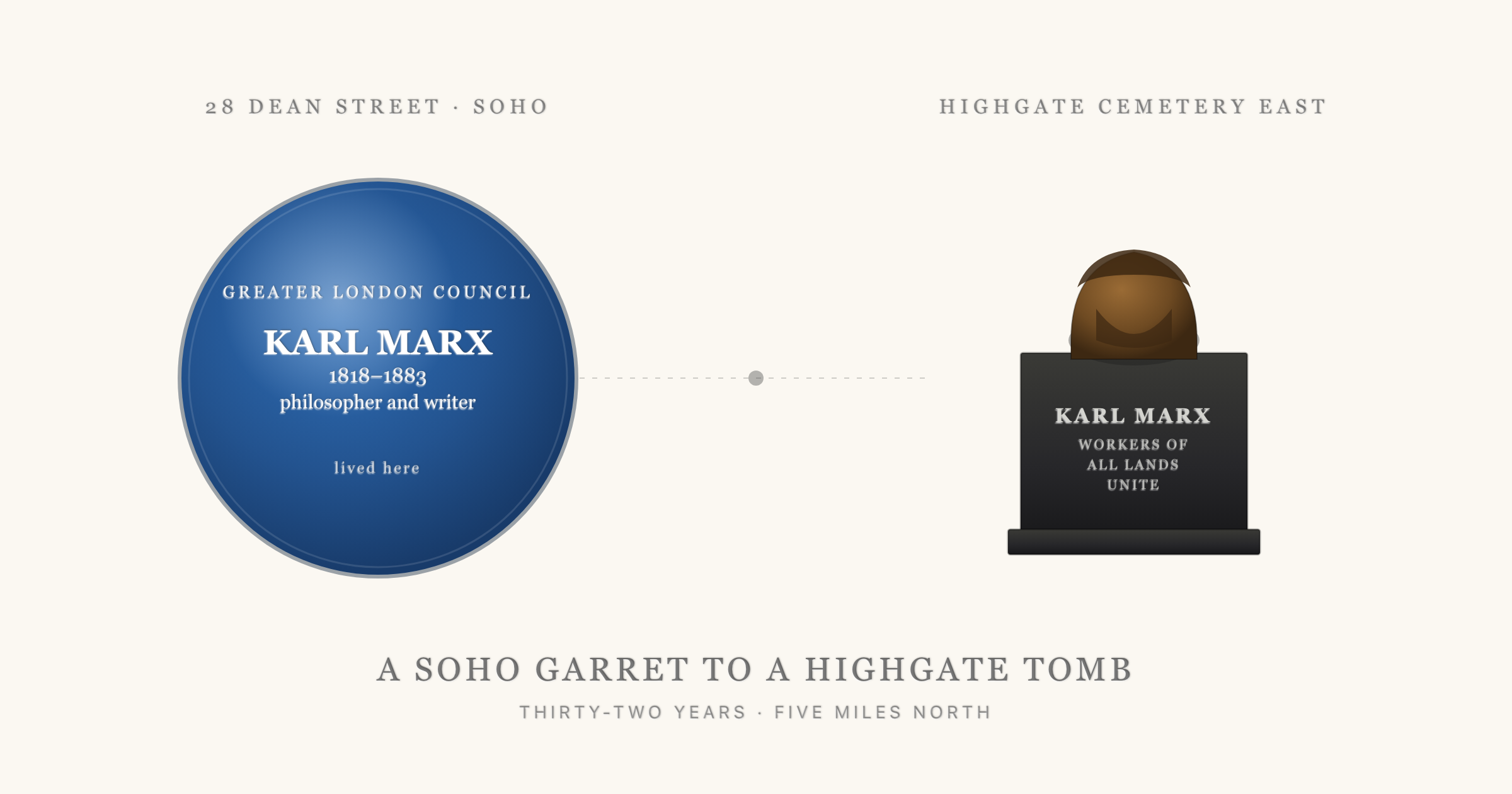
Karl Marx's grave at Highgate Cemetery East is a granite plinth, about twelve feet tall, topped with a bronze bust of the man himself, set on a quiet path lined with London plane trees. The inscription on the plinth reads "WORKERS OF ALL LANDS UNITE", and below it, "THE PHILOSOPHERS HAVE ONLY INTERPRETED THE WORLD IN VARIOUS WAYS. THE POINT HOWEVER IS TO CHANGE IT." The grave is one of the most-visited tombs in London, and for many visitors it is the entire reason they cross the city to reach Highgate. What most of them do not know is that this is not where Marx was originally buried, that the monument was built seventy-three years after his death, and that the most poignant Marx site in London is not the grave at all but a peeling blue plaque on a Soho restaurant five miles south.
This guide covers Karl Marx's grave at Highgate Cemetery East as it stands today, the practical details of visiting (which entrance, which ticket, which side of the cemetery), the history of how the grave became the monument, and a walking pairing with the Marx blue plaque on Dean Street, Soho, which together let you see the bookends of Marx's London life. Marx lived in this city for the last thirty-four years of his life. Highgate is where he ended up. Soho is where the work happened.
Finding Karl Marx's Grave at Highgate Cemetery
The first thing visitors get wrong about Marx's grave is which side of the cemetery to go to. Highgate Cemetery is split in two by Swain's Lane. The famous Egyptian-revival side, the one with the spiralling Lebanon Circle and the Terrace Catacombs that appears in every gothic London documentary, is Highgate Cemetery West. Marx is not there. The grave is in Highgate Cemetery East, on the opposite side of the lane.
The East cemetery is a separate ticket. As of 2026 the entry fee for the East side is around £10 per adult, with concessions for under-18s and a combined ticket option if you want to do both sides on the same visit. Tickets can be bought on the door but at peak times (summer weekends, the anniversary of Marx's death on 14 March) it is wise to pre-book through the Friends of Highgate Cemetery Trust website. The East entrance is on Swain's Lane, almost opposite the West gates.
Once inside, the route to Marx's grave is well-signposted. From the East entrance, walk straight ahead up the central path for about three minutes. The monument is on the left, set slightly back, and unmissable. It is by some margin the largest single grave marker in the East cemetery, partly because of its physical size and partly because it sits in its own widened plot, the result of a consolidation in 1954 that grouped Marx and his immediate family into one site.
The bronze bust at the top is by the British sculptor Laurence Bradshaw and depicts Marx in his late-period mode, full-bearded, looking outward and very slightly upward. The plinth below carries the family names: Karl Marx (1818-1883), his wife Jenny von Westphalen (1814-1881), his grandson Harry Longuet (1878-1883), his daughter Eleanor Marx (1855-1898), and Helene Demuth (1820-1890), the family's lifelong housekeeper.
What the Original Marx Grave Looked Like
Marx died on 14 March 1883 at his last home, 41 Maitland Park Road in Kentish Town, of complications from chronic bronchitis and a long-untreated pleurisy. Eleven people attended his funeral on 17 March, including Friedrich Engels, who delivered the graveside oration. Marx was buried in an unmarked grave on a small plot in the East cemetery purchased by the family. Jenny had been buried in the same plot two years earlier.
The original marker was modest: a small stone with the family names. Engels had wanted it that way, as had Marx himself. The location was relatively obscure, off the main path, and for the first seven decades after Marx's death the grave was visited by family members, occasional pilgrims, and very few others. Photographs from the 1920s and 1930s show a quiet, slightly overgrown plot, no different in scale from the surrounding Victorian graves.
The current monument is from 1956. The Communist Party of Great Britain commissioned it, paid for it through a public appeal, and arranged its installation on a different, larger plot than the original burial site. The remains of Marx, Jenny, Eleanor, and Helene Demuth were moved to the new location at the same time. So the bronze bust and the inscribed plinth that visitors see today sit on top of a re-interment, not the original grave.
This matters historically because the choice of monument was deliberately political. Bradshaw's bust depicts a heroic, public Marx, gazing into the future, the iconography of mid-century Soviet-aligned communism. It is not the grave that the Marx family or Engels would have chosen. It is a 1950s political statement built on top of an 1880s family grave.
The Soho Connection: 28 Dean Street and the Years That Made Capital
The walking pairing that makes Marx's London visible is the Karl Marx blue plaque at 28 Dean Street in Soho. The plaque is on the wall above what is now Quo Vadis, an Italian restaurant that has occupied the ground floor of the building in various forms since the 1920s. The plaque is at first-floor level and reads, in the standard Greater London Council format, "KARL MARX 1818-1883 PHILOSOPHER lived here 1851-1856".
The five years Marx and his family spent at 28 Dean Street were the worst years of his life and the most productive. The family lived in two rooms on the upper floors, in poverty so severe that two of their seven children, Henry Edward Guido and Franziska, died there of malnutrition-related illness in 1850 and 1852 respectively. The Prussian secret police had a spy on Dean Street through most of this period and his reports survive in the Berlin archives. They describe a chaotic flat covered in books, manuscripts, half-eaten food, and broken toys. The spy noted that Marx worked through the night at the British Museum Reading Room and slept in the day.
That British Museum work was the foundation of Capital. Marx was at the Reading Room (then in the centre of Bloomsbury, now relocated to St Pancras) almost every day from 1851 onwards, reading economic history, parliamentary blue books, factory inspectors' reports, and the entire English-language literature on industrial capitalism. The first volume of Capital, published in 1867, is essentially the digested output of those Bloomsbury reading sessions, written up in the Dean Street rooms or in the slightly less awful flat at 9 Grafton Terrace in Kentish Town that the family moved to in 1856.
The Soho years are the Marx that visitors to Highgate rarely picture. The Highgate monument shows the heroic public Marx. The Dean Street plaque marks the actual life: cramped, grieving, broke, and writing.
The Walking Route: Soho to Kentish Town to Highgate
The pilgrimage route, if you have a half-day and reasonable shoes, follows Marx's London life chronologically. Total walking distance is about five miles, which works as a long Sunday-morning walk with a cafe break in Camden.
Start at 28 Dean Street, Soho. The blue plaque is on the front of Quo Vadis. Around the corner on Greek Street is the French House, a pub that was there in Marx's day and still serves now. Soho in the 1850s was a dense quarter of European exiles, with German, French, Italian, and Polish refugees from the failed 1848 revolutions clustered in the streets between Oxford Street and Shaftesbury Avenue. Marx was one of dozens of revolutionary writers in those few blocks.
Walk north through Bloomsbury. Pass the British Museum (the Reading Room is no longer in use as a library but the building is open to visitors during museum hours). Continue up Russell Square and Tavistock Square. Marx's first Bloomsbury address was 64 Dean Street, briefly, in 1849 before moving to number 28.
Continue through Camden Town to Kentish Town. 9 Grafton Terrace, off Malden Road, is the second Marx London home, where he lived from 1856 to 1864. The family was still poor here but no longer in two rooms. There is no plaque on Grafton Terrace; the original house numbering has changed and the street has been substantially redeveloped.
End at 41 Maitland Park Road, Belsize Park. The family's last London home, where Marx died in 1883. The original house is gone, redeveloped in the 1960s. There is no plaque on the current building, though the local history society have lobbied for one.
Then Highgate Cemetery East. From Maitland Park Road, the cemetery is about a 25-minute walk north up Haverstock Hill and across to Swain's Lane. The grave is a few minutes inside the East entrance.
The whole route is doable in about three to four hours including stops. It is also one of the most coherent biographical walks possible in London for any major historical figure: you can stand in the room where Marx wrote the first drafts of Capital, the street where he moved when things got slightly better, the road where he died, and the grave where he ended up, all in one morning.
Practical Notes for Visiting Highgate
A few details that will save the visit from being annoying:
Opening hours. Highgate East opens at around 10am and closes at 4pm or 5pm depending on the season. Last entry is typically 30 minutes before close. Check the Friends of Highgate Cemetery Trust website on the day of the visit; emergency closures (weather, conservation work, filming) are not unusual.
Photography. Personal photography is allowed in both East and West cemeteries. Tripods, drones, and commercial photography require permission. Be respectful of any active funerals, which still happen at Highgate (it is a working cemetery, not a museum).
Combining East and West. The combined ticket lets you do both cemeteries on the same day. The West side is by guided tour only; the East side is free-roam. The tours fill up, especially at weekends. If your only goal is the Marx grave, East is enough. If you want the full Highgate experience (Egyptian Avenue, Lebanon Circle, the Beer Mausoleum), the West tour is necessary.
Other notable East graves. While at the East cemetery, the obvious Marx-adjacent graves include George Eliot (the writer Mary Ann Evans, buried under her pen name on the path leading to Marx), Eric Hobsbawm (the historian, buried near Marx in 2012), and Malcolm McLaren (the Sex Pistols manager, also nearby). The clustering is partly accidental, partly by request.
Anniversary visits. Marx died on 14 March 1883. The cemetery sees its peak Marx visitor numbers each year around this date, including occasional brief commemorations laid on by trade unions and political organisations. If you want a quiet visit, avoid the week around 14 March. If you want to see the grave at its most visited and most decorated, that is the day.
Why the Pairing Matters
The Highgate monument was built to make Marx's grave look the way the 1950s wanted his memory to look: monumental, public, heroic, finished. The Dean Street plaque marks something quieter and more honest. A house where a man with no money, two dead children, and an extraordinary work in progress sat up at night reading factory reports. Walking from one to the other, in that order, restores the proportions.
If you want to find more London history through the city's blue plaque network, the Legacy app maps all 1,625-plus London plaques onto your routes. Filter by neighborhood (Soho has more plaques per square mile than almost anywhere else in the city), by era (the Victorian wave is the largest), or by theme (the political-thinkers cluster in Bloomsbury and Camden is one of the most rewarding to walk). Marx is one of perhaps thirty exiles, refugees, and revolutionary writers commemorated in central London. The Dean Street plaque is the gateway to a much wider walking history.
The bronze bust at Highgate gets the photographs. The Soho plaque gets you the man.