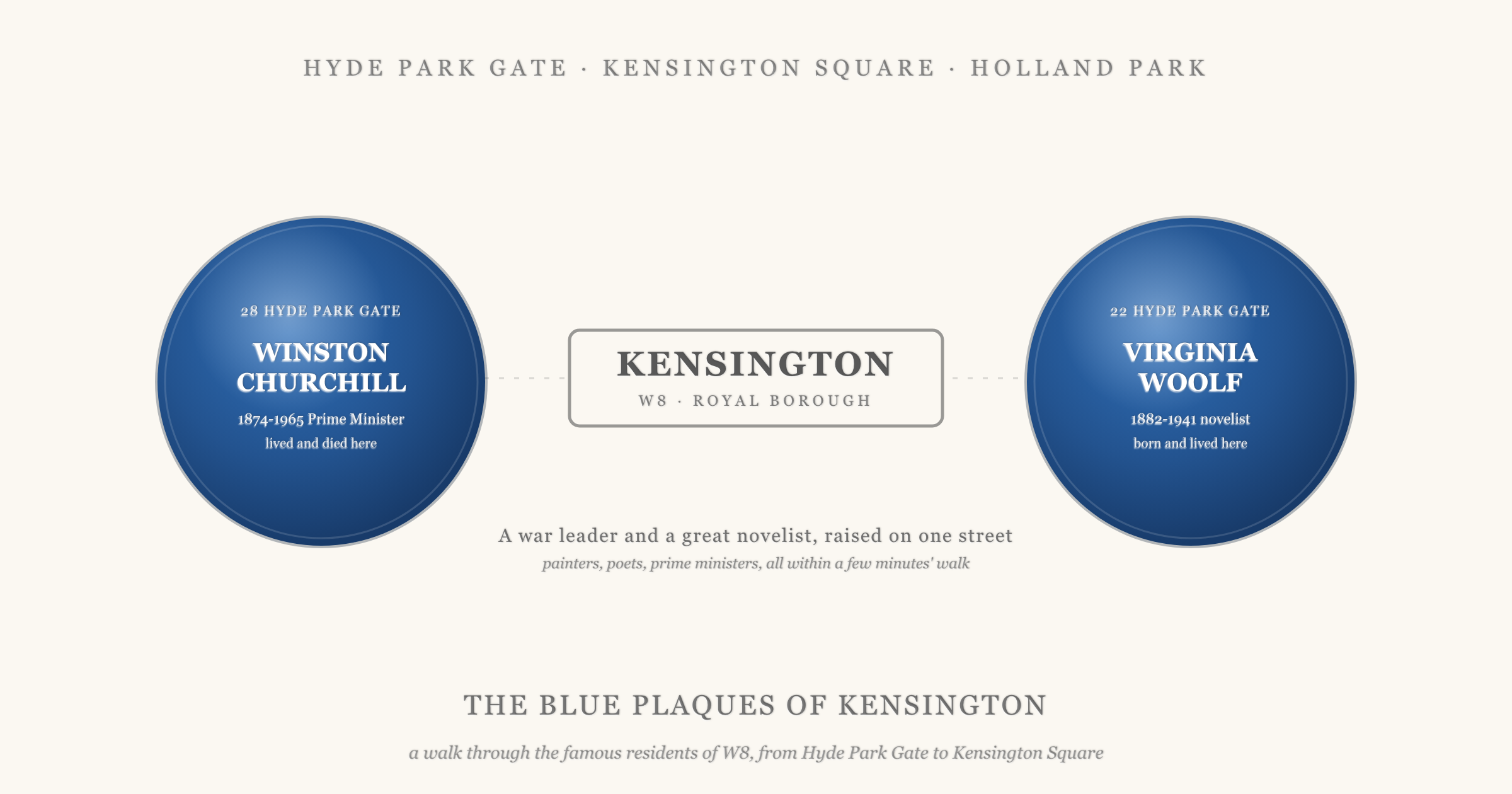
Kensington is one of the most plaque-dense corners of London, a royal borough of white stucco terraces and red-brick artists' houses where prime ministers, painters, and poets have lived almost on top of one another for two centuries. Walk it with an eye on the walls and you find a roll-call of British culture: a wartime leader and the novelist who reinvented the novel born on the same short street, the great Victorian painters who built their studios here, and two of the most important poets of the twentieth century a few minutes apart. This is a walking guide to the blue plaques of Kensington, W8, arranged so you can follow them from the grand houses of Hyde Park Gate to the quiet garden of Kensington Square.
For the wider scheme and how to read the markers, our complete guide to London's blue plaques is the place to start. Here, the focus stays inside Kensington.
Hyde Park Gate: Churchill and the Stephen Sisters
No street in Kensington carries more history per yard than Hyde Park Gate, a pair of quiet cul-de-sacs off Kensington Road. At 28 Hyde Park Gate, Sir Winston Churchill lived for the last fifteen years of his life and died in 1965; the plaque records simply that the prime minister "lived and died here." We follow his wider London in our guide to Winston Churchill's London.
A few doors away, at 22 Hyde Park Gate, stood the childhood home of one of the most influential families in modern British culture. The house was home to the Stephen family, and it was here that Virginia Woolf (born Virginia Stephen) and her sister, the painter Vanessa Bell, were born and raised, alongside their father, the scholar Sir Leslie Stephen, who also has a plaque on the house. The sisters would go on to be at the heart of the Bloomsbury Group, the circle of writers and artists who reshaped English literature and art in the early twentieth century. That a war leader and the woman who wrote Mrs Dalloway spent formative years on the same Kensington cul-de-sac is the kind of coincidence the borough specialises in.
Kensington Square and Young Street: The Novelists
South of the High Street lies Kensington Square, one of the oldest squares in London, laid out in the 1680s and still ringed with handsome houses carrying plaques. Around its edges and the streets nearby, the great Victorian novelists lived and worked.
At 16 Young Street, just off the square, William Makepeace Thackeray lived and wrote Vanity Fair, the satirical masterpiece that made his name; he was so proud of the book that he is said to have doffed his hat to the house in later years. He has a second Kensington plaque at 2 Palace Green, the grand house he built nearby. On the square itself, at 41 Kensington Square, the Pre-Raphaelite painter Sir Edward Burne-Jones lived in the 1860s, one of several great artists drawn to the light and space of Kensington.
The Painters' Kensington
In the second half of the nineteenth century, Kensington became the home of Britain's most successful artists, who built grand studio-houses here to live and work in. The plaques trace an entire artistic colony.
At 2 Palace Gate, Sir John Everett Millais, a founder of the Pre-Raphaelite Brotherhood and later President of the Royal Academy, "lived and died here" in a vast purpose-built house. A short walk away, at 12 Holland Park Road, Lord Leighton, the most celebrated painter of the age and the only artist ever made a peer, lived and died in the extraordinary palace of art he created, now open to visitors as a museum; we tell its full story in our guide to Leighton House. Nearby at 13 Holland Street lived the artist and illustrator Walter Crane, and at 18 Stafford Terrace the Punch cartoonist Edward Linley Sambourne kept the richly decorated home that survives, almost untouched, as a museum of late-Victorian taste. Together these houses made Kensington the artistic capital of Victorian London.
The Poets: Ezra Pound and T. S. Eliot
Kensington's literary importance did not end with the Victorians. In the years before the First World War, the American poet Ezra Pound lived at 10 Kensington Church Walk, a tiny lane behind the High Street, and from these modest rooms he helped launch the modernist revolution in poetry, championing the young writers who would change literature. Among the poets in his orbit was another American in London, T. S. Eliot, the author of The Waste Land and Four Quartets, who lived for decades at 3 Kensington Court Gardens, where he died in 1965. Two of the towering figures of modernist poetry, both adopted Londoners, both Kensington residents: the borough quietly shaped the course of twentieth-century writing.
Chesterton's Kensington
The writer and critic G. K. Chesterton, creator of the Father Brown detective stories and one of the most quotable essayists in the language, was a Kensington man through and through. He was born at 32 Sheffield Terrace in 1874, and later lived at 11 Warwick Gardens; his fantastical novel The Napoleon of Notting Hill is steeped in the streets of west London he knew. Sheffield Terrace has a second literary claim, too: a little along the same street, at number 58, the detective novelist Agatha Christie lived during her most productive years, a story we follow in Agatha Christie's London. For a street most visitors walk past, Sheffield Terrace has launched a remarkable amount of crime and fantasy fiction.
A Suggested Walking Route
Kensington rewards a slow wander, and you can take in the highlights in a couple of hours.
- Hyde Park Gate. Begin with Churchill at number 28 and the Stephen family home, birthplace of Virginia Woolf and Vanessa Bell, at number 22.
- Palace Gate and Holland Park. Walk west past Millais's house to Leighton House and the artists' quarter.
- Kensington Church Walk. Drop behind the High Street to Ezra Pound's lane.
- Kensington Square and Young Street. Finish at the old square, with Thackeray's house and Burne-Jones's, taking in Sheffield Terrace and Chesterton on the way.
It is a route that moves from politics to painting to poetry without ever leaving one small, extraordinary borough.
Discover the Plaques Yourself
Kensington's plaques are part of a far larger web of markers across London, recording where its writers, painters, and statesmen lived and worked. Tracing them turns a walk through W8 into a walk through the making of modern British culture, from a war leader's last home to the rooms where modern poetry was born. The Legacy app maps every blue plaque in the city, with the full inscription and the history behind it, so you can plan your own route, collect the ones you visit, and follow the trail onward, perhaps into the Bloomsbury Group's London or deeper into the complete guide to London's blue plaques. Start on Hyde Park Gate, and see where Kensington takes you.