Leighton House Museum sits at 12 Holland Park Road, a quiet side street in Kensington, West London, postcode W14. From the pavement it is a handsome but restrained red-brick Victorian house, the kind you might walk past on the way to Holland Park without a second glance. Step inside and it becomes one of the strangest and most beautiful interiors in London: a private palace of art built by one man, the painter Frederic Leighton, over thirty years, and crowned by a golden, domed, tile-lined room called the Arab Hall that has no real equal in the city. This is the guide to Leighton House: the artist who built it, the rooms that make it worth the trip, the colony of artists' studio-homes around it, and how to visit.
The house works because of a contradiction at its heart. Leighton, who became President of the Royal Academy and was made a lord the day before he died, built lavish public rooms for entertaining and painting, then slept in a single narrow bedroom as plain as a monk's cell. The opulence was for the art and the audience. The man himself lived simply behind it. Once you know that, the whole house reads differently.
Who Was Frederic Leighton?
Frederic Leighton (1830 to 1896) was, for the last decades of the Victorian era, about as established as a British artist could be. He trained on the continent, painted in a polished classical style full of drapery, marble, and figures from Greek myth, and rose to become President of the Royal Academy in 1878, a post he held until his death. He was knighted, then made a baronet, and his large set-piece canvases like Flaming June are still the images most people picture when they imagine high Victorian painting.
He never married and had no children. The house on Holland Park Road was not a family home; it was a working studio and a stage for the social side of an artist's career, the place where collectors, sitters, and fellow Academicians came to see new work. That single fact shapes everything about the building. There are no nurseries, no family wings, no compromises for domestic life. Every room is bent toward art and display, which is exactly why it survives as such a pure example of the Victorian artist-house.
The Arab Hall: The Room That Makes the House
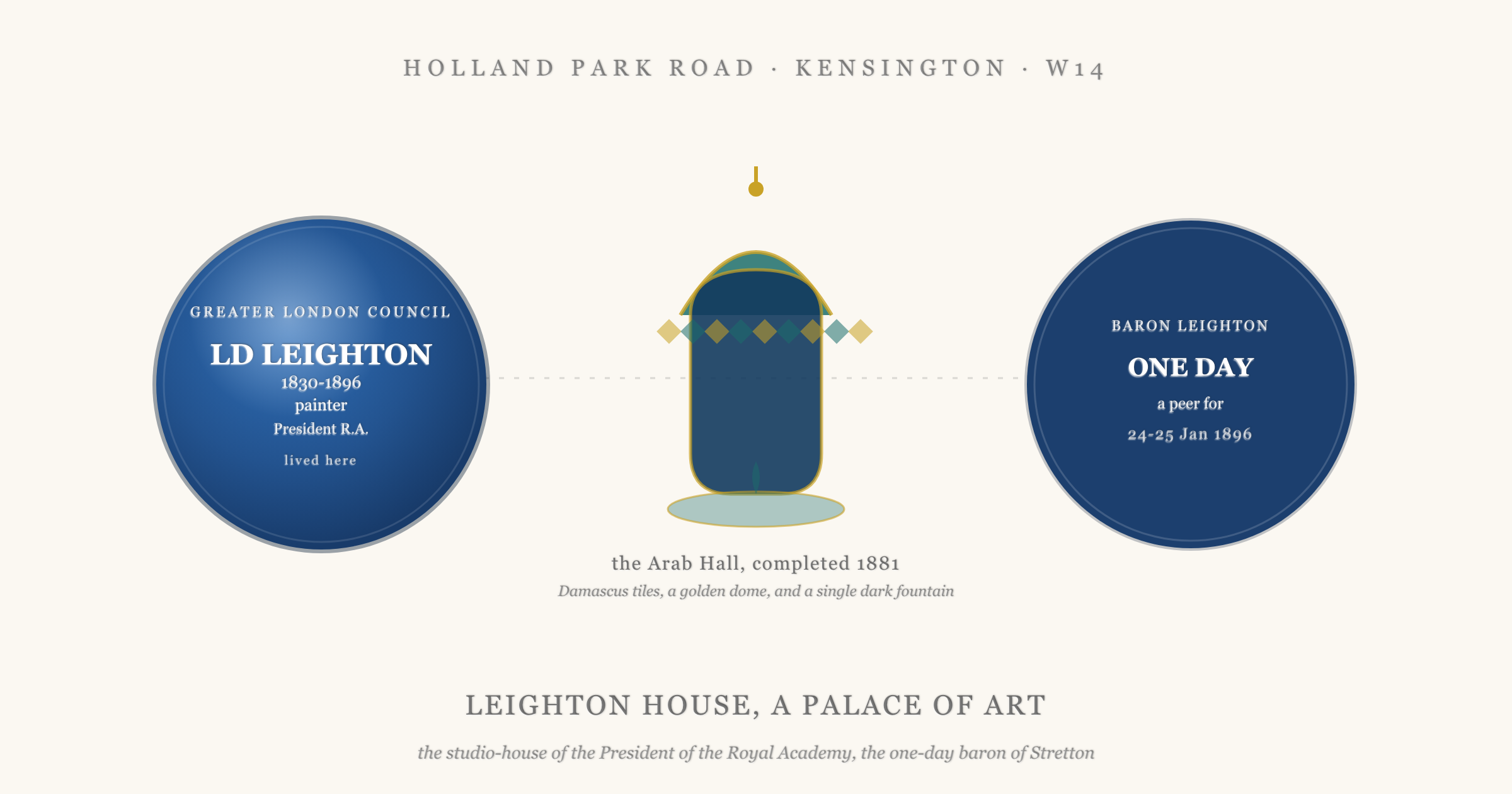
If Leighton House is famous for one thing, it is the Arab Hall, added between 1877 and 1881. Leighton had travelled in the Middle East and been captivated by Islamic architecture, in particular the Norman-Arab palaces of Sicily, and he set out to build a room to hold the collection of antique tiles he had gathered on his journeys. The result is the closest thing London has to a fragment of Damascus dropped into a Kensington terrace.
The hall is square, with a tall gilded dome, walls lined floor to height with 16th and 17th century ceramic tiles from Damascus, Iznik, and Cairo, latticework windows of carved wood, and a single dark marble fountain set into the floor at the centre. The trickle of water was deliberate, an old device for cooling and calming a room. A gilded mosaic frieze by the artist Walter Crane runs above the tiles, and the ceramicist William De Morgan helped arrange the antique tiles and supplied his own lustreware where the originals fell short. The overall effect is dim, gold, and otherworldly, a complete change of register from the polite brick exterior.
It is genuinely one of the great interiors in London, and it is the reason most people search for Leighton House in the first place. Photographs undersell it, because so much of the effect is the low light, the sound of the water, and the way the gold catches as you move.
The Rest of the House
The Arab Hall is the showpiece, but the house rewards the full visit. The ground floor rooms, including the Narcissus Hall named for a bronze cast that stands in it, carry the same deep, saturated colour schemes that the recent restoration brought back: ebonised woodwork, peacock blues, and walls hung with paintings.
Upstairs is the great studio, the actual engine of the house. It is a vast, north-lit room running much of the building's width, with a huge window for steady painting light, a small apse, and a gilded dome of its own. This is where Leighton produced the enormous canvases that went off to the Royal Academy each year. Standing in it, you understand that the whole house was built outward from the need for a serious working space, with the social rooms arranged around it.
And then there is the bedroom, which surprises everyone. After all the gold and tilework, Leighton's own sleeping quarters are tiny and austere, a single bed in a plain room. The contrast is the point. The palace was for the art and the public. The man lived like an ascetic in the middle of it.
The Holland Park Circle
Leighton House did not appear in isolation. In the 1860s and 1870s a cluster of wealthy, successful artists chose this corner of Kensington and built bespoke studio-houses near one another, a group later nicknamed the Holland Park Circle. The painter Val Prinsep built next door at 14 Holland Park Road. Nearby on Melbury Road came the homes of Marcus Stone and Luke Fildes, the latter designed by the architect Norman Shaw, and the spectacular Tower House built by the Gothic Revival architect William Burges for himself.
These were not bohemian garrets. They were statements, large purpose-built houses that announced their owners had arrived. Most have since passed into private hands and cannot be visited. Leighton House is the one you can walk into, which makes it the surviving doorway into a whole vanished world of late-Victorian artistic Kensington. If you enjoy tracing these clusters of creative London, the way the Bloomsbury Group's plaques map a literary set across a few squares, the Holland Park Circle is the painters' equivalent a couple of miles west.
The One-Day Baron
Leighton's death came with a peculiar distinction. On 24 January 1896 he was raised to the peerage as Baron Leighton of Stretton, the first and only British painter ever to be made a hereditary lord. He died the very next day, 25 January 1896, which means his barony lasted a single day, the shortest-lived peerage in British history. Because he had no heirs, the title died with him within twenty-four hours of being created.
He was buried in St Paul's Cathedral, among the national figures of the age. The house, his real monument, passed through various hands and uses across the twentieth century before becoming the museum it is today. The blue plaque on the wall outside marks the address for the casual passer-by; the building behind it tells the longer story.
Visiting Leighton House
Leighton House is run as a museum by the Royal Borough of Kensington and Chelsea, and after a major restoration completed in 2022 it reopened with its historic colour schemes returned, a new wing, and rooms that had long been off the public route brought back into the tour. It is one of the most rewarding small museums in London precisely because it is a single artist's complete vision rather than a collection assembled later.
A few practical notes:
- Where it is. 12 Holland Park Road, Kensington, London W14. The nearest Underground stations are High Street Kensington and Holland Park, each a walk of roughly ten to fifteen minutes, and Holland Park itself is right beside it if you want to make a half-day of it.
- Tickets. Entry is ticketed, and timed tickets are sensible because the rooms, especially the Arab Hall, are not large. Booking ahead is the safe move at weekends.
- When. Opening days and times do change, and the museum is usually closed one day a week, so check the official Leighton House website for current hours before you travel.
- How long. Give yourself an hour to ninety minutes inside, more if you linger in the studio and the Arab Hall, which you will.
For the practical details and to book, the official Leighton House museum site is the place to go. For the wider picture of who lived where in this part of London, our interactive map of London's blue plaques plots Leighton and his Holland Park neighbours alongside the rest of the city's commemorated residents, so you can build a Kensington walk that takes in the painters' houses, the grand mansions like Apsley House, and the green sweep of Holland Park in a single afternoon.
Leighton House is the rare museum where the building is the masterpiece. Go for the Arab Hall, stay for the studio, and remember as you leave that the man who dreamed all of it up was a lord for exactly one day.