Agatha Christie is the best-selling novelist of all time, outsold only by the Bible and Shakespeare, and the woman who gave the world Hercule Poirot, Miss Marple, and the most famous twist endings in fiction. She was born in Devon and her holiday home was on the river Dart, but the city where she lived, wrote, and is most visibly commemorated is London. Two blue plaques mark her homes in Kensington, a third marks the West End theatre where her play The Mousetrap has run continuously since 1952, and the streets between them trace the London of the Queen of Crime. This is the story of Agatha Christie's London, the addresses behind the plaques, and the real-life mystery she never explained.
For anyone tracing London's literary history, Christie belongs in the same company as Oscar Wilde and, fittingly for the inventor of so many detectives, the fictional resident of 221b Baker Street. The Legacy app maps every blue plaque in the city, with the inscription and the story behind each one.
The Queen of Crime
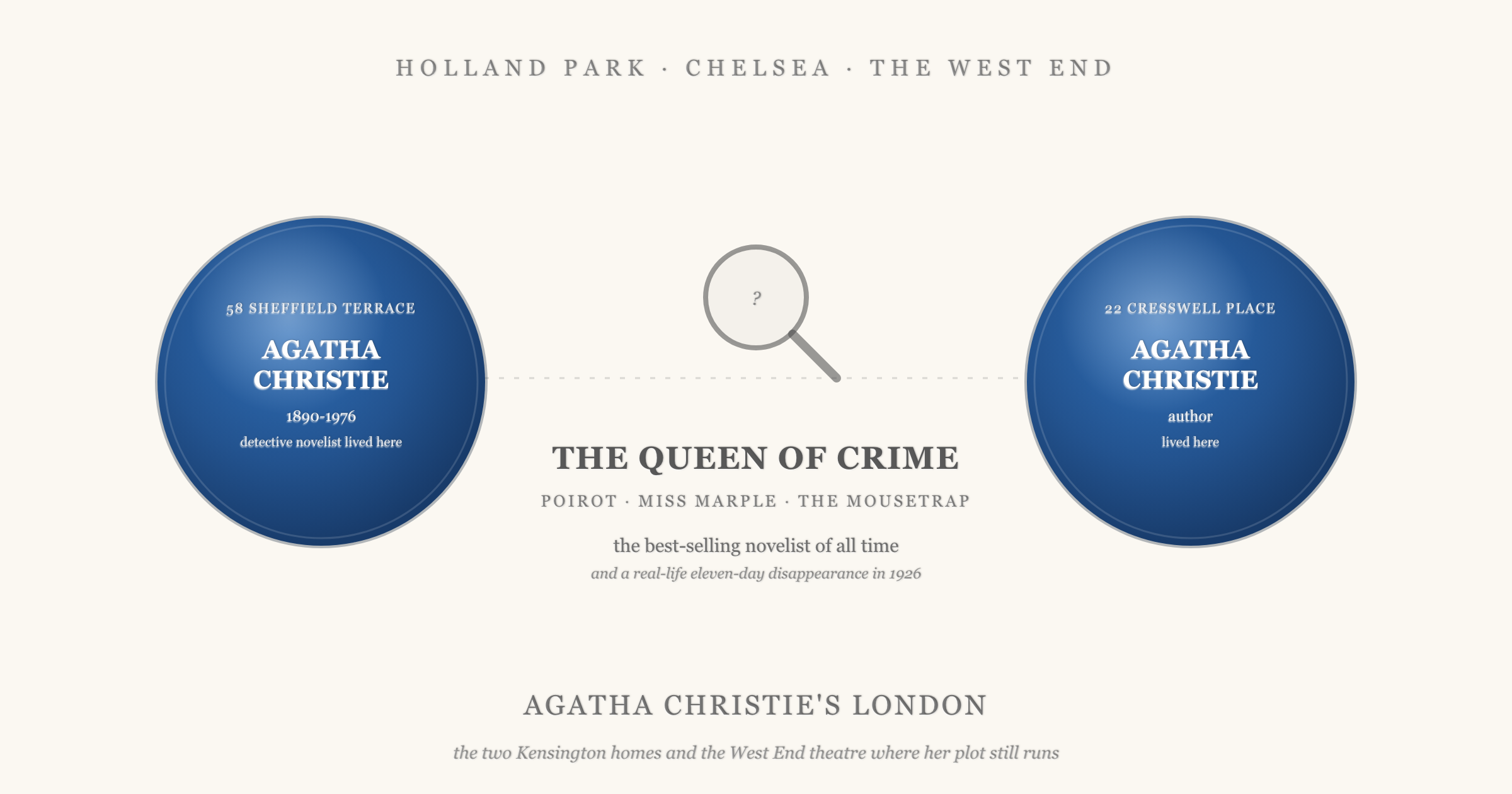
Born Agatha Miller in Torquay in 1890, Christie published her first novel, "The Mysterious Affair at Styles," in 1920, introducing the fastidious Belgian detective Hercule Poirot and his "little grey cells." A decade later, in "The Murder at the Vicarage," she introduced Miss Marple, the deceptively gentle village spinster whose knowledge of human nature solves what the police cannot. Over a career of more than fifty years she wrote sixty-six detective novels and fourteen short-story collections, and her books have sold an estimated two billion copies in more than a hundred languages.
She was also a playwright, and one play in particular made history. But to understand her London, start where she did most of her writing: a quiet street in Holland Park.
58 Sheffield Terrace: Where She Wrote at Her Peak
The first and most important of Christie's London blue plaques is in Holland Park, on the wall of 58 Sheffield Terrace, where she lived from 1934 to 1941. The English Heritage plaque, put up in 2001, calls her a "detective novelist and playwright," and the years it records cover one of the most productive periods of her life.
This was Christie at her peak. By the mid-1930s she was internationally famous, recently remarried to the archaeologist Sir Max Mallowan, and writing prolifically. In the Sheffield Terrace house she insisted on a room of her own purely for work, a private study with a large table and a hard chair, no telephone, and as few distractions as possible. The books she produced during these years include some of her most celebrated, and her marriage to Mallowan took her on regular expeditions to archaeological digs in the Middle East, journeys that gave her the settings for "Murder on the Orient Express," "Death on the Nile," and "Murder in Mesopotamia." The Holland Park house was damaged during the Blitz, and Christie left in 1941, spending much of the rest of the war in a flat in Hampstead.
22 Cresswell Place: The Mews House in Chelsea
Christie owned several London properties over her life, and a second blue plaque, reading simply "Dame Agatha Christie 1890-1976 author lived here," marks 22 Cresswell Place, a mews house near the Chelsea and South Kensington border, off the Old Brompton Road. Tucked into a cobbled mews, it is the more private and domestic of her two commemorated London homes, and it speaks to how thoroughly her life was woven into this corner of west London. Between Holland Park, Chelsea, and Kensington, Christie's London was emphatically a west-of-centre one, a world of quiet terraces and garden squares rather than the bustle of the centre.
St Martin's Theatre: The Play That Never Ends
Christie's third London plaque is not on a house but on a theatre, and it commemorates a record that may never be broken. The Mousetrap, her murder-mystery play, opened in the West End in 1952 and has been running ever since, making it by a vast margin the longest-running play in the history of theatre. Since 1974 it has been staged at St Martin's Theatre on West Street, just off Cambridge Circus, where a plaque marks the world-record run; the inscription notes the play's fiftieth-anniversary performance there in November 2002. It has now passed seventy years and tens of thousands of performances.
The Mousetrap comes with its own famous tradition: at the end of every performance, the audience is asked not to reveal the identity of the murderer, a secret kept by millions of theatregoers for over seventy years. Christie herself reportedly expected the play to run only a few months. That she was so spectacularly wrong is one of the happier mysteries of her career, and a visit to St Martin's Theatre, where the queue still forms nightly, is the most living of all her London landmarks.
The Disappearance of 1926
No account of Christie is complete without the one mystery she never solved on the page, because it happened to her. In December 1926, her life was in crisis: her mother had recently died, and her first husband, Archie Christie, had asked for a divorce, having fallen in love with another woman. One night Christie left her home, and her car was found abandoned the next morning near a chalk pit in Surrey, with no sign of her.
What followed was a national sensation. For eleven days she vanished completely, triggering one of the largest manhunts the country had seen, with thousands of police and volunteers searching the countryside and the newspapers running wild with theories of suicide, murder, and publicity stunt. She was eventually found, safe, at a spa hotel in Harrogate in Yorkshire, where she had checked in under an assumed name, the surname of her husband's mistress. Christie never publicly explained what had happened, and she left it out of her autobiography entirely. Whether it was a genuine psychological fugue brought on by grief and betrayal, a deliberate disappearance, or something in between has been argued over ever since. The greatest mystery writer of all time left her most personal mystery permanently unsolved.
A Walk Through Christie's London
Agatha Christie's London is a west-to-centre route that you can trace in an afternoon, ending, fittingly, with a play:
- 58 Sheffield Terrace, Holland Park. Start at the English Heritage blue plaque on the house where she wrote at her most prolific, in the private study she guarded so carefully.
- 22 Cresswell Place, Chelsea / South Kensington. Walk south to the second plaque, the quiet mews house that anchored her in this corner of London.
- St Martin's Theatre, West End. End in the theatreland off Cambridge Circus, where The Mousetrap has been running since 1952 and where, if you time it right, you can watch the longest-running play in the world and join the seventy-year conspiracy to keep its ending secret.
It is a route that takes you from the desk where the books were made to the stage where her work is still, every single night, performed live.
Discover the Plaques Yourself
Agatha Christie's plaques are part of a far larger web of markers recording where London's writers, artists, scientists, and reformers lived and worked. Tracing them turns an afternoon's walk into a literary detective story of its own, the kind Christie herself would have appreciated. The Legacy app maps every blue plaque in London, with the full inscription and the history behind it, so you can plan your own route, collect the ones you visit, and follow the trail from one famous resident to the next. Start with the Queen of Crime in Holland Park, and see where the city's plaques lead you, perhaps to the detective of Baker Street she was so often compared to, or deeper into literary London.