William Blake was born in Soho on 28 November 1757, lived almost the whole of his seventy years inside the bounds of London, and was buried in a dissenters' graveyard a mile from his birthplace. He is, by some distance, the most thoroughly London poet of the English language. The four English Heritage blue plaques and one further marker that record his addresses run in a clean geographic loop, from a Soho corner where the original house was demolished to a quiet Lambeth garden where he wrote "Jerusalem," through a Mayfair flat where he made the prophetic books, to a Hampstead house where he came to draw under the patronage of John Linnell, and finally to Bunhill Fields, where his actual grave has been marked, exactly, since 2018. Walked in order they trace the whole arc of his life.
This is the guide to William Blake's London. Five stops, two centuries of city change between them, and the books and pictures that were made at each address. If you want the route on the map with the inscription text and the historical context for every plaque, the Legacy app carries the whole network of London's blue plaques and lets you save the ones you have found.
A London Life, More or Less Whole
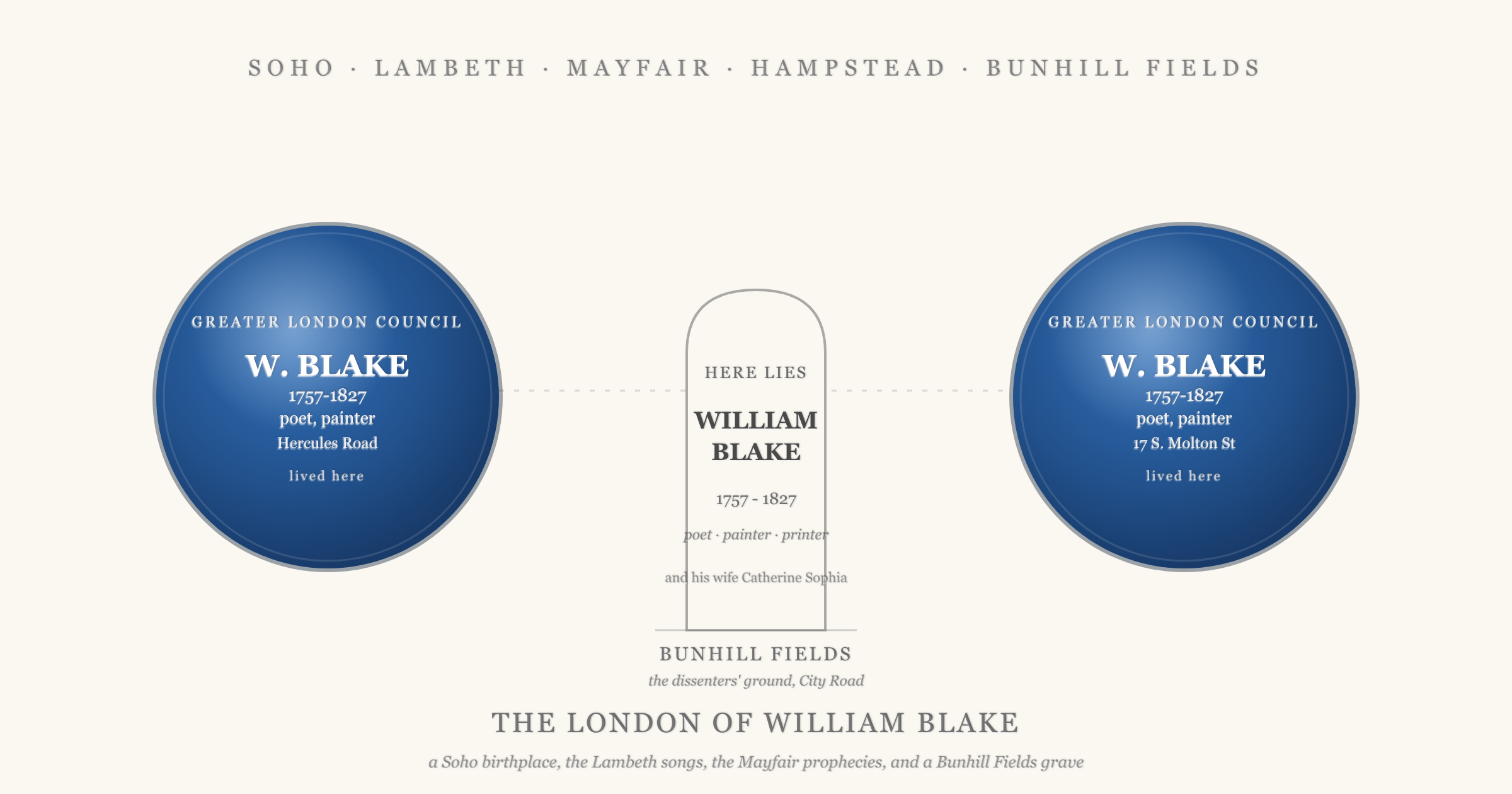
Five stops tell the story. Marshall Street in Soho marks where Blake was born, on a corner where the original house no longer stands. Hercules Road in Lambeth, south of the river, is where he and his wife Catherine spent the productive decade of the 1790s, the years that produced Songs of Innocence and of Experience, The Marriage of Heaven and Hell, and the preface to Milton that we now sing as "Jerusalem." 17 South Molton Street in Mayfair is where Blake returned to live from 1803 until shortly before his death in 1827, the address from which the great prophetic books Milton and Jerusalem were finally completed. Old Wyldes at North End, Hampstead, carries a plaque to the painter John Linnell that notes Blake's regular visits there in his last years. And Bunhill Fields, the City Road burying ground for English dissenters, holds his grave.
A note about the plaques themselves. Three are English Heritage blue plaques, in different physical forms because they were put up at different times under different versions of the scheme. The birthplace at Marshall Street is a Westminster City Council marker rather than the standard blue, because the original house went; the plaque is the next-best record the city could offer. The Bunhill Fields headstone, finally, is not part of the commemorative scheme but is a privately funded marker placed in 2018, after decades during which the exact location of Blake's grave was known only approximately.
Stop One: 28 Broad Street, Marked on Marshall Street, Soho
Blake was born above his father's hosiery shop at 28 Broad Street, a London address that was renumbered when the street was redeveloped and is today represented by 8 Marshall Street, just off Broadwick Street in Soho, a few minutes' walk from Oxford Street. The original house was demolished long ago; the white commemorative plaque on the modern building marks the site of the birthplace rather than a surviving structure.
That detail matters because it explains why the Soho stop feels slightly thin compared to the others. There is no Georgian house here to look up at, no original windows, no door he would have used. Soho changed almost completely between the eighteenth century and the present, and the Blake family's modest hosiery business was the kind of small commercial London that the Victorian and twentieth-century rebuildings cleared. What survives is the address, and a plaque that asks you to imagine the rest.
It is worth standing there anyway. Soho was the working London Blake grew up in, and his lifelong vision of the city, the streets and chimneys and "charter'd Thames" that fill the Songs and the prophetic books, started here. A short walk from Marshall Street through Carnaby Street, Golden Square, and onto Broadwick Street takes you through the streets the child Blake knew, even if the buildings have been re-laid around them.
Stop Two: Hercules Road, Lambeth, Where the Songs Were Written
In 1790 Blake and Catherine moved south of the river to a small house at 13 Hercules Road in Lambeth. The address is the second stop on the walk and, by any literary measure, the most important one. They stayed for ten years, and in that decade, in a Lambeth that was still semi-rural with cattle in the fields, William Blake produced almost all of the work for which most readers know his name.
The Lambeth output is staggering. Songs of Innocence (1789) was already published when he moved in, but Songs of Experience (1794) and the combined illuminated Songs of Innocence and of Experience (1794) were printed at Hercules Road. So were The Marriage of Heaven and Hell (1790–93), Visions of the Daughters of Albion (1793), America: A Prophecy (1793), Europe: A Prophecy (1794), The Book of Urizen (1794), The Book of Los (1795), and the great series of colour-printed monotypes that are now Tate Britain's most-photographed Blake holdings. The famous lyric we now call "Jerusalem," with its "And did those feet in ancient time," was written at the end of the Lambeth period as the preface to Milton. If you can name one thing William Blake made, the chances are it was made here.
The Hercules Road house itself is gone. The blue plaque, mounted on a block of flats called William Blake House on the site, records that "William Blake, poet and painter, lived in a house formerly on this site." The reference to "formerly on this site" is the giveaway: the original cottage was bombed during the Second World War. The garden at the back of the modern flats is now a small public space called Blake Gardens, with a stylised mural that quotes lines from the Songs on one wall. Lambeth has not let the address fade.
Stop Three: Fountain Court, Strand (No Plaque)
Between Lambeth and the final Mayfair years there is one address worth naming, even though there is no plaque to find. From 1803 until his death in 1827 Blake lived first at South Molton Street and then, for the final four years of his life, at 3 Fountain Court, a small alley off the Strand near Savoy Street. He died there on 12 August 1827, after a day spent finishing an engraving and, according to his wife Catherine, singing songs of his own composition. The Fountain Court building was demolished long ago and the spot is now Savoy Buildings or close to it, between the Strand and the river. There is no monument; this stop is a moment of pause on the walking route rather than a destination.
The reason to keep the death address in mind is that it ties Blake's geography back to the centre of London. He died not in some remote location but a few hundred yards from where Trafalgar Square now sits, in a corner of the West End. The London he knew was small and walkable, and his lodgings tracked the inner ring of the city throughout his life.
Stop Four: 17 South Molton Street, Mayfair, the Prophecies
In 1803 Blake and Catherine left Lambeth and took rooms at 17 South Molton Street, a narrow Mayfair lane that runs between Brook Street and Oxford Street. They stayed at the address for eighteen years, longer than anywhere else in his life. The English Heritage blue plaque on the modern building is one of the cleanest Blake markers in London, and the street remains roughly the kind of small commercial run it was in his lifetime, even now lined with boutiques.
The Mayfair years were when Blake finished the two great prophetic books. Milton: A Poem in 2 Books was begun at Lambeth and completed and printed at South Molton Street. Jerusalem: The Emanation of the Giant Albion, his last and longest illuminated work, was made there between roughly 1804 and 1820. He was also working, in the same room, on the watercolour illustrations to The Book of Job and to Dante's Divine Comedy that John Linnell commissioned in the 1820s and that became the visual masterpieces of his old age.
The Mayfair address is the most rewarding of the plaques to visit, because the building is on a real street that retains some of its eighteenth-century scale, and because you can stand outside it knowing that almost everything Blake completed in print in his last quarter-century was made above your head. It is also the easiest stop to combine with a bigger walk: South Molton Street feeds into Brook Street, and Brook Street is where the Handel and Hendrix plaques sit a few minutes away.
Stop Five: Old Wyldes, North End, Hampstead
The Hampstead stop is unusual, because the blue plaque at 'Old Wyldes', North End, NW3 is to the painter John Linnell rather than to Blake. It carries Blake's name as a notable visitor: Linnell took the rural house in 1824, and Blake, by then in his late sixties and supported by Linnell's patronage, walked or rode out from central London to visit and to work on commissions there. The route from South Molton Street to Hampstead would have been a journey then; today the destination is a short Northern Line trip from central London to Golders Green or Hampstead, and a walk across the heath to North End.
The visits matter because the last great works of Blake's life, including the Job and Dante watercolours, were made under Linnell's patronage in the years he was coming up to Old Wyldes. Hampstead, in the 1820s, was a quasi-rural retreat for London artists; the visit pattern of an ageing Blake walking up to the heath connects him to a particular London tradition of poets and painters seeking the air of the high ground. The plaque is privately mounted on the house and is best seen from the lane outside; the building is private and not open to the public.
If you make the Hampstead trip, the village around it is dense with literary plaques. Keats House Hampstead is a short walk from the heath, and the Hampstead literary geography is one of the easiest single neighbourhoods in London to walk through plaque to plaque.
The Final Stop: Bunhill Fields and the 2018 Headstone
Blake died on 12 August 1827 and was buried four days later in Bunhill Fields, the dissenters' burial ground off City Road, between Old Street and Moorgate. Bunhill is the nonconformist Westminster Abbey: a small walled cemetery where Daniel Defoe, John Bunyan, and Susanna Wesley are also buried, the chosen final ground of Londoners who lay outside the Church of England's parish system.
For most of the twentieth century the exact spot of Blake's grave was not known. The original markers had decayed; Bunhill had been bombed and rearranged; the rough location was recorded but the precise burial point was uncertain. The Friends of William Blake, with the City of London Corporation, undertook a research project that combined documentary evidence with site analysis, and in 2018, on the anniversary of his death, a new privately funded headstone was unveiled at the actual grave location. It marks Blake and his wife Catherine Sophia together, and it is now the standard final stop on any Blake walk through London.
Bunhill Fields is open to the public during daylight hours, free of charge, and the new headstone is well-signed within the cemetery's interior path system. Bunyan and Defoe lie within a few minutes' walk of Blake's stone, and the small ground reads, on a quiet weekday, like the geography of English dissent in concentrated form.
How to Walk It: A One-Day Route
The five stops are not in a single neat line, but the geography divides into two halves that work as morning and afternoon walks.
A central London morning links Marshall Street Soho, South Molton Street Mayfair, Fountain Court (pause), and Bunhill Fields. That run takes in Soho, Oxford Street, Mayfair, the Strand, and Old Street, roughly three miles total. A south-of-the-river afternoon visits Hercules Road Lambeth, ten minutes from Waterloo station, where the Songs were made. A separate, longer day adds Hampstead for the Linnell stop and the heath. The whole loop can be done in one day if you are determined; spread across two it leaves room for the museums (the Tate Britain Blake holdings are essential, and Tate has the original colour prints from the Lambeth years).
For a longer London literary route, the complete guide to London's blue plaques maps the figure walks and the cluster routes; the alternative walking tour of London uses the plaques to bridge between addresses across districts. Blake's geography fits neatly inside both.
Visiting
All five Blake locations are visible from public pavements or in publicly accessible spaces. The South Molton Street plaque is the cleanest of the surviving markers and the easiest stop to combine with shopping or a coffee on Oxford Street. The Lambeth plaque sits a few minutes' walk from Lambeth North Underground station; Blake Gardens, immediately behind, is open to the public during park hours. Bunhill Fields is between Old Street and Moorgate stations; the 2018 headstone is signposted from the main entrance. Old Wyldes in Hampstead is a private house and the plaque is best seen from the lane. The Soho birthplace marker is on the front of a building near Carnaby Street; the building itself is modern, and the plaque is the whole story at that stop.
To plan the walking route, see the inscriptions on every Blake plaque in London, and mark the ones you have visited, open the Legacy app and start collecting the markers of William Blake's city.