Most visitors to London spend two days walking the same six miles: Buckingham Palace, Westminster, Tower Bridge, St Paul's, Borough Market. It's fine. It's just not the London that actually shaped the world. An alternative walking tour of London skips the front-of-house attractions and builds around the city's real infrastructure of memory: the 1,600+ Blue Plaques scattered across front doors, side streets, and unremarkable-looking terraces. Done right, you'll walk past more cultural history in an afternoon than most tourists see all week.
This guide gives you four self-guided alternative walking tours, each built around a theme and a cluster of Blue Plaques dense enough to walk in 60 to 90 minutes. Literary, musical, scientific, political. At the end, we'll show you how to build your own custom route from the Legacy app's map of every plaque in the city.
Why Use Blue Plaques to Build a Walking Tour
Three reasons Blue Plaques are the best scaffolding for an off-tourist-trail London walk.
They cluster. Plaques are concentrated in the neighbourhoods where historically important people could afford to live. That means Mayfair, Bloomsbury, Chelsea, Fitzrovia, Hampstead, and Soho each contain dozens inside a 20-minute walking radius. You don't need to cover ground; you need to pick a neighbourhood.
They're stories, not monuments. A statue is a finished object. A Blue Plaque says "this person lived here" on an otherwise ordinary door. The combination of specific address and recognisable name makes the history feel present. Dickens didn't write Oliver Twist in a museum; he wrote it in a house that's still a house.
They're free. You can walk a dense neighbourhood plaque route for the cost of a coffee and an Oyster card. No ticket. No queue. No audio tour headset.
Route 1: Literary Bloomsbury (90 minutes)

The highest concentration of literary plaques in the world, arguably. Bloomsbury was the centre of English intellectual life from the mid-19th century through the early 20th, and the density of plaques around Russell Square, Gordon Square, and Fitzroy Square reflects it.
Start: Russell Square tube (Piccadilly line).
The route:
- Virginia Woolf, 29 Fitzroy Square (W1T 6LG). Woolf lived here from 1907 to 1911. George Bernard Shaw lived in the same square. Walk the full square perimeter; you will pass at least three plaques.
- T. S. Eliot, 3 Kensington Court Gardens (W8 5QE). A bit out of the cluster, but worth the detour for literary pilgrims. Most Bloomsbury-era literary plaques are around Tavistock and Gordon Squares.
- Charles Dickens, 48 Doughty Street (WC1N 2LX). The only surviving London home of Dickens and now the Charles Dickens Museum. Dickens wrote Oliver Twist and completed The Pickwick Papers here.
- W. B. Yeats (18 Woburn Walk, WC1H 0JL) and, at the other end of his life, Sylvia Plath (23 Fitzroy Road, NW1 8TN). A poetic doubling: Plath lived in a house once occupied by Yeats, and died there in 1963.
Finish: Goodge Street tube or walk into Fitzrovia for coffee. Budget 90 minutes if you stop at the Dickens Museum for 30.
Route 2: Musical Mayfair and Marylebone (60 minutes)
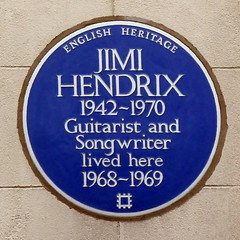
The single best "alternative" London musical walk, anchored on what is probably the most charming coincidence in the city.
Start: Bond Street tube (Jubilee / Central / Elizabeth lines).
The route:
- George Frideric Handel, 25 Brook Street (W1K 4HB). Handel lived here from 1723 until his death in 1759 and composed Messiah on the premises.
- Jimi Hendrix, 23 Brook Street (W1K 4HA). Literally next door. Hendrix lived here from 1968 to 1969. The flat is open to the public as part of the Handel & Hendrix in London museum, which lets you visit both homes back to back.
- John Lennon, 34 Montagu Square (W1H 2LJ). A short walk north through Marylebone. Lennon and Yoko Ono lived here in 1968. The famous "Two Virgins" album photograph was taken in this flat.
- Wolfgang Amadeus Mozart, 180 Ebury Street (SW1W 8UP). Further south in Belgravia, but worth the detour if you want to complete the century-spanning run. Mozart composed his first symphony here in 1764 at the age of eight.
Finish: Marble Arch, Hyde Park for a sit-down. 60 minutes if you skip the museum, two hours if you do both Handel and Hendrix properly.
Route 3: Scientific Hampstead (60 minutes)

Hampstead was the leafy home of a particular kind of intellectual: doctors, scientists, and the refugees from continental Europe who reshaped 20th-century thought.
Start: Hampstead or Finchley Road tube.
The route:
- Sigmund Freud, 20 Maresfield Gardens (NW3 5SX). Freud's final home, where he lived for the last year of his life after fleeing Vienna in 1938. Now the Freud Museum London, with his study preserved as he left it.
- John Keats, Keats House, 10 Keats Grove (NW3 2RR). A short walk away. Keats wrote Ode to a Nightingale here in 1819. Not technically a Blue Plaque house (it has its own scheme) but unmissable if you're in the area.
- Daphne du Maurier, Cannon Hall, 14 Cannon Place (NW3 1EH). Du Maurier lived here as a young woman before becoming the author of Rebecca and Jamaica Inn.
- Samuel Taylor Coleridge, 3 The Grove, Highgate (N6 6JU). A longer walk or a short bus ride to neighbouring Highgate. Coleridge spent his last 18 years here; Karl Marx is buried 10 minutes' walk away in Highgate Cemetery.
Finish: Highgate, then a bus or the Northern line back. Budget 90 minutes with the Freud Museum, 60 without.
Route 4: Radical Soho and Fitzrovia (75 minutes)

The revolutionary, bohemian, and occasionally infamous London that the tourist trail pretends isn't there.
Start: Tottenham Court Road tube (Central / Elizabeth lines).
The route:
- Karl Marx, 28 Dean Street, Soho (W1D 3RW). Marx lived on Dean Street between 1851 and 1856, in grinding poverty, while beginning work on Das Kapital. Three of his children died in the flat. The plaque is tucked above what is now a restaurant.
- Mary Wollstonecraft, 373 Mare Street, Hackney (E8 1HR). A longer walk or tube ride east. Wollstonecraft, author of A Vindication of the Rights of Woman (1792), lived here as a schoolmistress in the 1780s.
- Karl Marx again, 41 Maitland Park Road (NW3 2EZ). Later Marx address in Kentish Town. Worth pairing with the Dean Street plaque for the full Marx-in-London arc.
- George Orwell, 27B Canonbury Square, Islington (N1 2AL). Orwell lived here in 1945 while writing Animal Farm.
Because radical London is geographically spread out, this is the route we'd recommend customising most. The Legacy app lets you filter plaques by theme (politics, writing, science) and build your own radial route from a starting postcode.
How to Build Your Own Alternative Walking Tour
Once you've done one or two themed routes, the obvious next move is to build your own. The pattern is always the same:
- Pick a neighbourhood. Dense central plaque clusters: Bloomsbury, Fitzrovia, Mayfair, Marylebone, Soho, Chelsea, Kensington, Hampstead. Outside zone 1: Highgate, Islington, Hackney, Chiswick.
- Pick a theme. Literary, musical, scientific, political, architectural, theatrical. The plaque scheme is broad enough that any theme with at least 20 historical figures will produce a dense-enough route.
- Plot the plaques. Use the Legacy map to see every plaque in London. Filter by theme or period. Drop a pin on your starting point and the app shows what's within a 10-minute walking radius.
- Sequence them. Order by geography, not by importance. A walk that zig-zags based on who was more famous is a worse walk than one that flows naturally down a street.
- Budget realistically. A plaque stop takes three minutes (approach, read, photograph, move on). A museum stop takes 45. A 90-minute walk can comfortably include 10 plaques and one museum, or 15 plaques and no museums.
A Few Practical Walking Tour Tips for London
Things we wish someone had told us before our first plaque walk.
- Sundays are best. Many of the plaques are on residential streets and these are quieter at weekends. Weekday rush hours (8–9, 17–18) make central routes unpleasant.
- Shoes matter. You will cover 4–7 km on a themed route. Boots or trainers; no dress shoes.
- Pubs are historical too. Many of them have their own plaques or long connections to literary and political figures. Bake one or two in as rest stops.
- It rains. London's cultural-history walking season is technically April to October, practically any month you're willing to carry an umbrella.
- The plaque IS the destination. The buildings themselves are usually private residences. You don't enter, you don't knock. You stand on the pavement, read, photograph if you want, move on.
Track the Plaques You've Walked
Once you start noticing Blue Plaques, you stop being able to stop. London becomes a treasure map with 1,600+ pieces. The fun is discovering them, but the satisfaction is in the collection.
Legacy is a phone app that maps every Blue Plaque in London, lets you check them off as you find them, saves photos and notes to your personal collection, and suggests walking routes from wherever you happen to be standing. If you run or walk in London with any regularity, it turns that time into a slowly-building catalogue of the city you live in, alongside or behind the one the guidebooks describe.
You can explore the plaques on the web first, or download Legacy on the App Store to start walking.
If you want the broader picture on Blue Plaques (history of the scheme, criteria, most famous plaques), our complete guide to Blue Plaques in London is the pillar post. Everything on this page is a walking application of the material there.