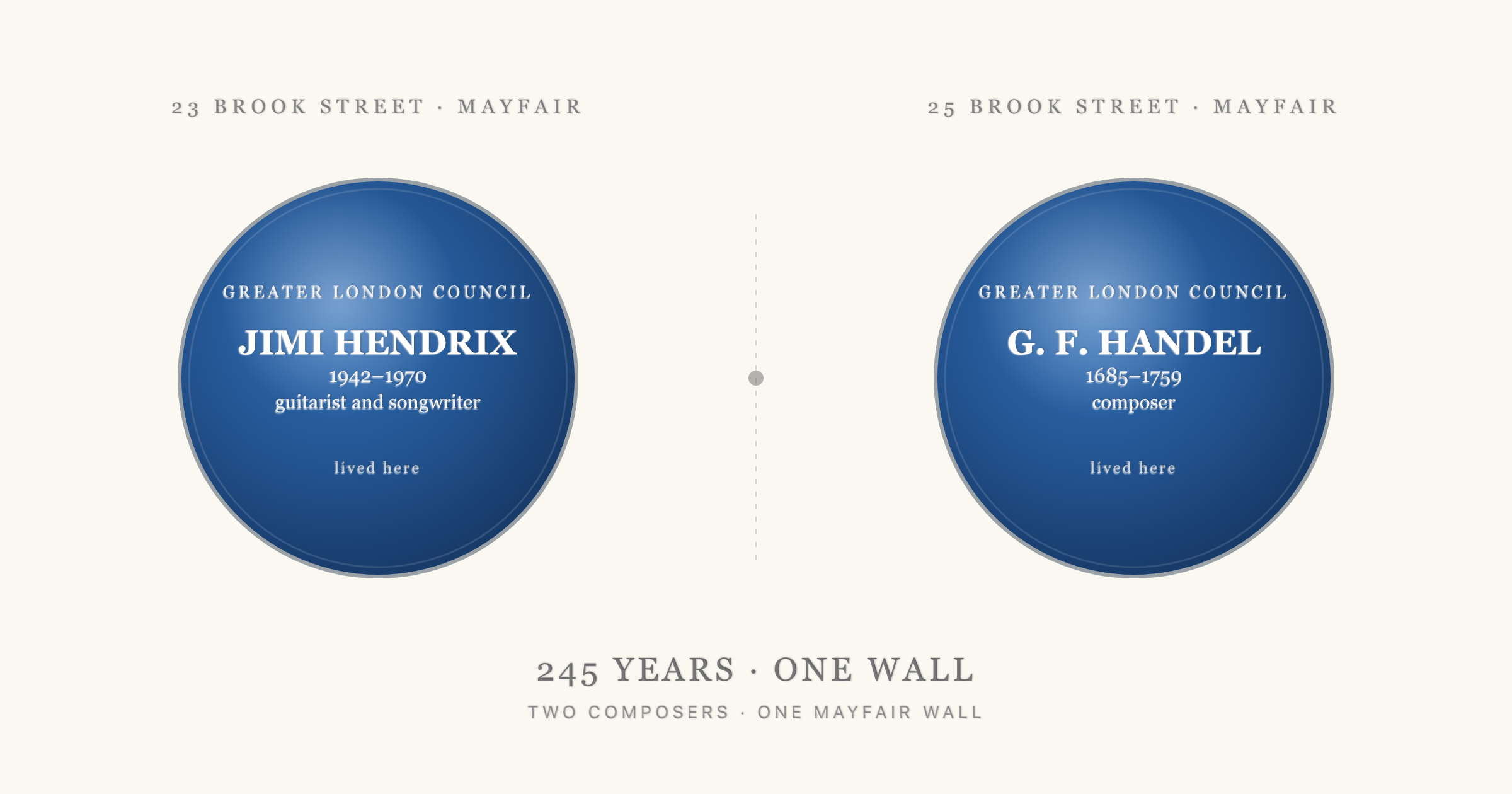
One Mayfair wall carries two of the most famous blue plaques in London, separated by just a few metres of Georgian brick and roughly 245 years of history. At 25 Brook Street, a plaque marks the house where George Frideric Handel lived from 1723 until his death in 1759. At 23 Brook Street, the building next door, a second plaque marks the top-floor flat where Jimi Hendrix lived with Kathy Etchingham in 1968 and 1969. Today, those two addresses are stitched together as the Handel Hendrix House London, a single museum that tells the story of two very different composers who happened to share the same patch of Mayfair wall.
This guide covers both plaques, both residents, what you'll find inside the museum today, a short walking route to visit the site along with the surrounding blue plaques in Mayfair, and the best time of day to go if you want a quiet visit.
The Two Blue Plaques on Brook Street
Walk along the north side of Brook Street, heading east from Grosvenor Square. You will pass a cluster of Georgian townhouses, most now occupied by galleries, tailors, and private-office tenants. Two of them carry blue plaques.
25 Brook Street, Mayfair, W1, a plaque to George Frideric Handel that reads:
George Frideric Handel 1685-1759 composer lived in this house from 1723 and died here
23 Brook Street, Mayfair, W1, the plaque next door, to Jimi Hendrix:
Jimi Hendrix 1942-1970 guitarist and songwriter lived here 1968-1969
They are two doors on the same row, roughly three metres apart when you stand in front of the shared façade. No one planned it. Handel took the Brook Street lease in 1723 because it was a fashionable new-build on the western edge of London, close to the royal court at St James's. Hendrix took 23 Brook Street in 1968 because Kathy Etchingham had found a top-floor flat she liked and the rent was £30 a week. Two private decisions, made 245 years apart, produced one of London's most remarkable coincidences of address.
George Frideric Handel at 25 Brook Street (1723-1759)
Handel moved into 25 Brook Street in the summer of 1723, not long after being appointed Composer of the Chapel Royal. He was thirty-eight, a German composer whose career had taken him through Hamburg, Italy, and Hanover before he settled in London in 1712. By the time he signed the Brook Street lease, he had already written Rinaldo, Water Music, and was in the middle of building the Royal Academy of Music opera company.
Handel stayed at 25 Brook Street for thirty-six years, until he died in the house in April 1759. That span of time is what makes the address extraordinary. Almost every major Handel work you have heard was composed under that Brook Street roof:
- Zadok the Priest (1727), the coronation anthem that has been sung at every British coronation since.
- Acis and Galatea and the bulk of his mature Italian operas.
- Messiah (1741), written at 25 Brook Street in roughly twenty-four days in the late summer, before its first performance in Dublin in April 1742.
- Music for the Royal Fireworks (1749), composed for the peace celebrations in Green Park.
- The major oratorios of the 1740s and 1750s, including Judas Maccabaeus and Solomon.
Handel composed at a harpsichord on the first floor. The room has been reconstructed inside the museum using period instruments and furnishings. He rehearsed his musicians in the same room, ran his publishing arrangements out of the house, and kept a staff of servants in the basement kitchen. He died on Holy Saturday, 14 April 1759, in the bedroom on the second floor. Six days later, he was buried in Westminster Abbey.
The house was privately occupied for the next two centuries, with no public commemoration beyond the blue plaque installed by the London County Council in 1952. The Handel House Trust acquired the upper floors in the late 1990s and opened the Handel House Museum in 2001.
Jimi Hendrix at 23 Brook Street (1968-1969)
Next door, a quarter of a century after the museum took over Handel's former rooms, a second story surfaced.
In July 1968, Jimi Hendrix moved into a top-floor flat at 23 Brook Street with his girlfriend Kathy Etchingham. The flat had been found by Etchingham and rented from her friend Ringo Starr's business manager. Hendrix was twenty-five, had just finished recording Electric Ladyland, and was at the commercial peak of his career. The flat was his first permanent London home after two years of hotel rooms and temporary lodgings.
Hendrix described 23 Brook Street as "my first real home of my own", a phrase Etchingham recorded in her memoir. He lived there, on and off, for about seven months, until early 1969, when the lease wound down and he moved to New York.
There is a well-documented moment from the Brook Street flat that has become part of the story of the house. At some point in late 1968, Hendrix noticed a blue plaque on the wall next door. He learned that Handel had lived there. According to Etchingham, he went to the record shop One Stop on South Molton Street and bought every Handel record he could find, particularly Messiah and the Water Music. He listened to them in the flat above Handel's former rooms for the rest of his tenancy.
The Hendrix blue plaque went up in 1997, making 23 Brook Street only the second blue plaque in London to be awarded to a rock musician. The top-floor flat was restored and opened to the public in 2016 as a permanent extension of the museum, and the museum was renamed Handel Hendrix House, then Handel Hendrix in London, and most recently Handel Hendrix House London.
What You'll See at the Museum Today
Handel Hendrix House London occupies the upper floors of both 23 and 25 Brook Street, connected internally by a staircase that cuts between the two Georgian party walls. The museum is divided in two distinct halves, each preserving the feel of its period.
The Handel Rooms (25 Brook Street)
- The composition room on the first floor, with a reconstructed 18th-century harpsichord on the spot where Handel worked.
- The rehearsal room, where the composer auditioned singers and drilled chorus and orchestra for his oratorios.
- The bedroom where Handel died in 1759, with contemporary furnishings based on the posthumous inventory of his estate.
- A small exhibition room with original Handel manuscripts on rotating loan, often including pages from Messiah or Zadok the Priest.
The Handel rooms are a good representation of what a successful composer's Mayfair house looked like in the mid-18th century. The ceilings are lower than you expect, the windows taller, and the rooms smaller than modern listeners imagine the Messiah score demanded.
The Hendrix Flat (23 Brook Street, top floor)
- The bedroom, recreated from Etchingham's photographs and her memoir. Cushions, scarves draped over the lights, an Indian bedspread, and the famous oval mirror Hendrix kept on the wall.
- A small sitting room with a period Bang & Olufsen stereo and a replica of Hendrix's guitar.
- An exhibition space with archive material, photographs, letters, and rotating items from the Hendrix estate.
The Hendrix flat is noticeably smaller than the Handel rooms, not because the building is meaner but because an 18th-century house upper floor was where the servants slept, and by the 20th century those rooms had been subdivided into a bedsit for a rock musician and his girlfriend. The scale mismatch is part of the charm.
Visiting Practicalities
A short checklist for your visit.
- Address: 25 Brook Street, Mayfair, London W1K 4HB. Entrance is through the 25 Brook Street door.
- Nearest Tube: Bond Street (Elizabeth, Central, Jubilee lines), two minutes walk. Oxford Circus (Central, Victoria, Bakerloo) is also a short walk east along Oxford Street.
- Best time of day: weekday mornings are quietest. The museum is small, and a full tour of both flats takes roughly an hour to ninety minutes. On weekends and bank holidays the Hendrix flat in particular can feel crowded because the rooms are genuinely tiny.
- Tickets: check the Handel Hendrix House official site for current admission prices and opening hours before you go. The museum is closed on some weekdays outside the summer season.
- Photography: permitted without flash in most rooms, including both flats.
One practical note. The staircase between the two halves of the museum is steep and narrow, consistent with the original Georgian layout. There is step-free access to the Handel ground-floor exhibition but limited step-free access to the upper floors and the Hendrix flat.
A Short Walking Route Around the Handel Hendrix Plaques
Brook Street is on one of the densest blue-plaque streets in London. If you are making a day of the Mayfair blue plaques, here is a loop that starts at the Handel Hendrix House and takes roughly ninety minutes at a relaxed pace.
- Start at 23-25 Brook Street. The Handel and Hendrix plaques, side by side.
- Walk east along Brook Street to Grosvenor Square. Pass the United States Embassy's former building. At the northeast corner, 47 Grosvenor Square, a plaque marks Dwight D. Eisenhower's wartime HQ.
- Turn north onto Duke Street, then right onto Oxford Street, then left onto Marylebone Lane. A ten-minute walk brings you to 17 Bruton Street (via a small detour) where HM Queen Elizabeth II was born. The plaque is discreet, on a modern Chinese restaurant frontage.
- Continue north across Oxford Street to Wigmore Street, then left onto James Street. 67 York Street carries a plaque to Benjamin Disraeli's birthplace.
- Loop back south via Marylebone Lane and South Molton Street. South Molton Street is a short pedestrianised run with a tailor's shop at number 34 that holds one of the smallest plaques in the area, to the painter Richard Parkes Bonington.
- End back at Brook Street and walk west five minutes to 49 Grosvenor Square, where a plaque marks Admiral Sir George Cockburn's residence.
That's five or six plaques inside a single loop, centred on the Handel Hendrix House. For a longer multi-neighbourhood walk, see our alternative walking tour of London.
Why the Handel Hendrix House Matters
The coincidence of 23 and 25 Brook Street is lovely on its own terms. Two of the most important composers in their respective centuries, lived within a few metres of each other, separated by time but not by geography. The house where Messiah was written and the flat where Electric Ladyland was listened back to, sharing a single brick wall.
But the Handel Hendrix House London does something else, more quietly. It demonstrates that blue plaques are not just labels on buildings. They're an index. They point at the way London's streets have absorbed layer after layer of cultural history into the same footprint. The people who lived at 23 and 25 Brook Street were each, in their own era, the most important composer in English-speaking music. They never met. They couldn't have. But they rehearsed, composed, and listened in rooms that share a chimney stack.
If you want to keep track of which plaques you've visited, that's the whole premise of the Legacy app. Tap a plaque's marker on the map, and it goes into your personal collection. The Handel and Hendrix plaques are two of the most popular in the dataset, and you can build a day around them, or just drop by one afternoon when you're already in Mayfair.
FAQ
Where is the Handel Hendrix House in London?
At 25 Brook Street, Mayfair, London W1K 4HB. The museum spans both 23 and 25 Brook Street, joined internally.
Did Handel and Hendrix know each other?
No. Handel died in 1759, 183 years before Hendrix was born. The connection is purely geographic.
Is there really a blue plaque for Hendrix?
Yes. English Heritage installed it in 1997. It was only the second blue plaque awarded to a rock musician (Jim Morrison's plaque at 25 Holland Park is also private, not English Heritage).
Can you visit both flats in one ticket?
Yes, a standard admission to Handel Hendrix House includes access to both the Handel rooms at 25 Brook Street and the Hendrix flat at 23 Brook Street.
What's the quickest way to get there?
Bond Street Underground station (Elizabeth, Central, Jubilee lines), then a two-minute walk east along Brook Street.
Are the blue plaques on the outside?
Yes. You can view both plaques from the pavement without entering the museum. The Handel plaque is to the left of the door at 25 Brook Street; the Hendrix plaque is next door at 23.
The Short Version
Handel and Hendrix lived next door on Brook Street, 245 years apart. Both have blue plaques. Both former flats are now a single museum. If you are in central London and you have ninety minutes, it is one of the most rewarding cultural visits in the city, and it costs about the same as a decent pint.
For the full picture of London's blue plaque scheme, including how the plaques are selected and where the densest clusters are, see our complete guide to blue plaques in London. To turn visits like this one into a long-running project, you can track everywhere you've been in the Legacy app.