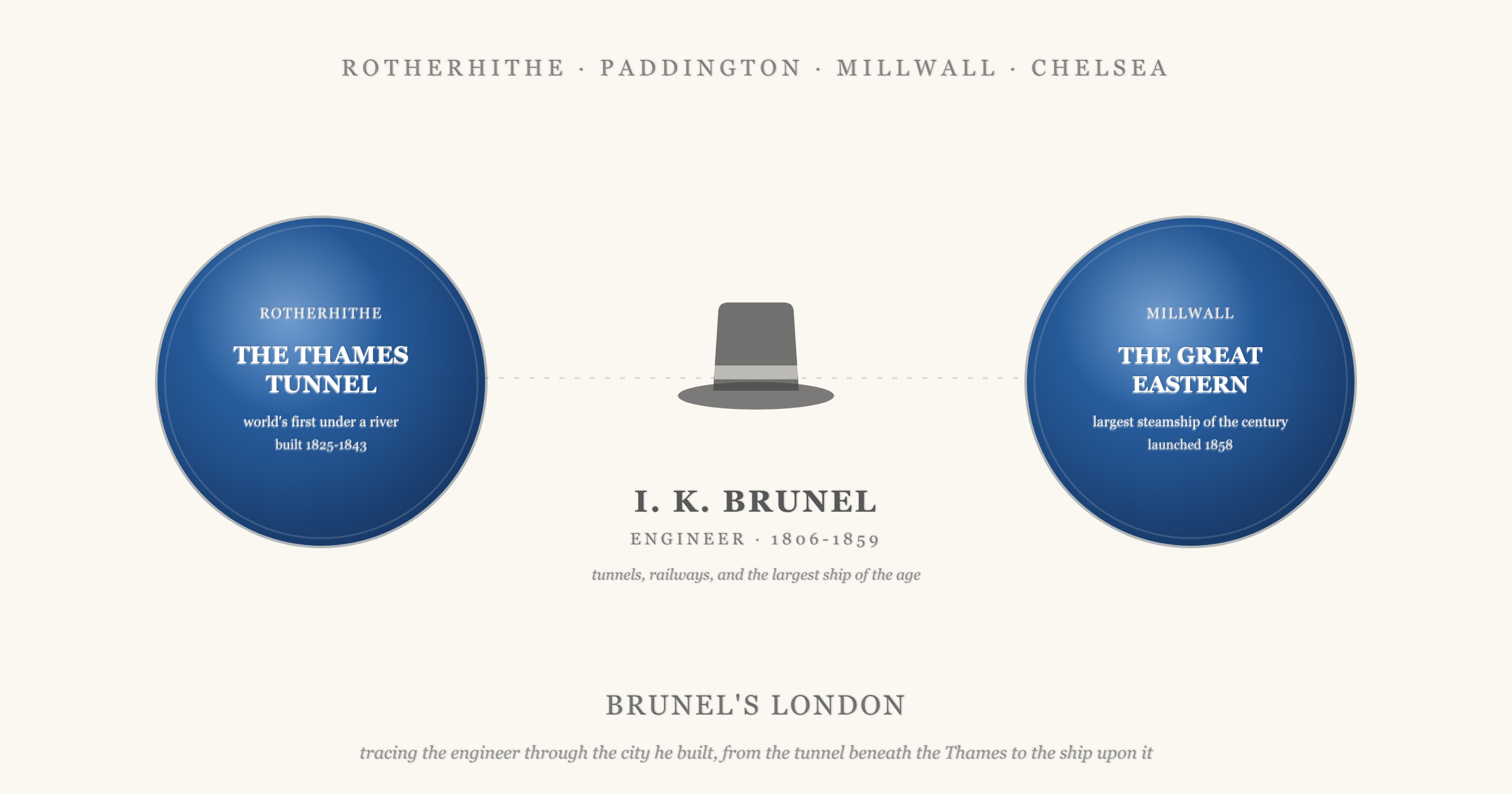
Isambard Kingdom Brunel built more of the modern world than almost any engineer who ever lived, and a remarkable amount of it began, or still stands, in London. The bridges, railways, tunnels, and ships that made him a Victorian hero, and earned him second place (behind only Churchill) in a famous national poll of the greatest Britons, can be traced through the city in a series of blue plaques marking where he worked, nearly died, and changed what was thought possible. This is a guide to Isambard Kingdom Brunel's London, from the Thames Tunnel that almost killed him to the colossal ship he launched on the river's edge.
For the wider scheme and how to read the markers, our complete guide to London's blue plaques is the place to start. Here, we follow one extraordinary engineer through the city.
The Thames Tunnel: Where It Began, and Nearly Ended
Brunel's London story starts underground, at Rotherhithe, with the project that launched him and almost ended his life. The Thames Tunnel was the world's first tunnel built under a navigable river, an engineering feat so daring that many thought it impossible. It was the brainchild of Brunel's father, the French-born engineer Sir Marc Isambard Brunel, who invented the revolutionary "tunnelling shield" that made it possible to dig through soft, waterlogged ground beneath the Thames. Construction ran from 1825 to 1843, and the young Isambard worked on it as resident engineer.
It nearly cost him everything. In 1828 the river broke into the workings, and, as a plaque on Rotherhithe Street records, the young Brunel "was pulled half-drowned from the flooded shaft." Several men died; Brunel survived, and the tunnel was eventually completed. Today the Brunel Museum stands at Railway Avenue in Rotherhithe, in the original engine house that pumped the workings dry, and the tunnel itself still carries trains: it is part of the London Overground, making it the oldest section of underwater tunnel in the world still in daily use. It is the perfect place to begin, because it is where the legend, and very nearly the tragedy, started.
Paddington Station: The Cathedral of the Railway Age
If Rotherhithe is where Brunel began, Paddington Station is where he built one of his masterpieces. As engineer of the Great Western Railway, Brunel designed not just the line that linked London to Bristol and the West but the great London terminus at its head. Paddington, with its soaring iron-and-glass train shed, is one of the supreme monuments of the railway age, and a plaque there commemorates the station "designed and built by Isambard Kingdom Brunel."
Paddington is where you can still feel the scale of Brunel's ambition. He did everything on a grand scale, including building the Great Western to his own enormous "broad gauge," wider than the standard track used elsewhere, because he believed it gave a faster, smoother, safer ride. He was eventually overruled and the broad gauge was abandoned, but standing under the curving roof of Paddington, it is easy to see the mind that thought bigger than everyone around it.
The Great Eastern: A Leviathan on the Thames
Brunel's final and most audacious project rose on the north bank of the river at Millwall, on the Isle of Dogs. The Great Eastern was, by an enormous margin, the largest ship ever built at the time, a leviathan of iron designed to carry thousands of passengers all the way to Australia without refuelling. A plaque at Burrell's Wharf on Westferry Road records that the ship, "the largest steamship of the century, was built here by I. K. Brunel and J. Scott Russell."
She was so vast that she had to be launched sideways into the Thames, a fraught and hugely difficult operation that took months and strained Brunel to breaking point. The ship was a commercial failure in her intended role and her construction broke his health, but she found a second life laying the first lasting transatlantic telegraph cable, knitting the world together in a way that suited Brunel's outsized vision. It is from this period that the most famous image of him comes: the small, determined figure in the tall stovepipe hat, cigar in mouth, photographed in front of the ship's giant launching chains. The Great Eastern was the project that killed him; he suffered a stroke in 1859, days before her maiden voyage, and died at fifty-three.
98 Cheyne Walk: The Brunels at Home
Away from the great works, the family had a London home, and it carries a plaque to two generations of genius at once. At 98 Cheyne Walk, in Chelsea, a plaque records that "Sir Marc Isambard Brunel 1769-1849 and Isambard Kingdom Brunel 1806-1859, civil engineers, lived here." Father and son, the inventor of the tunnelling shield and the builder of the Great Western, under one Chelsea roof on the riverside. It is a quiet counterpoint to the vast public projects, and a reminder that the Thames, which Brunel tunnelled under and launched ships into, also ran past his own front door.
Brunel's London Legacy
Brunel belongs to the great company of London's scientists and engineers whose work reshaped the modern world, a lineage the blue plaques trace across the city, from Isaac Newton and Charles Darwin to Ada Lovelace and Alan Turing. What sets Brunel apart is the sheer physical scale and visibility of what he left behind: not theories or equations but tunnels you can still ride through, a station you can still stand in, and the memory of a ship so large it had to be launched sideways. More than a century and a half after his death, you can walk his London and find it largely still working.
A Brunel Walk
Brunel's London is spread along the river, so this is a walk in stages rather than a stroll.
- Rotherhithe. Start at the Brunel Museum and the Thames Tunnel, where it all began and nearly ended in 1828.
- Millwall, Isle of Dogs. Cross to Burrell's Wharf, where the Great Eastern was built and launched sideways into the Thames.
- Chelsea. Head upriver to 98 Cheyne Walk, the family home of the two Brunels.
- Paddington. Finish under the great roof of the station, Brunel's monument to the railway age.
It is a route that follows the Thames Brunel spent his life mastering, from the tunnel beneath it to the ship he floated on it.
Discover the Plaques Yourself
Brunel's plaques are part of a far larger web of markers across London, recording where its engineers, scientists, and visionaries lived and worked. Tracing them turns a journey along the Thames into a tour of the industrial age that made the modern city. The Legacy app maps every blue plaque in London, with the full inscription and the history behind it, so you can plan your own route, collect the ones you visit, and follow the trail onward, perhaps to more of scientific London or deeper into the complete guide to London's blue plaques. Start at Rotherhithe, and follow the river.