Most people picture Isaac Newton under an apple tree at his family farm in Lincolnshire, or bent over his books at Cambridge. But the last thirty years of his life, by far the most powerful and public part of it, belonged to London. He came to the capital in 1696 not as a reclusive mathematician but as a senior government official, running the Royal Mint from the Tower of London, presiding over the Royal Society, and being knighted by a queen. Two blue plaques mark where he lived during those years, one in St James's and one beside Leicester Square, and his tomb stands in the most prominent position science has ever been given in Westminster Abbey. This is the story of Isaac Newton's London, told through the addresses that still carry his name.
For anyone tracing the city's scientific history, Newton is the keystone of a constellation that runs through Charles Darwin, Ada Lovelace, and Alan Turing: the men and women whose plaques mark where modern knowledge was actually made. The Legacy app maps every one of them, with the inscription and the history behind each marker.
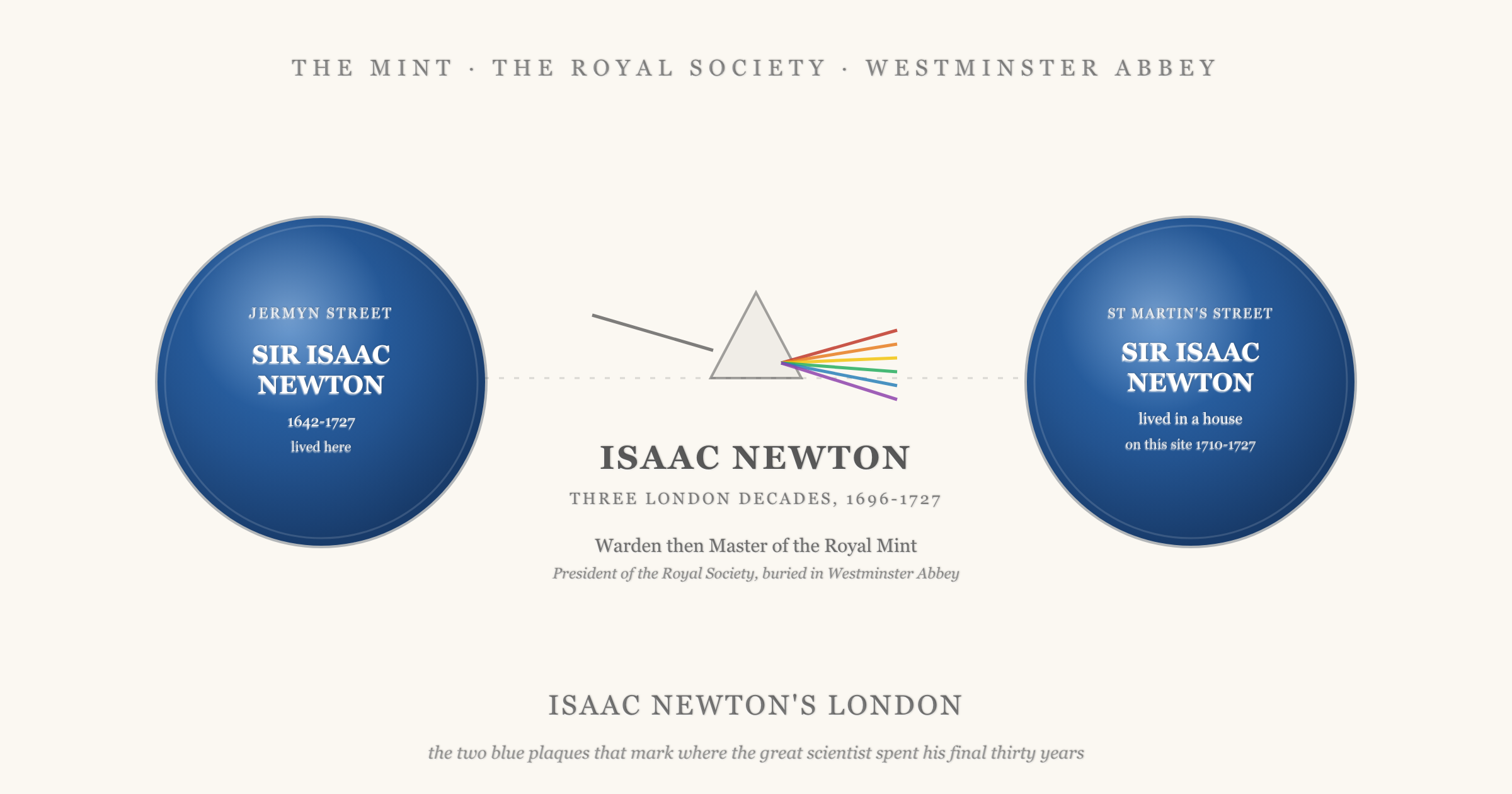
The Move to London, 1696
By the 1690s Newton had already done the work that made him immortal. The "Philosophiae Naturalis Principia Mathematica," published in 1687, had laid out the laws of motion and universal gravitation and effectively founded modern physics. But Newton was restless and, by some accounts, exhausted and unwell after the intensity of those Cambridge years. He wanted a change, and he wanted a position in London.
It came through his friend Charles Montagu, later the Earl of Halifax, a powerful politician who arranged for Newton to be appointed Warden of the Royal Mint in 1696. On the face of it, it was a strange post for the greatest scientist in Europe: a civil-service job in charge of the nation's coinage. It was meant partly as a comfortable sinecure, a reward for a national treasure. Newton, characteristically, refused to treat it as one.
He left Cambridge and moved to the capital, taking a house on Jermyn Street in the fashionable district of St James's. A blue plaque there records simply, "Sir Isaac Newton 1642-1727 lived here." It is one of London's older commemorative plaques, put up in 1908, and it marks the address from which Newton walked to work at the Tower of London to run the country's money.
Master of the Mint and the Hunt for Counterfeiters
Newton arrived at the Mint during a crisis. England's silver coinage had been clipped and counterfeited so badly that the currency was close to collapse, and a vast project, the Great Recoinage of 1696, was underway to call in the old money and strike it anew. Newton threw himself into the logistics with the same ferocious focus he had brought to optics and gravity, reorganising the Mint's operations and driving its output to levels it had never reached.
The part of the job he was not expected to take seriously was law enforcement. As Warden, Newton was responsible for catching and prosecuting counterfeiters, or "coiners," a crime that counted as high treason and carried the death penalty. He could have left it to underlings. Instead he became, in effect, a detective. He gathered evidence in the taverns and prisons of London, ran informants, conducted interrogations himself, and built cases with meticulous care.
His most famous quarry was William Chaloner, a brazen and talented counterfeiter who had the nerve to publicly accuse the Mint itself of corruption. Newton pursued him relentlessly, assembled the evidence, and saw Chaloner convicted and hanged at Tyburn in 1699. That same year Newton was promoted to Master of the Mint, the senior and far more lucrative post, which he held for the rest of his life. The scientist who had explained the motion of the planets spent his London decades making sure the nation's shillings were honest.
President of the Royal Society
In 1703 Newton was elected President of the Royal Society, the body at the centre of English science, and he held that office until his death twenty-four years later. He ran it as he ran everything, with total authority, turning a somewhat genteel club into a more rigorous and influential institution, and not shrinking from the bitter priority disputes that marked his life, above all the long and poisonous quarrel with Gottfried Leibniz over who had invented calculus.
It was in London, in 1704, that Newton finally published "Opticks," his great work on light and colour, much of it based on experiments he had done decades earlier. The book described how a glass prism splits white light into the colours of the spectrum, and how those colours recombine into white again, demonstrating that white light is not pure but a mixture. It is the work behind the prism in the illustration above, and it shaped the study of light for a century.
Honours followed. In 1705 Queen Anne knighted him, making him Sir Isaac Newton. It is often said to be the first time a scientist was knighted for scientific work, though the timing was tangled up with Mint business and politics as much as pure science. Either way, it set the seal on a remarkable second career: the Lincolnshire farmer's son had become Sir Isaac, master of the nation's money and the most celebrated natural philosopher alive.
Where Did Isaac Newton Live? The St Martin's Street House
In 1710 Newton moved from St James's to a house on St Martin's Street, just south of what is now Leicester Square, then called Leicester Fields. The second blue plaque marks this address: "Sir Isaac Newton lived in a house on this site 1710-1727." He lived here for most of his remaining years, and it became the social centre of his late life, where he hosted visitors and presided, informally, over the scientific establishment of the city. The house was said to have a small observatory built at the top, a fitting crown for the home of the Royal Society's president.
By this point Newton was a grand old man of European science, wealthy from the Mint, internationally famous, and increasingly looked after by his niece Catherine Barton, who kept his house and was a celebrated wit in London society. In his final years his health declined and he moved out to the cleaner air of Kensington, then a village on the edge of town, where he died in the spring of 1727.
Isaac Newton's Grave in Westminster Abbey
Newton died on 31 March 1727 and was given a state funeral. He was buried in Westminster Abbey, in a prominent position in the nave, and an elaborate monument was raised over him in 1731. It shows him reclining, surrounded by figures and symbols of his work, a prism and a telescope among them, with a celestial globe above. The French writer Voltaire, who was in London at the time, was struck that England buried a scientist with the honours of a king, and the contrast with how his own country treated its thinkers stayed with him.
The grave made a statement that outlasted Newton himself: that the pursuit of knowledge was worthy of the nation's highest honours, in its most sacred building, among kings and statesmen. It is why a walk through scientific London so often ends at the Abbey, where Darwin too would later be buried, near Newton, in a deliberate echo of this first great scientific funeral.
A Walk Through Newton's London
Newton's London sits in a compact and very walkable stretch of the West End and the City, and you can trace the shape of his thirty years here in an afternoon:
- Jermyn Street, St James's. Start at the first blue plaque, on the street where Newton lived when he arrived in 1696 to take up the Mint. The district is still one of London's most elegant.
- St Martin's Street, by Leicester Square. Walk north and east to the second plaque, marking the house where he spent most of his London life as President of the Royal Society.
- The Tower of London. To the east stands the Tower, home of the Royal Mint in Newton's day, where he ran the coinage and pursued his counterfeiters. The Mint moved out only in the nineteenth century.
- Westminster Abbey. End, as the story does, at Newton's grave and monument in the Abbey nave, the most prominent resting place science has ever been given.
It is a route that turns the abstract Newton of the textbooks, the one with the apple and the equations, into a real Londoner: a senior official walking to the Tower, a president holding court near Leicester Fields, a knight buried among kings.
Discover the Plaques Yourself
Isaac Newton's two plaques are part of a far larger web of markers that record where London's scientists, writers, artists, and reformers lived and worked. Tracing them turns a walk across the city into a walk through the history of ideas, from Newton's prism to Darwin's evolution to Turing's computers. The Legacy app maps every blue plaque in London, with the full inscription and the story behind it, so you can build your own route, collect the ones you visit, and turn an ordinary afternoon into a piece of historical detective work worthy of the man who ran the Mint. Start with Newton, and see where the city's plaques take you next.