Charles Darwin's London is a story of two homes and a country footpath. The first home, on Gower Street in Bloomsbury, is the townhouse he and Emma took as newlyweds in 1838, where their first two children were born, and where Darwin began the notebook entries that would become the theory of evolution by natural selection. The second, Down House in the Kent village of Downe, on the outer London edge in what is now the London Borough of Bromley, is the rural family home he bought in 1842 and lived in for the rest of his life, where he wrote On the Origin of Species, raised ten children, kept an experimental garden, and walked the same gravel loop every day for forty years to think through the next problem. The country footpath is the Sandwalk, the quarter-mile circular path he laid out in his own grounds, sometimes called Darwin's "thinking path," and it is still walkable today exactly as he left it.
This is the walking guide to Darwin's London. The route runs from Bloomsbury, where the Gower Street site sits beside University College London's biological sciences buildings, out to Bromley, where Down House is run by English Heritage and the Sandwalk is part of the tour. The two sites are forty-five minutes apart by Underground and Southeastern train, which makes them comfortably one day together. If you want to see how Down House and the Gower Street plaque join the wider map of London's scientific commemorations, the Legacy app plots both alongside the Florence Nightingale, Ada Lovelace, and Alan Turing sites that mark the scientific century that began with Darwin's books.
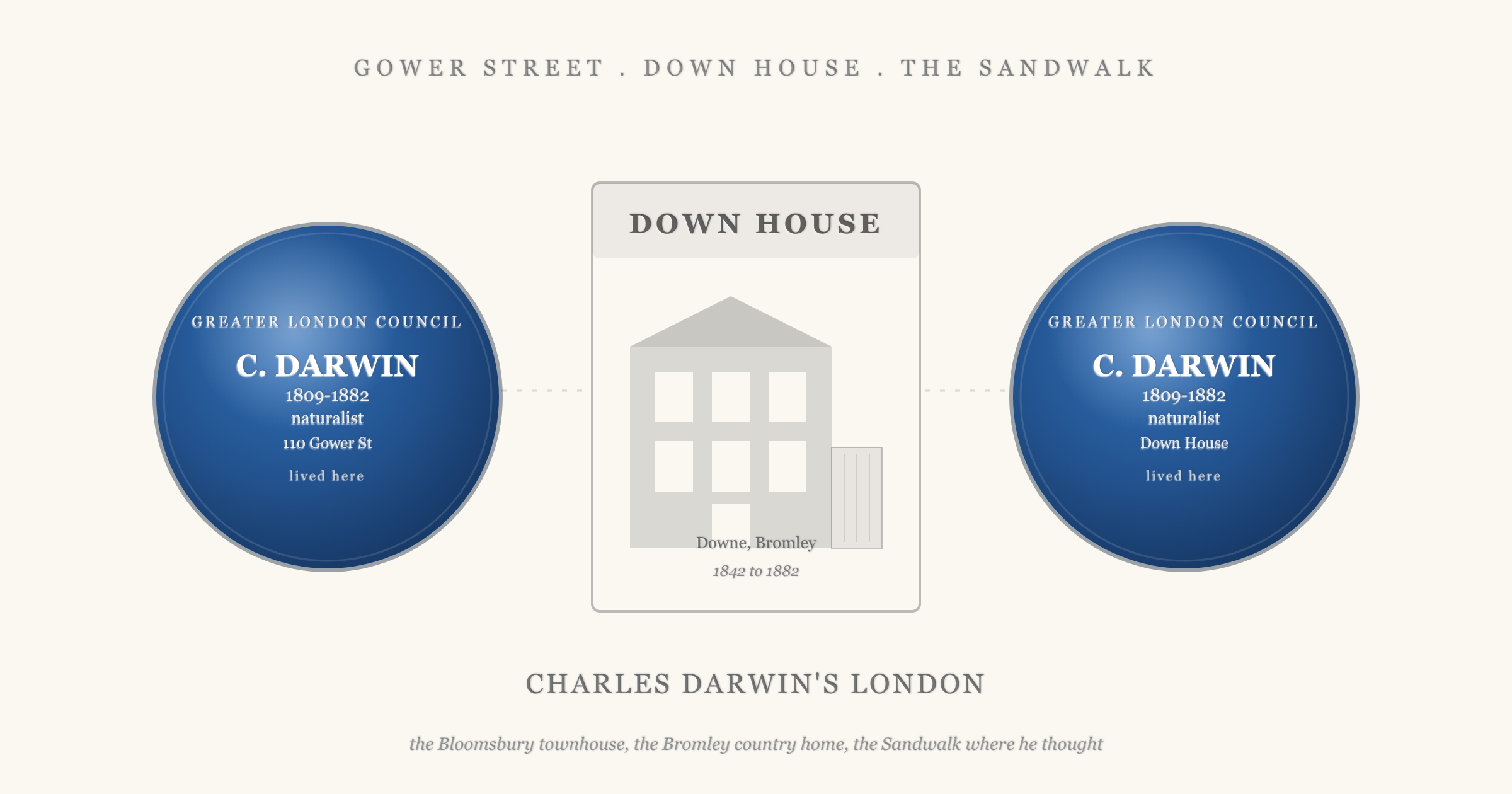
Two Homes, Forty Years Apart
Darwin's adult life in London divides cleanly in two. The first phase is short, four years in Bloomsbury, the period historians call the "London years." The second is long, forty years at Down House, the period that produced almost every book.
The Bloomsbury phase begins in late 1838. Darwin had returned to England in 1836 from the five-year voyage of HMS Beagle, spent a year sorting collections in lodgings near the British Museum, and become engaged to his first cousin Emma Wedgwood in November 1838. He took the lease on 12 Upper Gower Street in December 1838 ahead of the marriage, the couple moved in after the January 1839 wedding, and they lived there for just under four years. Two of their ten children, William Erasmus and Anne Elizabeth, were born in the house.
The Bloomsbury years are the period when Darwin worked up the Beagle materials into the Zoology of the Voyage of the Beagle (1838 to 1843) and the Journal of Researches (1839, later better known as The Voyage of the Beagle), began the species notebooks (B, C, D, and E, kept between 1837 and 1839, where the natural-selection idea is first written down), and was elected a Fellow of the Royal Society in 1839. The species notebooks were entirely a Bloomsbury product. The first transmutation diagram, the famous "I think" tree on page 36 of Notebook B, was sketched within yards of the Gower Street house.
The London phase ends in September 1842, three years after the wedding. Darwin's health, never robust after the Beagle voyage, had collapsed under the demands of London social and scientific life. Emma was managing two young children in a city the Darwins found loud, smoky, and exhausting. They bought Down House in July 1842 and moved in that September, with Emma seven months pregnant. They did not move back. Darwin came up to London for Royal Society meetings, gentlemen's-club evenings, and family visits across the rest of his life, but he never lived in London again. The forty years at Down House are when he became the Darwin the world remembers.
Stop One: The Gower Street Site and the UCL Block
The Gower Street house was at 12 Upper Gower Street, on the eastern side of the road, in a stretch of terrace built in the 1790s. Like many central-London terraces, it did not survive the nineteenth and twentieth centuries intact. The original number 12 was demolished as part of UCL's expansion of its biological sciences buildings, and the modern numbering on Gower Street does not match the old. What survives is the location, marked by an English Heritage plaque now mounted on the Biological Sciences Building of University College London at the relevant point in the street.
The plaque records that Darwin lived on the site between 1838 and 1842 and that the original house was destroyed during the Second World War. The choice of UCL as the host institution is deliberate: UCL's biological sciences research today is in the direct intellectual line of the work Darwin began three streets away, and the building's address sits on top of the location where his first species notebooks were written.
The street itself is the same Georgian terrace pattern Darwin would recognise on the surviving sections. Standing in front of the plaque, look north along Gower Street toward Euston, and you are facing the direction Darwin would have walked to reach the Linnean Society, the Geological Society, and the British Museum, the three institutions that anchored his daily working life. Look south and you are facing the direction toward the Athenaeum on Waterloo Place, the gentlemen's club he was elected to in 1838 and which remained his London base for visits across the next forty years.
The Gower Street plaque is not a destination in itself for most visitors. It is a quiet wall-mounted roundel in a busy university street. What it does is anchor the date: this is where the work began, this is where the notebooks were kept, this is where Darwin was when he wrote down the idea that the next four decades at Down House would test and publish.
Getting from Gower Street to Down House
The journey from Bloomsbury to Down House is the journey Darwin himself made in September 1842, and it is the same journey visitors make today, just faster.
The Darwins moved by carriage, took about a day with the children, and arrived at a Down House that had been bought sight-unseen by Darwin in a hurried single visit. The modern journey is about two hours door to door from central London using public transport:
- Underground from Euston Square or Goodge Street (both close to the Gower Street plaque) on the Northern line to London Bridge, about 15 minutes.
- Southeastern train from London Bridge to Bromley South, about 25 minutes.
- Bus from Bromley South or a 15-minute taxi to Downe village, with Down House a short signposted walk from the village green.
By car the journey is faster, about 45 minutes from central London on a clear road, taking the A21 south out of London and the small lanes east into Downe. The English Heritage car park is at the house itself.
The geographical surprise of the route is that Down House feels rural the moment the train enters Kent, and once you are in Downe village (population about 350) the landscape is recognisably the high-Wealden farmland Darwin walked: small fields, mature hedgerows, beech and ash copses, and the chalk underneath that he wrote about in The Formation of Vegetable Mould Through the Action of Worms (1881), his last book. The village still has the parish church where Emma is buried (Darwin himself is in Westminster Abbey, an honour he had not asked for and which the family resisted), and the village pub on the green is still the pub the Darwins' household staff used.
Stop Two: Down House Itself
Down House sits about a quarter of a mile from Downe village centre, set back from the lane behind a low brick wall, with the main facade facing south across the garden. The house is mid-eighteenth-century in its core fabric, a substantial but unfussy country gentleman's house, three storeys on the front, brick with stucco, double-pitched roof. The Darwins extended it twice across their forty years, adding the bay window on the south side in 1843 and the new dining room in 1858. The conservatory on the west wing is later still and was where Darwin grew the carnivorous plants he wrote about in Insectivorous Plants (1875).
The interior preserved by English Heritage is the working interior of the family the house held. The study on the ground floor is the room where Darwin wrote every major book, and it is restored with his actual furniture, his microscope, his weighing scales, his snuff jar (he was a lifelong snuff-taker), and the small horsehair-stuffed chair he sat in to write. The chair has wheeled feet, an adaptation he had made because his chronic stomach symptoms meant he often needed to swing himself out of position quickly. The desk faces a window onto the garden so that he could see his experimental plant pots from his seat.
The drawing room is Emma's room as much as Charles's: the family piano (Emma was a competent pianist and had as a young woman taken lessons from Chopin), the family portraits, and the chairs around the fireplace where the children read aloud in the evenings. Darwin's working day, as recorded in his autobiography and in the children's letters, was famously regular: write in the study from 8 to 10 in the morning, a Sandwalk loop, more writing 10:30 to 12, a long break for letters and family, more work 4 to 5:30, then dinner and the family piano. The drawing room held the second half of the day; the study held the first.
Upstairs, the bedrooms hold the family's private life. Anne Elizabeth, the second-born child and the daughter Darwin loved most openly, died at Down House at the age of ten in 1851, after a long illness probably tuberculosis. Her death affected Darwin profoundly and is widely credited with ending whatever remained of his Christian faith. Anne is buried in Malvern, where she had been taken for water-cure treatment. Her bedroom at Down House is preserved with her writing case and her childhood objects, and it is one of the quieter rooms in the house.
The greenhouse and the experimental garden behind the house are the working laboratory the books came out of. The orchid house produced the material for On the Various Contrivances by Which British and Foreign Orchids Are Fertilised by Insects (1862). The pigeon lofts (now gone in fabric but reconstructed in interpretation) held the fancy-breed pigeons Darwin bred to study artificial selection for the opening chapter of On the Origin of Species. The Worm Stone, a circular millstone in the lawn, is the instrument Darwin used over thirty years to measure the sinking rate of stones into soil through earthworm action, providing the data for his worms book.
Stop Three: The Sandwalk
The Sandwalk is the path beyond the garden, and it is the part of Down House that visitors are most surprised by. It is a quarter-mile gravel loop that Darwin laid out in 1846 through a strip of woodland leased and then bought from his neighbour. It runs in a flattened oval through a fringe of hazel, beech, and lime, with the south side opening onto the field beyond. The path is the path Darwin walked every working morning and most afternoons for thirty-six years.
The walk had a daily protocol. Darwin would carry a stack of small flints, placed at the start of the loop, and at each circuit he would kick one onto the side. Three flints kicked aside meant three loops walked, the standard morning serving. When a difficult passage in a book was the subject, the count would go higher. Members of the household and visitors knew to leave him alone when he was on the Sandwalk; the children later wrote that the path was where their father's working was visible.
What the path produced is a long list. The argument for natural selection in On the Origin of Species was thought through on the Sandwalk between 1846 and 1858. The structure of The Descent of Man (1871) was worked out there in the late 1860s. The experimental design of The Expression of the Emotions in Man and Animals (1872), with its early use of photography to capture facial expression, was planned there. So was, in old age, the long quiet observational project on earthworms that produced his final book. The path is the part of the working method that does not appear in the citations.
The Sandwalk is still there. The English Heritage path follows Darwin's exact route. The trees have grown beyond their nineteenth-century scale but the loop, the field on the south, and the woodland strip on the north are the same. Walking the loop yourself is the most direct thing you can do at Down House: it is the surviving part of the working method, and it takes about ten minutes per circuit.
Stop Four (Optional): St Mary's Church, Downe
Walk back into Downe village from Down House (about ten minutes on the lane), and the parish church of St Mary's stands at the eastern edge of the village green. The church is medieval in its core, with sixteenth-century additions, and the building Darwin would have known.
Darwin himself did not attend services after the early 1850s, having lost what religious faith he had after Anne's death. He would, by his own account, walk Emma and the children to the church door on Sunday mornings, then continue past on his Sandwalk and meet them outside the church afterwards. The arrangement was understood by the household and by the village.
Emma Darwin is buried in the churchyard, in the family plot, where she chose to be interred after Darwin's death rather than alongside him at Westminster Abbey. The plot also holds Darwin's brother Erasmus and several of the Darwin children who outlived their parents. Two of Darwin's earliest blue-plaque-era contemporaries who lived in the village, including the village schoolmaster who taught the Darwin children in the early years, are also nearby.
The church is the quiet end of the visit. Darwin's national fame is at Westminster Abbey under the choir floor. Emma, the family, and the village forty years of Down House life are at St Mary's. The Westminster grave is the public honour; the Downe churchyard is the private one.
The Walking Day in Practice
Down House and the Gower Street plaque are not adjacent. They are forty-five minutes apart by Underground plus train. The practical sequence:
Start in Bloomsbury in the morning at the Gower Street plaque. The UCL biology buildings are open during term time and you can usually approach the wall-mounted plaque from the street side without going inside. Allow fifteen minutes. Coffee at one of the Russell Square cafes or the British Museum's pillared portico, both within a five-minute walk, sets the day up.
Travel to Down House by mid-morning. Underground Northern line from Goodge Street to London Bridge, Southeastern to Bromley South, then either bus or taxi to Downe village. Aim to arrive at Down House by 11:30 am, which gives time before lunch for the study and the ground floor.
Do the interior first. Allow ninety minutes for the house, longer if you want to read the case notes on the major books in the upstairs rooms. The English Heritage audio guide is good and covers the main rooms in about forty-five minutes.
Lunch in the village. The Queen's Head pub on the green is the practical option; it is open lunchtimes and serves a small menu. The pub was the Darwins' household staff pub in the period.
Walk the Sandwalk in the early afternoon. Allow at least three loops, twenty to thirty minutes. The path is best walked alone or with a single quiet companion; the point of the path is that it is a thinking path, and that quality survives the visit.
Finish at St Mary's churchyard. Ten minutes from Down House. Emma Darwin's grave is signposted from the church door.
Return to London by mid-afternoon for early-evening pubs or the family.
The Two Plaques in One Career
The blue plaque on Gower Street and the English Heritage signage at Down House mark the same naturalist at two ends of his working life. Gower Street is the start: the Beagle materials, the species notebooks, the first sketch of the tree of life, the year of the wedding, the year of the Royal Society election. Down House is the long body of work: thirteen books, forty years of experimental gardening, the daily Sandwalk circuits, and the most consequential scientific argument of the nineteenth century, written by a man who did not want to be in London and made a career out of not being there.
The walk between them is the geography of Victorian science. Darwin's preferred form of intellectual life was rural quiet plus daily letters plus annual visits to the Royal Society; he wrote roughly fifteen thousand letters across his life and the postal system that made that possible passed through London. The Gower Street site is where the London period sits in the chronology. The Down House Sandwalk is where the books were thought.
To plot every London plaque that connects Darwin's circle of correspondents, including Florence Nightingale (correspondent on public-health statistics), Joseph Hooker (lifelong friend, Director of Kew, plaque in Kew), and Thomas Henry Huxley (defender of evolution, plaque in St John's Wood), the Legacy app plots the whole nineteenth-century scientific network alongside Down House on the wider map, so a day trip out to Bromley can sit inside a larger week of Victorian London walks.