Ada Lovelace died at thirty-six. Before she did, she wrote what most computer scientists now agree was the world's first computer program, an algorithm to compute Bernoulli numbers on a machine that did not yet exist, in a footnote (Note G) to a translation of an Italian engineer's account of Charles Babbage's Analytical Engine. The machine was never built in her lifetime. The program would not be executed for another century. And the woman who wrote it, the only legitimate child of Lord Byron, the wife of an earl, the close intellectual collaborator of the man who imagined the first general-purpose computer, has four London plaques across four addresses that together map a life of poetry, mathematics, and a vision of computing about a hundred years ahead of its hardware. This is the walking guide that connects them.
Ada Lovelace's London is small geographically but spans a full life. Marylebone for the Byron birthplace and the Babbage Saturday salons. Westminster for her own residence, where the blue plaque is mounted. Ealing for the wedding house and the green plaque. Walked in the order the story unfolds, the four addresses sketch a daughter who never met her father, a mother determined to suppress every trace of his influence, a marriage into the Lovelace earldom, a friendship with Babbage that produced the most important footnote in the history of computing, and a death from cancer at the same age as Byron's own death. If you want to follow the route, the Legacy app maps every plaque on it and gives you the full inscription text plus the historical context for each one.
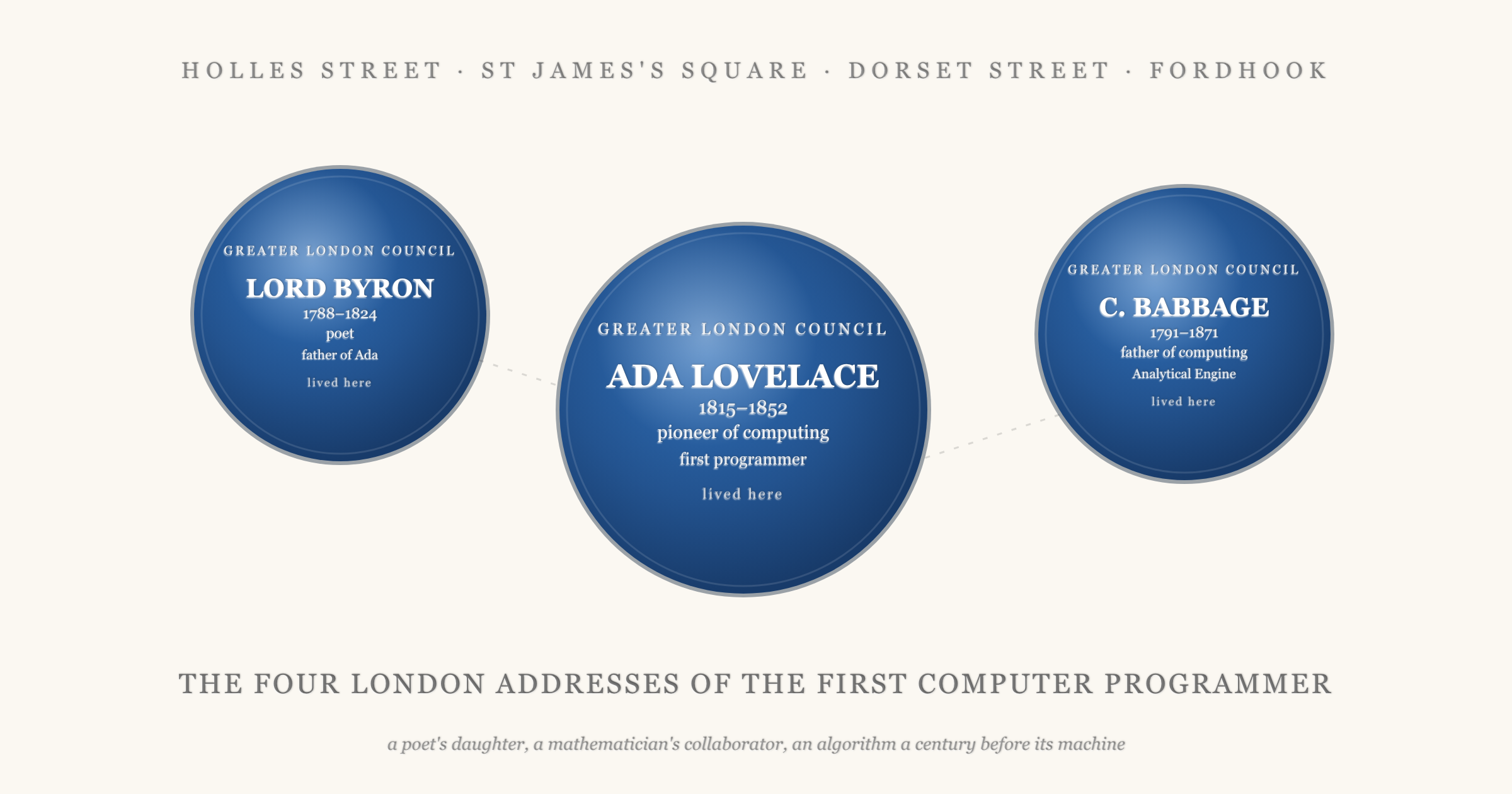
Why Ada Lovelace Has Plaques in Four Different London Boroughs
The English Heritage scheme limits a single official blue plaque per person at the most significant surviving address. Ada Lovelace has one, the blue plaque at 12 St James's Square in Westminster, where she lived as Countess of Lovelace. The other three plaques on the walk are not all hers. Two belong to the men whose lives she was bracketed by: Lord Byron's green plaque at Holles Street in Marylebone (her father, who left England before her first birthday and never met her again) and Charles Babbage's green plaque at 1a Dorset Street, also in Marylebone (her mathematical collaborator, the inventor of the Analytical Engine). The fourth is a separate Ada plaque in Ealing, a green local-authority plaque at Fordhook, where she was married in 1835.
Four plaques, three subjects, two boroughs (Westminster and Ealing) plus the City of Westminster's Marylebone district where Byron and Babbage's plaques both sit. Together they map the family she came from, the household she set up, the salon where her ideas formed, and the country house where she became Countess of Lovelace. Walked in the order the story unfolds, they trace a remarkable thirty-six years.
Plaque One: Holles Street, Marylebone (Lord Byron, the father she never met)
The earliest of the four plaques in chronological terms. A green plaque on Holles Street, the small road off Cavendish Square where Lord Byron was born on 22 January 1788. The inscription reads:
Lord Byron, widely regarded as one of the greatest British poets was born here 22 January 1788. "Always laugh when you can. It is a cheap medicine."
The actual house Byron was born in (16 Holles Street) was demolished in 1889 to make way for the John Lewis department store, which itself was destroyed by German bombing in September 1940 and rebuilt after the war. The current building on the site is the rebuilt John Lewis. The plaque marks the spot, not a surviving structure.
Byron is the start of the Ada story for two reasons. The first is direct: he is her father. He married Annabella Milbanke, a serious-minded mathematician who would later be called by Byron's friends "the Princess of Parallelograms", on 2 January 1815. Augusta Ada Byron was born on 10 December that year, at the family residence at 13 Piccadilly Terrace (no surviving plaque, the building demolished). The marriage collapsed within five weeks of Ada's birth. Annabella took the infant and left for her parents' house in Leicestershire on 16 January 1816. Byron signed a deed of separation in April 1816 and left England forever a few weeks later, dying eight years later at Missolonghi in the Greek War of Independence.
The second reason Byron starts the story is indirect. Annabella spent the rest of her life trying to suppress Byron's influence on Ada. She drilled mathematics and logic into her daughter from an early age, partly out of conviction (Annabella was a serious mathematician) and partly as a vaccination against what she saw as Byron's "dangerous poetic imagination". Ada absorbed both. The mathematician her mother trained her to become and the imaginative leaper her father had been are the two halves of what she would later put together in Note G.
If you start at Holles Street, you are starting at the absence the rest of Ada's London is structured around. From here it is a fifteen-minute walk south through Mayfair to the second plaque.
Plaque Two: 12 St James's Square, Westminster (Ada's own blue plaque)
The official English Heritage blue plaque, mounted on a Georgian terrace on the east side of St James's Square, between Charles II Street and King Street. The inscription reads:
Ada Countess of Lovelace 1815-1852 pioneer of computing lived here.
This is the plaque most Ada-related London search results point at, and the one to make the centrepiece of the walk. The house belongs to the period when Ada and her husband William King-Noel, by then created the Earl of Lovelace, kept a London residence here for the parliamentary and social season. They had married in 1835 (more on that at the fourth plaque), William inherited the earldom in 1838, and the family kept three principal residences: Ockham Park in Surrey (William's family seat), Horsley Towers near Guildford (a neo-Gothic country house William commissioned), and the London house at St James's Square.
By the time the family moved into the St James's Square address, Ada was deep into her mathematical correspondence with Charles Babbage. The Saturday salons that Babbage held a few streets to the north were where she had first met him in 1833 (introduced by Mary Somerville, the Scottish polymath and one of the first women admitted to the Royal Astronomical Society), where she had first seen the working portion of the Difference Engine, and where she had begun the lifelong correspondence that would produce her work on the Analytical Engine. From St James's Square, Ada's letters to Babbage went out at the rate of several a week during the 1842 to 1843 burst of activity that produced the famous Notes to the Sketch.
The Sketch was a paper by the Italian engineer Luigi Menabrea, published in French in 1842, describing Babbage's lectures on the Analytical Engine he had given in Turin in 1840. Babbage asked Ada to translate it into English. She did, and then, at his suggestion, added a series of seven Notes (labelled A through G) that ran to nearly three times the length of the original paper. Note G contains the algorithm that is now generally regarded as the first published computer program: a step-by-step procedure for computing Bernoulli numbers on the Analytical Engine, with a tabular trace showing the state of each variable at each step. The Notes were published in 1843 in Taylor's Scientific Memoirs under the initials "A.A.L." (Augusta Ada Lovelace) at her own request, partly because women publishing under their own names was complicated in 1843 and partly because she wanted the work judged on its merits.
Note G is also the source of the much-quoted passage in which Ada described what the Analytical Engine could and could not do:
The Analytical Engine has no pretensions whatever to originate anything. It can do whatever we know how to order it to perform.
This passage, sometimes called Lady Lovelace's Objection, was cited by Alan Turing a century later in his 1950 Mind paper "Computing Machinery and Intelligence", where he argued against it as evidence that machines could not think. Whether Ada was right or whether Turing was, the conversation she started in Note G is one the field has not finished having. (Turing has his own London plaques; see our Alan Turing London walk.)
She lived in this house for fewer than ten years before her death from uterine cancer in 1852. The house was where she returned for treatment, where she dictated letters during her final months, and where her mother Annabella controversially took over the religious instruction of her dying daughter, attempting to extract a deathbed confession of various imagined sins. Ada died on 27 November 1852 at the age of thirty-six, the same age as Byron at his death. She is buried alongside Byron at the Church of St Mary Magdalene in Hucknall, Nottinghamshire, by her own explicit instruction, an act that infuriated her mother, who had spent thirty-six years trying to keep them apart.
Plaque Three: 1a Dorset Street, Marylebone (Babbage's Saturday salons)
A green plaque on the wall at the corner of Dorset Street and Manchester Square, marking the site of Charles Babbage's London house from 1839 until his death in 1871. The inscription reads:
Charles Babbage (1791-1871) mathematician & pioneer of the modern computer lived in a house on this site 1839-1871.
This is the address most directly linked to Ada's mathematical work, even though it is not her plaque. Babbage held Saturday-evening salons here that drew much of mid-Victorian scientific and intellectual London: Charles Darwin, Charles Dickens, Florence Nightingale (whose own London plaques are mapped here), Michael Faraday, Mary Somerville, the geologist Charles Lyell, the engineer Isambard Kingdom Brunel. The salons were the working environment in which Ada, Babbage, and a small circle of correspondents thrashed out the theory of the Analytical Engine. The portion of the unfinished Difference Engine that had been built sat in a workshop at the back of the Dorset Street house and could be demonstrated to visitors.
Ada attended the salons throughout the 1840s. The mathematics she was doing at this stage went well beyond her formal education (which had been good but not exceptional by the standards of mathematical training available to British men of the period). She was studying calculus with Augustus De Morgan, professor of mathematics at University College London, by correspondence, and the De Morgan letters that survive show her working through what would now be considered an undergraduate analysis curriculum on her own. Her self-described "imaginative" approach (her phrase, used in a famous letter to Babbage in which she said she had "a peculiarity of nervous system" that allowed her to "perceive what is hidden in mathematical relations") was unusual for the period and is the part of her temperament that her mother had spent decades trying to suppress.
The Dorset Street house no longer stands. The current building on the site is a 20th-century block. The plaque is mounted at street level on the corner. From St James's Square, Dorset Street is about a fifteen-minute walk north through Mayfair and across Oxford Street into Marylebone. The walk takes you past several other plaques worth a brief stop, including the Wallace Collection (Manchester Square) and the Wigmore Hall area's clutch of musical and literary plaques.
If you have time for one detour, the Royal Institution at 21 Albemarle Street (a few minutes south of Babbage's house) was where Faraday gave the lectures Ada attended as a teenager in the late 1820s and early 1830s. Faraday's plaque at 48 Blandford Street (his apprenticeship address as a bookbinder) is also walkable from Dorset Street. Together they sketch the scientific London Ada moved through.
Plaque Four: Fordhook Avenue, Ealing (the wedding house)
The fourth plaque, and the one most often missed because it sits well outside central London. A green plaque on Fordhook Avenue, just south of Ealing Common, on the site of the now-demolished Fordhook House. The inscription reads:
Ada Countess of Lovelace computer pioneer 1815-1852 lived & was married at Fordhook near this site in 1835.
Fordhook was the country house belonging to Lady Byron (Annabella's title after Byron's death) where Annabella and Ada lived during periods of the 1830s. The house had a longer history; Henry Fielding, the novelist and magistrate, had owned it in the 1750s and sailed to Lisbon from it in 1754 in a final attempt to recover his health. By the time Annabella bought it in the early 1830s, Fielding's house had been substantially altered, but the building Ada lived in was effectively the same structure he had lived in.
Ada married William King at Fordhook on 8 July 1835. The marriage was small, family-only, and conducted by the local rector. William was eleven years older, a graduate of Trinity College Cambridge, owner of Ockham Park, and within three years would inherit the recreated Lovelace earldom (a family title that had lapsed and been revived). Ada became Countess of Lovelace by his elevation. Their three children (Byron, Anne Isabella, and Ralph) were born across the late 1830s.
Fordhook House was demolished in the early 20th century and the site redeveloped as residential streets. Fordhook Avenue is the road that traces the original drive. The plaque marks the absence of the house. From central London, Fordhook is about thirty minutes by Underground (Ealing Common station on the District line). It is the optional fourth stop, but the one that completes the chronology.
How to Walk the Route in One Afternoon
The full Ada Lovelace London walk is roughly four miles end to end if you do all four plaques, with the Ealing leg done by Tube. A practical itinerary:
- Start at Holles Street, Marylebone (Bond Street tube). Ten minutes at the Byron plaque outside the rebuilt John Lewis. Walk south.
- Walk to St James's Square via Hanover Square and Piccadilly Circus (about 25 minutes). Pause at 13 Piccadilly Terrace if you want to mark the unplaqued birthplace; the address is now occupied by a hotel. Continue south.
- Visit 12 St James's Square for the official Ada blue plaque. Forty-five minutes here gives you time to read the inscription, sit in the square garden, and visit the London Library (also on the square) if you have a reader's ticket.
- Walk back north to 1a Dorset Street, Marylebone (about 25 minutes through Mayfair). Babbage's plaque is at the corner. The Wallace Collection on Manchester Square is a worthwhile stop on the way. Forty-five minutes gives you time for the Wallace.
- Optional: take the District line from Bond Street to Ealing Common (about thirty minutes) for the Fordhook Avenue plaque. This is the long-form option for the full chronology.
Total walking time, central London only: about an hour and a half. Total with reading and stops: half a day. With the Ealing leg added: a full day with a Tube journey.
Why Ada Lovelace Day Falls in October
Ada Lovelace Day is celebrated on the second Tuesday of October each year, an annual event founded by the technology activist Suw Charman-Anderson in 2009 to highlight the work of women in science, technology, engineering, and mathematics. The date is not Ada's birthday (10 December) or the date of her death (27 November). The October date was chosen because it sits between academic-year-start celebrations and the run-up to year-end conferences, a deliberately practical choice rather than a biographical one.
The day is now marked at major science institutions across the UK and internationally. The Royal Society holds a Diversity in STEM event around it. The Science Museum in South Kensington (which has hung a portrait of Ada in its mathematics gallery) often runs related programming. The connections to her London geography are direct: most of the institutions that mark Ada Lovelace Day are within walking distance of one or other of the four plaques on this walk.
If you happen to be in London in mid-October, the second Tuesday of the month is the right day to do this walk. The plaques are quiet, the institutions are programming around them, and the city has, briefly, an explicit reason to think about the woman whose name now belongs to the U.S. Department of Defence's Ada programming language (1980), the U.K. Government's Ada Lovelace Institute (2018), and a steadily growing portion of mainstream technology history.
What the Plaques Don't Tell You
Three pieces of context the inscriptions are too short to capture, worth carrying as you walk.
The Bernoulli algorithm in Note G is a real program. Modern reconstructions (Allan Bromley's 1990 paper in the Annals of the History of Computing is the canonical analysis) have shown that the algorithm is correct, that it would have run on the Analytical Engine had the Engine been built, and that it goes substantially beyond anything in Babbage's own published writing on the machine. Babbage himself acknowledged in correspondence that Ada had identified loop structures and conditional branching he had not articulated. The historical question of "how much of the Notes is Ada and how much is Babbage" is unresolved at the margins, but the consensus is that Note G is hers.
The Analytical Engine was never built in her lifetime, and was barely built in any lifetime. Babbage produced detailed designs but no working machine. A small portion of the Difference Engine (an earlier, simpler design) was demonstrated, but the full Difference Engine and the more powerful Analytical Engine remained on paper. The Science Museum in London built a working Difference Engine No. 2 in 1991, two centuries after Babbage's birth. The Analytical Engine has still never been built. Ada wrote a program for a machine that did not exist, would not exist for a century, and even today exists only in design documents.
The wager about her death age is true. Ada died at thirty-six years and ten months. Byron died at thirty-six years and three months. The coincidence was noticed at the time, was emphasised by Annabella in her later writings, and is one of the eerier pieces of biographical symmetry in 19th-century British history. Whether the wager is meaningful or coincidental is a matter of taste. It is, factually, what happened.
Plan the Walk in Legacy
The Ada Lovelace London walk is one of several literary, scientific, and historical routes that the Legacy app maps across the city. The app covers all 1,625-plus blue and green plaques in the openplaques dataset, with full inscription text, historical context, and walkable routes between them. If you are planning a Lovelace walk for Ada Lovelace Day, or a longer mathematical-London tour that connects Ada's plaques to the Babbage and Turing plaques nearby, open the app and use the women-in-STEM filter to surface the related plaques on the same map. The four plaques in this article are the start; the full network around them is much larger.