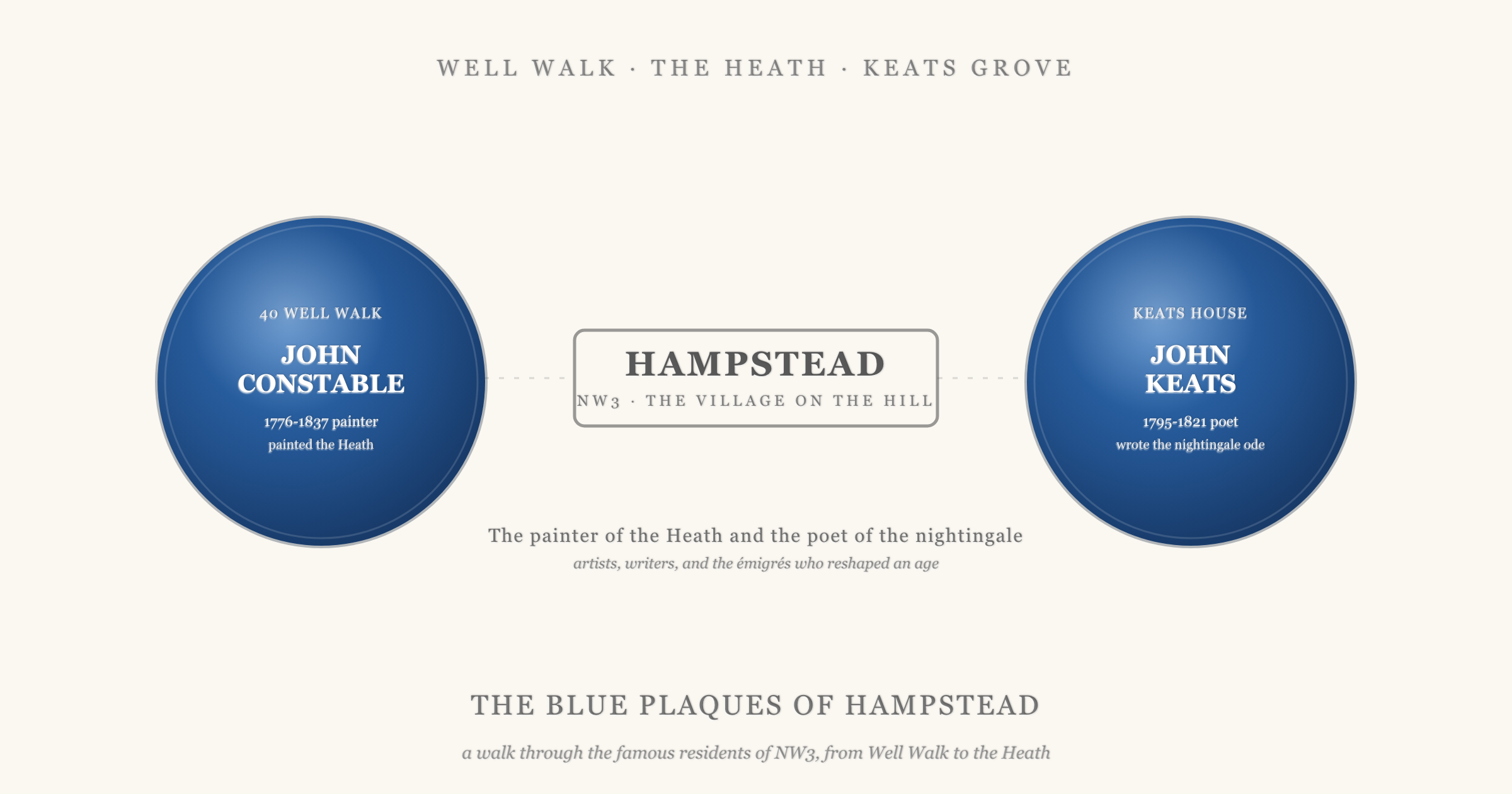
Hampstead is the village on the hill that London's artists, writers, and thinkers have been escaping to for three hundred years. High above the city, with its steep lanes, Georgian terraces, and the great wild expanse of Hampstead Heath at its edge, it has drawn a density of creative talent that few places on earth can match, and the blue plaques prove it: a painter who made the Heath itself famous, a poet who wrote some of the greatest verse in English here, and a remarkable colony of émigrés who reshaped twentieth-century thought. This is a walking guide to the blue plaques of Hampstead, NW3, from the painters of the Heath to the writers of the lanes to the exiles who found a home on the hill.
For the wider scheme and how to read the markers, our complete guide to London's blue plaques is the place to start. Here, the focus stays up the hill, in Hampstead.
The Painters of the Heath: Constable
Hampstead's greatest artistic association is with John Constable, the landscape painter who did more than anyone to fix the English countryside in the national imagination, and who found one of his great subjects right here. Constable lived in Hampstead from 1819, taking lodgings including at 40 Well Walk and 2 Lower Terrace, and he painted Hampstead Heath again and again: its skies, its trees, its weather. His famous cloud studies, sketched on the Heath, are some of the most influential paintings of the sky ever made. He is buried in the churchyard of St John-at-Hampstead, and to walk the Heath today is to walk through his paintings.
Constable was not the only painter drawn to the hill. The great portraitist George Romney lived at 5 Holly Bush Hill, and the beloved children's-book illustrator Kate Greenaway lived and died at 39 Frognal, in a house designed for her by the architect Norman Shaw. Hampstead's light and air, and its escape from the soot of the city below, made it an artists' colony long before it became a literary one.
The Writers of the Lanes
If Constable owns Hampstead's art, the writers own its streets. The most luminous of them is John Keats, who lived from 1818 in the house now known as Keats House on Keats Grove, where he wrote "Ode to a Nightingale," fell in love with his neighbour Fanny Brawne, and produced much of the poetry that made him immortal before his death at just twenty-five. The house is now a museum, and we tell its full story in our guide to Keats House.
Keats is the start of a long literary roll-call. Robert Louis Stevenson, author of Treasure Island, lived at 7 Mount Vernon; the short-story writer Katherine Mansfield lived at 17 East Heath Road; D. H. Lawrence lived at 1 Byron Villas in the Vale of Health in 1915; and John Galsworthy, author of The Forsyte Saga and a Nobel laureate, lived at Grove Lodge on Admiral's Walk. Hampstead also nurtured a dynasty: George du Maurier, the Punch artist and author of Trilby, lived at New Grove House, beginning a creative line that ran through his actor son Sir Gerald to his granddaughter, the novelist Daphne du Maurier.
The Émigré Thinkers: Freud, the Isokon, and the Hill of Exiles
Hampstead's most extraordinary chapter is its role, in the 1930s especially, as a refuge for the brilliant minds fleeing fascism in Europe. The hill became one of the great gathering points of émigré genius.
The most famous arrival was Sigmund Freud, who spent his final year in Hampstead; his daughter Anna Freud, herself a pioneer of child psychoanalysis, has a plaque at 20 Maresfield Gardens, the family home that is now the Freud Museum. Nearby, the modernist Isokon Building on Lawn Road, a startling white concrete block of "minimum flats" opened in 1934, housed an astonishing roster of talent: the Bauhaus masters Walter Gropius, Marcel Breuer, and László Moholy-Nagy all lived there after fleeing Germany, and so, for a time, did the crime writer Agatha Christie. Add the Indian Nobel poet Rabindranath Tagore, who stayed in the Vale of Health, and the family-planning pioneer Marie Stopes on Well Walk, and Hampstead in these years held a concentration of world-changing minds that is hard to believe of one small London suburb.
Orwell, Politics, and the Modern Set
The twentieth century kept coming to Hampstead. George Orwell lived at 77 Parliament Hill and worked in a Hampstead bookshop, an experience that fed his writing; we follow his wider London in George Orwell's London. The Labour leader Hugh Gaitskell lived at 18 Frognal Gardens, the conductor Sir Thomas Beecham on East Heath Road, and the great Russian ballerina Anna Pavlova at Ivy House by Golders Hill, where she kept a garden of her beloved swans. From radical politics to high culture, the hill kept drawing the people who shaped the age.
A Suggested Walking Route
Hampstead is steep and tangled, which is part of its charm, and a slow wander is the way to take it in.
- Well Walk and Flask Walk. Begin with Constable at 40 Well Walk and Marie Stopes nearby, in the heart of the old village.
- The Heath. Walk out onto Hampstead Heath, Constable's great subject, and up to the views from Parliament Hill, near Orwell's old home.
- The Vale of Health. Drop into the hidden hamlet where D. H. Lawrence and Tagore stayed.
- Church Row and Frognal. Wind back past the painters' and writers' houses and St John-at-Hampstead, where Constable is buried.
- Keats Grove. Finish at Keats House, where the nightingale ode was written.
It is a route that climbs from a Georgian village into a wild heath and back through three centuries of art, literature, and exile.
Discover the Plaques Yourself
Hampstead's plaques are part of a far larger web of markers across London, recording where its painters, writers, and thinkers lived and worked. Tracing them turns a walk up the hill into a walk through the making of British and European culture, from a cloud study sketched on the Heath to the white walls where the Bauhaus came to rest. The Legacy app maps every blue plaque in the city, with the full inscription and the history behind it, so you can plan your own route, collect the ones you visit, and follow the trail onward, perhaps to Keats House itself or deeper into the complete guide to London's blue plaques. Start on Well Walk, and climb toward the Heath.