George Orwell's London is the writer's London, not the soldier's or the journalist-of-the-North's. The five years in Burma as an Imperial Police officer (1922 to 1927) belong to Burma. The Northern industrial-poverty research that produced The Road to Wigan Pier (1937) belongs to Wigan and Sheffield. The Spanish Civil War belongs to Catalonia. The dying years that produced Nineteen Eighty-Four mostly belong to the Hebridean island of Jura. What London holds is the developmental arc: the Portobello Road lodgings he took the week he returned from Burma in 1927, determined to become a writer; the Hampstead bookshop and lodging house of the mid-1930s, when he was still working other jobs to pay rent; the BBC Broadcasting House years of 1941 to 1943, where the Indian Section conference room number 101 gave Nineteen Eighty-Four its Room 101; and the Canonbury Square top-floor flat in Islington (1944 to 1947), where he finished Animal Farm and began Nineteen Eighty-Four.
This is the walking guide to George Orwell's London. The four sites are geographically scattered (Notting Hill, Hampstead, Marylebone, Islington), which is itself the point: Orwell's London is the city as a writer moved through it in twenty years, not as a tourist would arrange it in an afternoon. The four sites are connected by chronology, not by a continuous walk; the practical structure is one site per Underground stop, four hops across a day. The Legacy app plots all four alongside the other twentieth-century literary plaques on the London map, including Oscar Wilde, Bloomsbury Group, and Charles Dickens, so the walking-day can be threaded with the other London-author markers as time allows.
The Writer London Made
Eric Arthur Blair was born in 1903 in Motihari, in what was then British India, the son of an Opium Department clerk in the Indian Civil Service. He was sent to England at the age of one, schooled at St Cyprian's preparatory school in Eastbourne and then at Eton, and returned to the East in 1922 as a probationary Assistant Superintendent of the Indian Imperial Police, posted to Burma. The five years in Burma were the experience that broke him as a colonial functionary and made him as a writer. He resigned in 1927 on home leave, sat his parents in Southwold down for what must have been a difficult conversation, and announced he would not be returning to Burma. He would write.
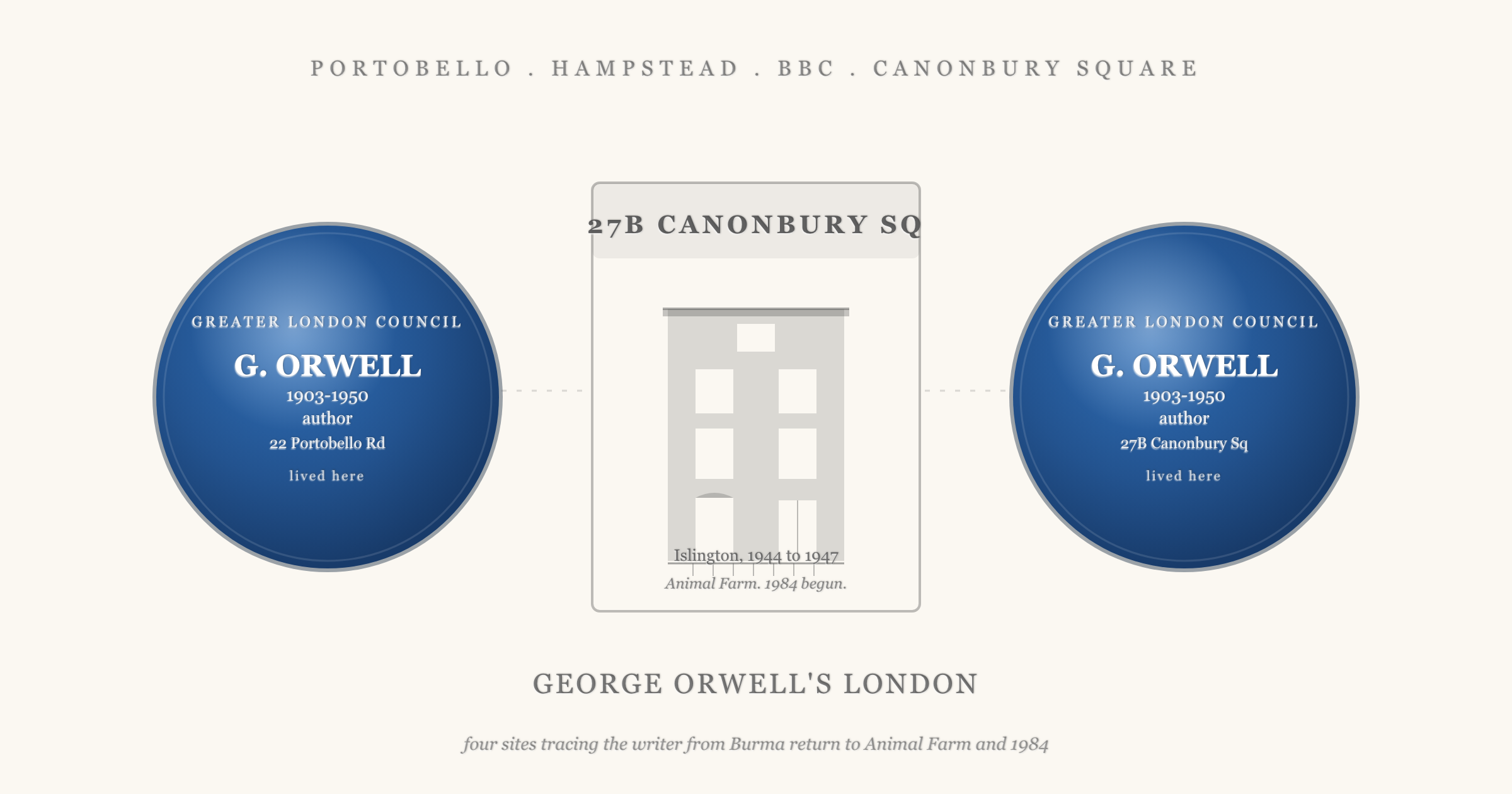
The London phase of the writing life starts that autumn, in 1927, in a lodging at 22 Portobello Road in Notting Hill. Over the next twenty-two years he would move through perhaps fifteen London addresses, mostly rented rooms and small flats, almost all in the broad arc from Hampstead in the north-west to Islington in the north-east, with one major southern interlude when he ran a smallholding in Hertfordshire (1936 to 1940) and one wartime stint in central London at the BBC. The pen name "George Orwell" was chosen in 1933, before the publication of his first book, Down and Out in Paris and London, drawn from England's St George and the Orwell River in Suffolk, where the family had a summer cottage. Eric Blair the man retained the legal name and answered to it among friends; George Orwell was the byline.
The London years did the developmental work that turned a colonial functionary's contempt for empire into a writer's voice with a specific ear for English prose, a specific eye for the way ordinary people lived, and a specific suspicion of any political certainty that did not survive contact with that life. Burma gave him the contempt. Wigan and Spain gave him the politics. London gave him the prose.
Stop One: 22 Portobello Road, Notting Hill
The first plaque on the walking tour is also the first lodging Orwell took on the return from Burma. 22 Portobello Road, in the part of Notting Hill that runs north from Notting Hill Gate Underground station toward the famous market, was a boarding house in 1927 and is still a residential building today. The English Heritage blue plaque records that Eric Blair (the name on the plaque, not the pseudonym Orwell would later adopt) lived in the house in 1927. The lodging was modest, a single furnished room rented from a Mrs Craig, on a road that in 1927 was working-class respectable, decidedly not yet the antiques-market destination it would become after the Second World War.
The Portobello Road months are the period when Orwell decided what he was going to write and how he was going to live to support the writing. The decision he made was the central decision of his early career: he would deliberately live among the destitute, the unemployed, the homeless, and the hop-pickers, on the grounds that he could not write honestly about the conditions of the poor in industrial Britain until he had taken on those conditions himself. The "tramping" expeditions through East-End London doss-houses and Kent hop fields, dressed in second-hand work clothes that smelled enough of poverty to be accepted, began from Portobello Road in late 1927. The material from those expeditions, refined across the next four years in Paris and back in England, became Down and Out in Paris and London (1933), the first book and the first appearance of the pseudonym.
The Notting Hill of the Portobello Road plaque is not the Notting Hill of the 1958 race riots, the 1990s Hugh Grant film, or the present-day antique market. It is the pre-war Notting Hill of immigrant boarding houses, second-hand-clothes shops, and Sunday-only street trading on the lower section of the road. Walking the street today, looking at the cast-iron Victorian terraces and the slightly grimy stuccoed fronts, the bones of the lodging-house Notting Hill Orwell knew are still visible, particularly on the section north of the bridge under the Westway. The plaque is high on the front of number 22 and is visible from the pavement opposite.
Getting there: Notting Hill Gate Underground (Central, District, Circle), then north on Pembridge Road, left onto Portobello Road. About a five-minute walk.
Stop Two: 77 Parliament Hill (and Booklovers' Corner, South End Green)
The second plaque is in Hampstead, on a Victorian terraced house on 77 Parliament Hill on the eastern edge of Hampstead Heath. The English Heritage plaque records that Orwell lived in the house in 1935. Like the Portobello Road plaque, it is modest in scale and high on the facade.
The Parliament Hill year is the year Orwell was lodging with the Westrope family in a household that became part of his Hampstead routine. Mrs Westrope ran a quietly bohemian boarding-house environment that suited Orwell's mid-1930s circumstances: he was poor, recently returned from Paris and the East-End research, and writing both fiction (the novels A Clergyman's Daughter and Keep the Aspidistra Flying) and the long-form non-fiction that would become The Road to Wigan Pier. He needed a clean room and tolerant landlords. Parliament Hill provided both.
What makes the Hampstead site geographically richer than a single plaque is that Orwell worked five minutes away, in a part-time job that paid his rent. Booklovers' Corner, a small second-hand bookshop on the corner of South End Road and Pond Street, just below Hampstead Heath's southern fringe at South End Green, employed Orwell as a shop assistant from October 1934 to January 1936. The job was a Mr and Mrs Westrope arrangement: the Westropes were the bookshop's owners as well as Orwell's landlords, and the job came as part of the lodging. Booklovers' Corner is no longer a bookshop (the building has been a pizza restaurant for several decades), but the corner is unchanged and the building is the same: a Victorian commercial-residential block on the angled south-east corner of South End Green.
Booklovers' Corner gave Orwell two things. It gave him steady part-time income, three afternoons a week, with mornings free to write. And it gave him the material for the novel Keep the Aspidistra Flying (1936), whose protagonist Gordon Comstock is a poet failing in love and failing at his bookshop job in a thinly-fictionalised version of Booklovers' Corner. The novel's bookshop scenes, the long observational sketches of customers and stock and the dust on the upper shelves, are direct portraits of the Hampstead shop.
The combination is unusual on the Orwell map: a working address (the shop) and a lodging address (the house) within five minutes of each other, both still architecturally present, both feeding directly into a published book. Standing on South End Green and looking up Parliament Hill toward number 77 is the closest the walking tour gets to seeing Orwell's daily routine inscribed on the street.
Getting there: Belsize Park or Hampstead Heath Overground, then a five-minute walk to South End Green for Booklovers' Corner; from there a ten-minute walk up Parliament Hill to number 77.
Stop Three: BBC Broadcasting House, Portland Place
The third site is the wartime BBC. Orwell worked at Broadcasting House on Portland Place, just north of Oxford Circus, from August 1941 to November 1943, as a Talks Producer for the BBC's Eastern Service, which broadcast English-language wartime programmes to India and South-East Asia. The Eastern Service was effectively wartime cultural propaganda: literary talks, political commentary, news commentary, all aimed at keeping educated Indian audiences sympathetic to the British war effort while India itself was edging toward independence. Orwell, the colonial functionary turned anti-imperialist writer, was an awkward fit for the role and a productive one.
The BBC plaque is inside Broadcasting House rather than mounted on the exterior, in the wartime broadcasting hall where the Eastern Service operated. The plaque acknowledges Orwell as one of the writers and broadcasters who worked from the building during the war. Public access is limited; the BBC runs scheduled tours of Broadcasting House on most weekdays, and the plaque is part of the standard tour route. The exterior of Broadcasting House at the foot of Portland Place is itself worth standing in front of: the curved Art Deco facade by G. Val Myer (1932), with the Eric Gill Prospero and Ariel sculpture above the main entrance, is the building Orwell walked into and out of every working day for over two years.
The most famous Orwell connection to Broadcasting House is Room 101. The Talks Department's main conference room, on the third floor of the old Broadcasting House building, was Room 101. Orwell sat through what he later described as some of the most tedious editorial meetings of his life there. When Nineteen Eighty-Four needed a name for the chamber in the Ministry of Love where Winston Smith is taken to face the thing he fears most, Orwell reached for the room number he had spent two years dreading. Room 101 in the novel is the worst place in the world. Room 101 in Broadcasting House was a meeting room. The transition is one of the great repurposings of personal annoyance into literary symbol.
Orwell resigned from the BBC in November 1943, partly because he wanted to write more of his own work and partly because, as he later wrote, the wartime broadcasting was "of less importance than I should have wished." He moved straight into his next job, as literary editor of the Tribune at 222 Strand, where he wrote his "As I Please" column from December 1943 to early 1945. The Tribune office is unmarked today, but the Strand address is part of the same wartime central-London arc that included Broadcasting House.
Getting there: Oxford Circus Underground (Central, Bakerloo, Victoria), then a three-minute walk north on Regent Street and Portland Place to the foot of Broadcasting House. For the interior plaque and the Room 101 conference space, the BBC tour is the route.
Stop Four: 27B Canonbury Square, Islington
The fourth and most important plaque is in Islington. 27B Canonbury Square is a four-storey Georgian terrace on the south side of Canonbury Square, near Highbury and Islington Underground. The English Heritage plaque records that Orwell lived in the top-floor flat from 1944 to 1947, the most productive years of his life as a writer.
Orwell, his first wife Eileen O'Shaughnessy, and their newly adopted son Richard moved into the Canonbury Square flat in October 1944. Animal Farm, which Orwell had finished in February 1944 after a year of writing in Mortimer Crescent in Kilburn (the flat was destroyed by a flying bomb in June 1944, which is part of why the Canonbury move happened), was awaiting publication; it appeared in August 1945, became a bestseller in the UK and the US, and made Orwell a financially comfortable writer for the first time in his life. Eileen, tragically, died in March 1945 during a hysterectomy operation, before Animal Farm's success; Orwell raised Richard alone in the Canonbury flat with intermittent help from his sister Avril and from a series of housekeepers.
The Canonbury years are the years in which Nineteen Eighty-Four was begun, the years in which Orwell wrote the great post-war essays ("Politics and the English Language" in 1946, "Why I Write" in 1946, the essays on James Burnham and on Tolstoy and Shakespeare, the literary columns for Tribune), and the years in which he made the decision to move to the Hebridean island of Jura to write Nineteen Eighty-Four away from London. The move to Jura was in May 1946 for summer working visits and a near-permanent move in April 1947; the Canonbury flat was retained as the London base. Orwell was diagnosed with tuberculosis on Jura in 1947, came back to London for treatment, and was admitted to University College Hospital in Gower Street (a few hundred yards from where Charles Darwin had lived a century earlier) in September 1949. He died there on the night of January 21, 1950, at the age of 46, of a pulmonary haemorrhage. He had married his second wife Sonia Brownell in the hospital bed three months before. He is buried at All Saints' parish church in Sutton Courtenay, Oxfordshire, in a quiet country churchyard at his own request.
The Canonbury Square plaque is the canonical Orwell site for visitors. Standing in front of it, the four-storey terrace facade above is the building, almost unchanged from 1944 to 1947 in fabric and proportions. The top-floor flat (the windows under the eaves) is the room where the first chapters of Nineteen Eighty-Four were drafted. The square in front is the Islington garden square the Orwells took their toddler son into on the better afternoons. The pubs around the corner (the Marquess Tavern on Canonbury Street is the most direct survival) are pubs Orwell drank in.
Canonbury Square is also one of the most pleasant garden squares in north London to spend an hour in. The square's central garden is open to the public, the terraces are uniformly Georgian and Regency, and the area is comfortably walkable in any direction.
Getting there: Highbury and Islington Underground (Victoria) or Overground, then a five-minute walk south on Canonbury Road, then east on Canonbury Square. The plaque is on the south side of the square.
The Walking Day in Practice
The four sites do not connect on foot. They are four separate Underground hops. The practical sequence:
Start in Notting Hill in the morning. Notting Hill Gate Underground, then north to 22 Portobello Road. Coffee at one of the many cafes on the lower section of the road, or breakfast at Pellicci's-style greasy-spoon survivors on Kensington Park Road. Allow forty minutes for the plaque and a stroll up the antiques-market section of Portobello Road. The market is at its busiest on Saturdays; Friday or Sunday morning is calmer.
Mid-morning to Hampstead. Notting Hill Gate (Central line) east to Tottenham Court Road, change to the Northern line, north to Belsize Park or Hampstead Heath Overground. Walk to South End Green for the Booklovers' Corner corner, then up Parliament Hill to the number 77 plaque. Allow ninety minutes, including lunch at one of the South End Green or Hampstead Heath fringe pubs, of which the Magdala (the pub outside which Ruth Ellis shot her lover David Blakely in 1955) and the Wells Tavern on Well Walk are both walking distance.
Early afternoon to the BBC. Hampstead Heath Overground south to Highbury and Islington (via the North London Line), or Northern line south to Oxford Circus and walk to Broadcasting House. If you have booked a BBC tour, this is the slot. If not, the exterior facade plus the Eric Gill Prospero and Ariel above the door is enough for a thirty-minute visit; carry on into Marylebone for the route to Islington.
Late afternoon to Canonbury Square. Oxford Circus (Victoria line) to Highbury and Islington, then a five-minute walk south to Canonbury Square. The plaque, the square, and a drink at the Marquess Tavern or another of the Canonbury pubs is the natural close to the day. Around 5 to 6 pm in the summer the square's garden is at its quietest.
Total walking and travel time for the four sites is about six hours, including transit, pauses, and a long lunch. The day fits comfortably into a single Saturday or Sunday for a London visitor.
Why Orwell's London Matters
Orwell's London is not a tourist itinerary in the way Dickens's London or Sherlock Holmes's Baker Street is. There are no Orwell museums, no themed restaurants, no statue (a 2017 statue by Martin Jennings outside Broadcasting House is the partial exception, but it commemorates the BBC connection specifically and is small and quiet). The plaques are modest. The associated buildings are working residences and a working broadcast headquarters, not preserved interiors.
What the four sites give the walker is the developmental arc. Portobello Road is the moment Orwell decided he would write rather than continue as a colonial functionary. Parliament Hill and Booklovers' Corner are the mid-1930s years when he was still earning rent in a bookshop and writing in the mornings, before the political clarity of Spain and Wigan. The BBC is the wartime period when he was inside a state propaganda apparatus and learning, from the inside, how language is bent by institutions, the material that would become "Politics and the English Language" and the appendix on Newspeak. Canonbury Square is the post-war success period, the brief good years in which Animal Farm made him a known writer and Nineteen Eighty-Four was being typed at the top of a Georgian terrace before the tuberculosis closed in.
The visiting interest of the day is in the contrast. Orwell lived in cheaper and quieter parts of London than the literary tourism map of Bloomsbury and Westminster usually suggests. The streets are quiet residential streets, the buildings are working residences, the pubs are local pubs. The interpretation work, in Orwell's case more than for most twentieth-century English writers, is the work the visitor does standing in front of an ordinary house and remembering what was written inside it.
The Legacy app plots all four Orwell sites on the London plaque map alongside the literary-London cluster that includes Oscar Wilde's Tite Street, the Bloomsbury Group's Gordon Square, the Keats House in Hampstead, and the Charles Dickens Museum on Doughty Street, so the walking day can be threaded with other writers' London markers for those visitors who want to thread Orwell's twentieth-century arc into the longer story of London's literary commemoration.
George Orwell's London is the writer's London: four sites that are not on the tourist trail, not architecturally famous, not even visually striking, but together they trace the twenty-two-year arc from the Burma return to the Animal Farm and Nineteen Eighty-Four breakthrough. The plaques are quiet. The walking day is short. The novels are still in print and still on the shelves of the Booklovers' Corner that no longer exists.