Emmeline Pankhurst was born in Manchester in 1858, founded the Women's Social and Political Union there in 1903, and then made London the stage on which the militant campaign for women's suffrage was won. From 1906 the WSPU ran its operation out of offices off the Strand and on Kingsway, marched its deputations from Westminster halls to the doors of the House of Commons, and filled the cells of Holloway Prison with hunger-striking women whose treatment turned public opinion. Pankhurst herself was imprisoned, released, and re-arrested under the so-called Cat and Mouse Act, and died in June 1928 just weeks before Parliament finally gave women the vote on equal terms with men. The London she fought in is still walkable, and five sites trace the whole arc of the story.
This is the guide that connects them. Pankhurst's London runs from a quiet Notting Hill street to the heart of Westminster: the English Heritage blue plaque at 50 Clarendon Road that she shares with her daughter Christabel, the Caxton Hall meeting room where the WSPU held its "Women's Parliaments," the 1930 statue in Victoria Tower Gardens that stands within sight of the building she campaigned against, the Holloway Prison site in north London where the hunger strikes and force-feeding happened, and her grave in Brompton Cemetery in the west. Walked in roughly chronological order, the five sites move from the campaign headquarters to the cell to the memorial. If you want to follow the route, the Legacy app maps every London plaque connected to the suffragette movement and gives you the inscription text plus the historical context for each one.
The Plaque, the Statue, and the Word "Suffragette"
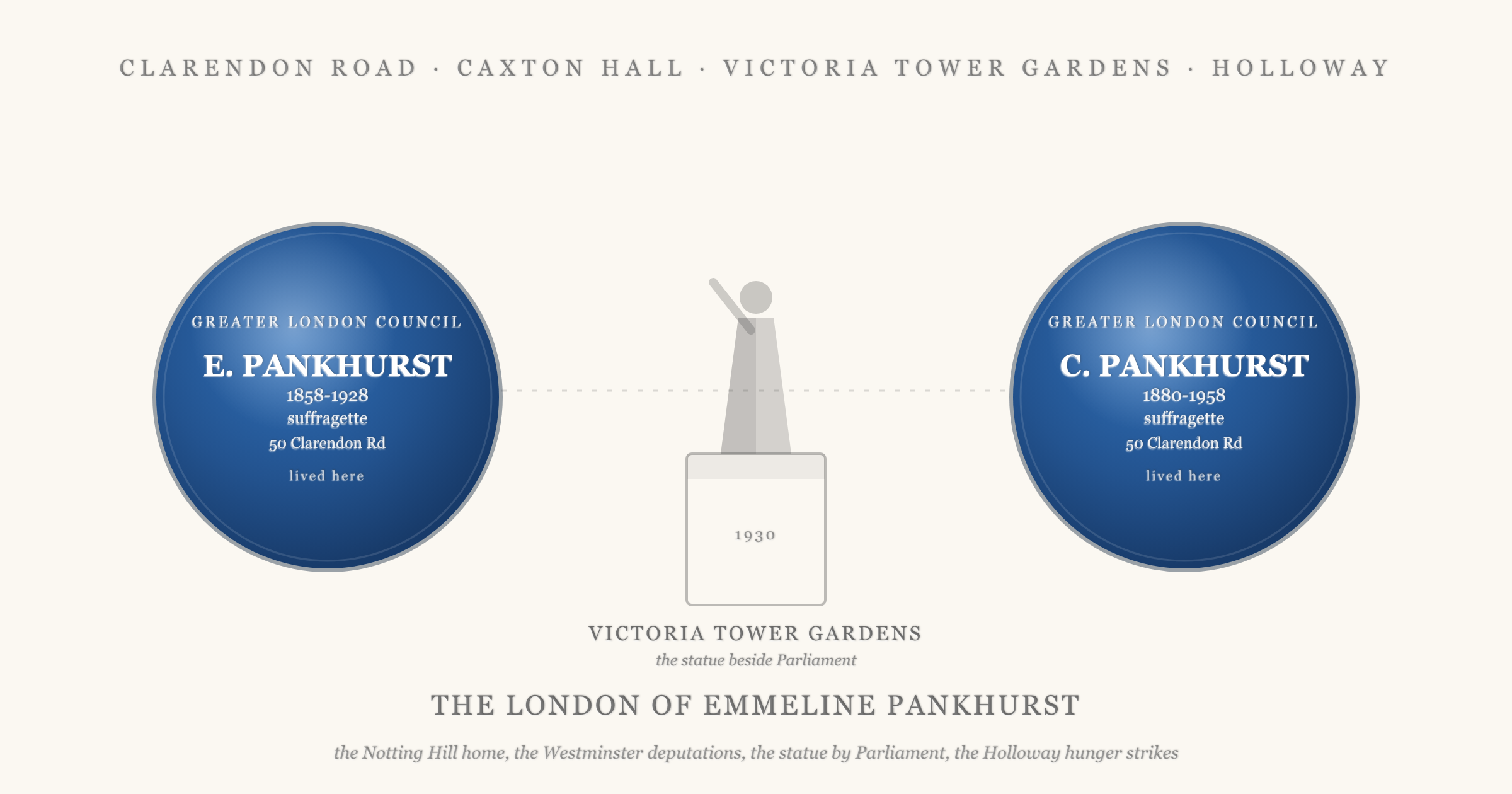
Two London memorials carry Pankhurst's name directly. The English Heritage blue plaque at 50 Clarendon Road, in Holland Park, reads for both Emmeline and her eldest daughter Christabel Pankhurst, the two leaders of the WSPU, who lived at the house. The 1930 statue in Victoria Tower Gardens, beside the Houses of Parliament, is the public memorial, unveiled two years after her death. Between the two sit the working locations of the campaign: the meeting halls, the prison, and the offices.
It is worth being precise about the word. "Suffragette" was coined by the Daily Mail in 1906 as a belittling diminutive for the militant campaigners of the WSPU, and the women promptly adopted it as a badge of pride, hard "g" and all, to distinguish their "deeds not words" from the patient, law-abiding "suffragists" of Millicent Fawcett's National Union of Women's Suffrage Societies. Pankhurst led the suffragettes. The split between the militant and constitutional wings runs through the whole London geography of the movement, and the statue of Fawcett that now stands in Parliament Square (the first statue of a woman in that square, unveiled in 2018) marks the other half of the story a few hundred metres from Pankhurst's own monument.
Stop One: 50 Clarendon Road (the Blue Plaque)
In a residential street in Holland Park, a short walk from Holland Park or Notting Hill Gate Underground stations, the English Heritage blue plaque at 50 Clarendon Road commemorates Emmeline Pankhurst and her daughter Christabel, naming them both as suffragettes who lived at the house. It is the only English Heritage plaque in London to carry Emmeline Pankhurst's name, and it is unusual in the scheme for naming a mother and daughter together, a recognition that the WSPU was led by the two of them in tandem: Emmeline the figurehead and orator, Christabel the strategist who eventually ran the campaign from Paris to avoid arrest.
The house is privately owned and not open to the public, but the plaque is mounted at a readable height from the pavement. Clarendon Road is a fitting first stop because it marks the domestic side of a life that was overwhelmingly public. Emmeline Pankhurst spent very little of the suffrage years at any single address; she lived out of suitcases, on speaking tours, and in prison cells, and the WSPU's real London base was its offices rather than any home. The Clarendon Road plaque is the closest the scheme comes to a residence for a woman who was constantly on the move.
Stop Two: Caxton Hall (the Women's Parliament)
A walk or short Underground ride east into Westminster brings you to Caxton Hall, on Caxton Street near St James's Park. From 1907 the WSPU used Caxton Hall as the venue for what it called the "Women's Parliament," sessions timed to coincide with the State Opening and the parliamentary calendar, from which the suffragettes would set out in deputations to carry their demands to the House of Commons. The marches from Caxton Hall to Parliament repeatedly ended in confrontation with police and in mass arrests; the first Women's Parliament in February 1907 led to a melee at the gates of Westminster that the press called the "Battle of Westminster" and that filled the Holloway cells.
The hall itself, a red-brick and stone Victorian building, later became better known as a register office for fashionable weddings, but in the suffragette years it was a campaign headquarters in all but name. From Caxton Street it is a few minutes' walk to Parliament Square and the river, the same short, charged distance the deputations covered when they tried to reach the Commons. Walking it today, with the Supreme Court and the Palace of Westminster ahead, gives a sense of how close the campaign brought its confrontation to the seat of power.
Stop Three: The Statue in Victoria Tower Gardens
South of the Palace of Westminster, in Victoria Tower Gardens beside the river, stands the statue of Emmeline Pankhurst. Sculpted by Arthur George Walker and unveiled in 1930 by the former Prime Minister Stanley Baldwin, it shows Pankhurst in characteristic pose, addressing a crowd. A memorial to Christabel Pankhurst, including the WSPU's "prison brooch" portcullis badge, was added beside it some years later, making the monument a tribute to both women and to the union they led.
The placement is deliberate and pointed: the statue stands within sight of the building whose members the suffragettes spent years trying to reach, a permanent reminder set down by the same establishment that had once imprisoned the woman it commemorates. The monument is a listed structure, and it has been the subject of its own modern campaign: a proposal in recent years to relocate it to Regent's Park drew strong objection from those who argued that the meaning of the statue is inseparable from its position beside Parliament, and it has remained in Victoria Tower Gardens. The gardens are open and free to walk through, and the statue sits a couple of minutes from the Houses of Parliament and the Buxton Memorial fountain.
Stop Four: Holloway Prison
North of the centre, in Islington, the site of the former Holloway Prison is the hardest and most important stop on the route. Holloway was the prison that held the suffragettes, and it was here that the campaign's most harrowing chapter played out. From 1909, imprisoned suffragettes began to refuse food, and the authorities responded with force-feeding, a violent and dangerous procedure that involved restraining the woman and passing a tube into the stomach. The public revulsion at the force-feeding of middle-class women was one of the things that shifted opinion toward the cause.
The government's answer to the hunger strikes was the Prisoners (Temporary Discharge for Ill-Health) Act of 1913, known almost universally as the Cat and Mouse Act: a hunger-striking prisoner would be released when she grew dangerously weak, then re-arrested once she had recovered to serve the rest of her sentence. Emmeline Pankhurst was caught in this cycle repeatedly, released and re-arrested again and again, her health worn down by the strikes. Holloway closed as a prison in 2016, and the large site is being redeveloped, with the suffragette history a central part of how the campaigners and local groups have argued the place should be remembered. A memorial near the former prison marks the women who were held and force-fed there.
The Optional Fifth Stop: Brompton Cemetery
In the west of the city, in Brompton Cemetery between Earl's Court and Fulham, Emmeline Pankhurst is buried. She died on 14 June 1928, at the age of sixty-nine, her constitution broken by the years of strikes and imprisonment. Her death came only weeks before the Representation of the People (Equal Franchise) Act 1928 received royal assent in July, the law that finally gave women the vote on the same terms as men, at twenty-one. She had lived to see the 1918 Act, which enfranchised women over thirty who met a property qualification, but she died just short of the equal franchise that was the WSPU's original demand.
Her grave in Brompton Cemetery is marked by a Celtic cross and is a recognised stop for visitors tracing the history of the movement. The cemetery is one of London's "Magnificent Seven" Victorian burial grounds, open to the public during daylight hours, and the grave can be combined with a visit to the cemetery's other notable monuments. As a final stop it closes the route the way the life closed: short of the full victory, but close enough to see it coming.
The Walking Route in Practice
The five sites are spread across the city, so this is a route best done in two halves or with the Underground between stops rather than as a single continuous walk.
Start at 50 Clarendon Road in Holland Park, ten minutes from Holland Park or Notting Hill Gate stations. Read and photograph the plaque, then take the Central Line and District or Circle Lines toward Westminster.
Caxton Hall, Victoria Tower Gardens, and Parliament Square form a tight Westminster cluster. From St James's Park station, walk to Caxton Hall on Caxton Street, then down toward Parliament Square and through to Victoria Tower Gardens for the statue. Allow an hour for this central section, including time to read the Fawcett statue in Parliament Square as a counterpoint. The three points are within ten minutes of one another on foot.
Holloway is a separate trip by Underground to Caledonian Road or Holloway Road and a short walk to the former prison site in Islington. Check current access, because the site is under redevelopment.
Brompton Cemetery is reached via West Brompton station and is open during daylight hours; the grave is within the cemetery grounds. Treat it as an optional final stop if you have the time and want to complete the arc.
How Pankhurst's London Connects to the Rest of the Map
Emmeline Pankhurst's route overlaps several other London walks already on this blog. The Westminster cluster of Caxton Hall, the statue, and Parliament Square sits within minutes of the Winston Churchill walking tour of the Cabinet War Rooms and Parliament Square, and a short distance from the Florence Nightingale plaques in Mayfair. For the longer thread of women who changed British public life, the Mary Wollstonecraft route traces the mother of modern feminism through Westminster and Newington Green a century before the suffragettes, the natural prequel to the Pankhurst story. And the Holland Park starting point is a manageable walk or bus ride from the Bloomsbury Group's London, the intellectual circle whose own arguments about women, work, and independence ran in parallel with the suffrage campaign.
The Bottom Line
One English Heritage blue plaque at 50 Clarendon Road that names both Emmeline and Christabel Pankhurst, the Caxton Hall meeting rooms where the Women's Parliaments gathered, the 1930 statue standing beside the Parliament the suffragettes fought to enter, the Holloway Prison site where the hunger strikes and force-feeding happened, and the Brompton Cemetery grave where the campaign's leader was buried weeks before women won the equal vote. Five sites across Holland Park, Westminster, Islington, and West Brompton, tracing the most consequential protest movement in modern British history from its London headquarters to its hardest cost to its memorial. The Legacy app maps the full set and gives you the inscription text plus the historical context for every plaque on the route.