The greatest painter of light in British history was born above a barber's shop in Covent Garden, and a plaque on Maiden Lane is all that marks the spot. Covent Garden is one of the most visited corners of London, a place most people pass through on the way to a show or a market stall, and almost nobody stops to read the markers on its walls. They should. Few neighbourhoods of this size carry so much history per square foot: the birthplace of J.M.W. Turner, the homes of David Garrick and the composer of "Rule, Britannia!", the church where Punch and Judy were first performed in England, the bookshop where Samuel Johnson met James Boswell, and the rooms where a young Charles Dickens learned what poverty felt like. This is a walking guide to Covent Garden's blue plaques and the famous residents they record.
Covent Garden sits in WC2, between the Strand and Long Acre, and its shape is older than almost anything around it. In the 1630s the architect Inigo Jones laid out the Piazza for the Earl of Bedford as London's first modern square, and for three centuries the fruit-and-vegetable market filled it until the traders moved to Nine Elms in 1974. What stayed behind was the theatre district that had grown up around the market, and the plaques that record the people who made it. If you want the wider story of the scheme that put them there, start with our complete guide to London's blue plaques; then come back and walk this one street by street.
The Piazza and the Actors' Church
The heart of Covent Garden is the Piazza, and the building that has watched over it longest is St Paul's Church, designed by Inigo Jones at the same time as the square in the 1630s. It is known to every performer in London as "the actors' church," its walls lined with memorials to stage and screen names, and it has a claim to a particular first in English entertainment. A plaque near the church records that "near this spot Punch's Puppet Show was first performed in England and witnessed by Samuel Pepys." Pepys saw the show in May 1662 and noted it in his diary, which is why the date is taken as the English birthday of Punch and Judy. The spot is marked today by the street performers who still work the Piazza's west portico, a tradition with a documented pedigree of more than 360 years.
The market itself is the other half of the story. For all the centuries the Piazza was a working wholesale market, loud and chaotic at dawn, and the historic pubs and coffee houses around it grew up to serve the porters and traders. When the market left in 1974, the Victorian market buildings were saved from demolition and turned into the shops, cafes, and craft stalls that fill them now, which is why Covent Garden feels like a piece of preserved London rather than a modern development.
Maiden Lane: Turner's Birthplace, Voltaire, and a Murdered Actor
If you walk one street in Covent Garden for its plaques, make it Maiden Lane, a narrow lane behind the Strand that holds an extraordinary run of them.
At 21 Maiden Lane, a plaque records that "Joseph Mallord William Turner RA (1775-1851) artist was born in a house on this site." Turner, the supreme painter of light and weather in British art, was the son of a barber and wig-maker who worked on this lane, and he grew up in the noise and smell of the market before becoming the most celebrated landscape painter of his age. There is no grander origin story hidden on a quieter street.
A few doors away at 10 Maiden Lane, a plaque marks where "Voltaire 1694-1778 French philosopher and satirist lodged in a house on this site 1727-1728." Voltaire spent these years in exile in England, learning the language and absorbing the ideas that would shape the Enlightenment, and he did it from a lodging in Covent Garden.
Maiden Lane also remembers a darker moment. Outside the stage door of the Adelphi Theatre, a plaque records that the actor William Terriss (1847-1897), "hero of the Adelphi melodramas, met his untimely end outside this theatre." Terriss was stabbed to death at the stage door by a deranged bit-part actor, and his ghost is said to haunt the theatre and nearby Covent Garden Tube station to this day. At the eastern end of the lane, the restaurant Rules, opened in 1798 and still serving, holds a plaque as London's oldest restaurant.
The Theatre District: Drury Lane, the Opera House, Garrick, and Arne
Covent Garden is, above all, a theatre district, and its two great houses are among the most famous stages in the world. The Theatre Royal Drury Lane, whose site has held a theatre since 1663, is the oldest theatre site in continuous use in London. A short walk away, the Royal Opera House on Bow Street, in its present form built in 1858, is the home of the Royal Opera and the Royal Ballet and the reason "Covent Garden" is shorthand for opera around the world.
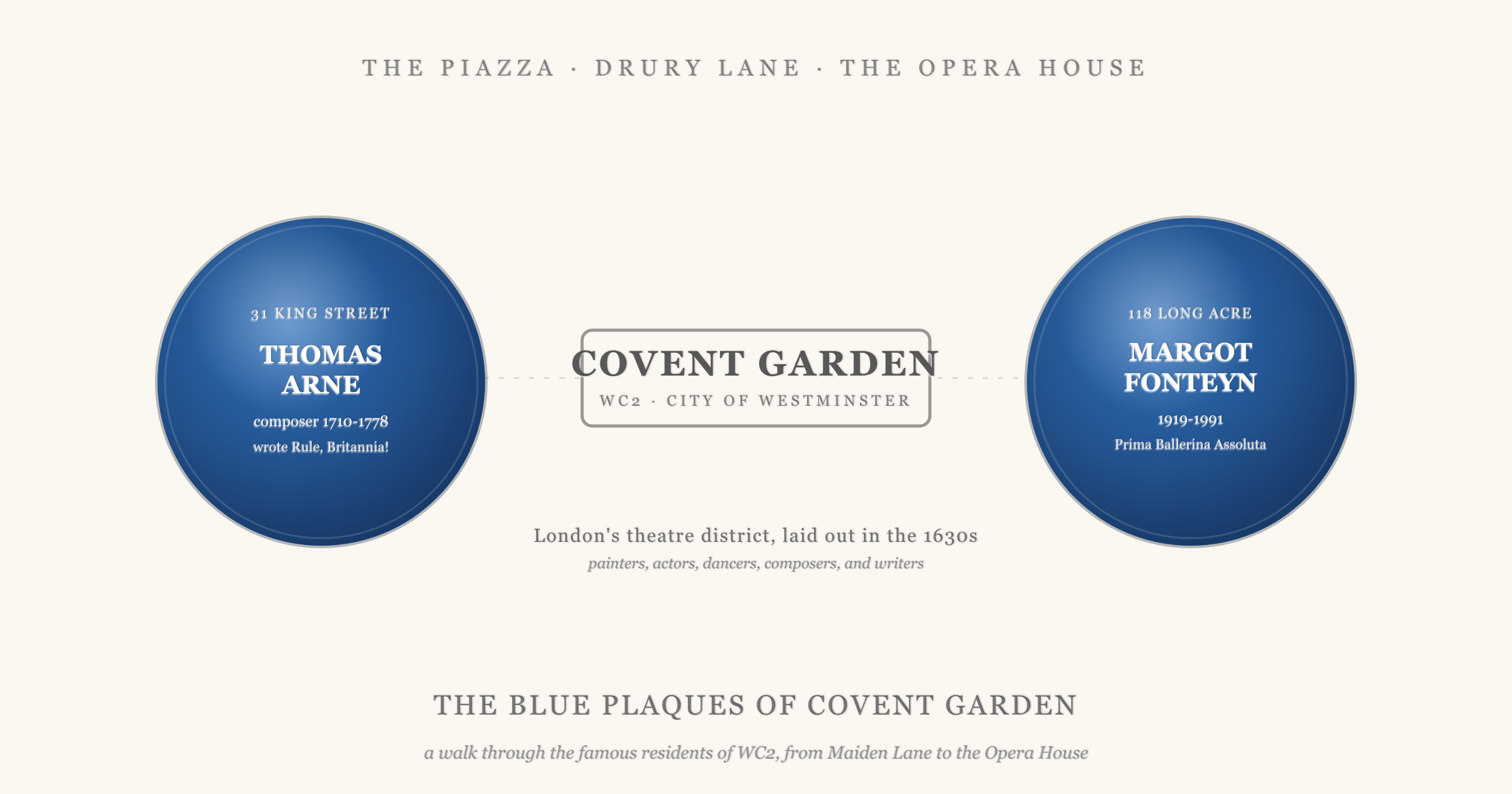
The people who ran those stages are marked all around them. At 27 Southampton Street, a plaque records that "David Garrick lived here 1750-1772." Garrick was the greatest actor-manager of the eighteenth century, the man who reformed the English stage from his base at Drury Lane, and his name still hangs over the area in the Garrick Club on Garrick Street nearby. At 118 Long Acre, a blue plaque marks the home of Dame Margot Fonteyn (1919-1991), "Prima Ballerina Assoluta," the defining dancer of the Royal Ballet across the road at the Opera House.
And at 31 King Street, a blue plaque records that "Thomas Arne 1710-1778 composer lived here." Arne was born in Covent Garden and wrote the music for "Rule, Britannia!", so the anthem most associated with British naval pride was composed by a man raised among the market porters of WC2. The grand and the everyday have always stood side by side here, which is exactly what made Covent Garden draw the same kind of resident the plaque scheme later went looking for.
Writers in Covent Garden: Jane Austen, Johnson Meets Boswell, and De Quincey
The market and the theatres made Covent Garden a magnet for writers, and three plaques in particular mark moments that matter to English literature.
At 10 Henrietta Street, a plaque records that "Jane Austen 1775-1817 Novelist stayed here 1813-1814." The house belonged to her brother Henry, a banker, and Austen stayed above the bank on visits to London while she was seeing her novels through the press, so some of the business of publishing Pride and Prejudice and Mansfield Park ran through this address.
A short walk away at 8 Russell Street stood the bookshop of Thomas Davies, and a plaque records the meeting that happened in its back room: this is where Samuel Johnson first met James Boswell in 1763. The friendship that began over a bookseller's counter produced Boswell's Life of Johnson, the most famous biography in the English language, so this quiet address is the seed of an entire literary genre.
And at 36 Tavistock Street, a plaque records that Thomas de Quincey (1785-1859) "wrote 'Confessions of an English Opium Eater' in this house," the addiction memoir that has never been out of print since. Three writers, three streets, three works that outlived everyone who walked past them.
Dickens's Covent Garden
No writer is more bound up with this neighbourhood than Charles Dickens, and two plaques mark the opposite ends of his life here. At 6 Chandos Place, a plaque records simply that "as a boy Charles Dickens worked here 1824-1825." This was near the blacking warehouse where the twelve-year-old Dickens was sent to label bottles while his father sat in a debtors' prison, the most formative humiliation of his life and the raw material for David Copperfield. He never forgot the streets around Covent Garden, and they reappear throughout his novels.
By the end of his life the relationship had reversed. On Wellington Street, a plaque records the building that "housed the offices of Charles Dickens' magazine 'All The Year Round' and his private apartments." The boy who had labelled blacking bottles a few streets away now ran one of the most successful magazines in the country from rooms above its office. The same few hundred yards of Covent Garden hold both the bottom and the top of the most famous literary career in Victorian London. If you enjoy tracing a single life across the city, the same approach works beautifully for Vincent van Gogh's London, whose own art-dealing job began just around the corner on Southampton Street.
The Pubs, the Furniture Maker, and the Hidden Corners
Covent Garden rewards anyone who looks down the alleys. Tucked off Garrick Street, the Lamb & Flag on Rose Street is one of the oldest pubs in the area, once nicknamed the "Bucket of Blood" for the bare-knuckle fights held upstairs; a plaque nearby recalls that the poet John Dryden was attacked in the alley beside it in 1679, in the notorious "Rose Alley ambush." On St Martin's Lane, a plaque marks where "the workshop of Thomas Chippendale and his son, cabinet makers, stood near this site 1753-1813," the address from which the most famous name in English furniture sent his designs around the world.
Wander north and you reach Neal's Yard and the Seven Dials, a tangle of small streets that have kept their seventeenth-century plan, and which carry their own scattering of plaques to the more recent residents who made Covent Garden a creative quarter again after the market left. The pleasure of the neighbourhood is exactly this density: you cannot walk a hundred yards without passing something marked.
Walking It: A Suggested Route
Covent Garden is small enough to do in an unhurried hour or two. A natural route starts at St Paul's Church and the Piazza, then drops south to Maiden Lane for Turner, Voltaire, the Adelphi, and Rules. From there it is a short step to Southampton Street for Garrick and on to Henrietta Street for Jane Austen. Cut up to Russell Street for Johnson and Boswell, pass the Theatre Royal Drury Lane, and swing west through Bow Street past the Royal Opera House to Long Acre for Margot Fonteyn. Finish among the alleys around Rose Street and St Martin's Lane for the Lamb & Flag and Chippendale. You are never more than a couple of minutes from a coffee, a theatre, or another plaque.
This is exactly the kind of walk Legacy is built for. The app maps every blue plaque in Covent Garden and across London, shows you which ones are near you as you walk, and lets you collect each plaque you visit, turning a stroll through the theatre district into a record of the history you have actually stood in front of. If you enjoyed tracing the famous residents of Covent Garden, the same approach works for the writers of Bloomsbury or the playwrights and wits of Oscar Wilde's London. Open Legacy, start at the Piazza, and see how much history is hiding between the market stalls.