Oscar Wilde lived in London for twenty-two years, from his arrival as a young Oxford graduate in 1878 to his arrest at the Cadogan Hotel in 1895 and his deportation to Reading Gaol the same year, and the city carries that life across a small handful of geographically distinct sites. The Chelsea house at 34 Tite Street, where he lived with Constance Lloyd and their two sons and wrote The Picture of Dorian Gray and most of the plays. The Cadogan Hotel on Sloane Street, where the arrest happened between the libel verdict and the police's first knock at the door. The Royal Courts of Justice on the Strand, where the libel trial he himself started against the Marquess of Queensberry collapsed under cross-examination. And the Old Bailey, where the criminal trials that followed sent him to prison for two years' hard labour. Four sites, three streets, four months of life, the rise and fall in a compact London geography.
This is the walking guide that joins them. The four-stop walk from Tite Street to the Old Bailey via the Cadogan Hotel and the Strand is short enough to do on a long afternoon and dense enough to cover the rise of the Aesthetic Movement, the friendship and quarrel with Whistler, the marriage to Constance, the meeting with Lord Alfred Douglas, the libel that turned into the criminal trials, the prison years that produced De Profundis and The Ballad of Reading Gaol, and the exile in Paris that ended in 1900. The Legacy app plots all four stops on a single map alongside the wider Chelsea and Aesthetic Movement plaques, so you can drop in any side stop you want as you walk.
Why Tite Street Was the Aesthetic Movement Address
Tite Street is a short Chelsea street that runs north from Chelsea Embankment to Tedworth Square, three blocks east of the Royal Hospital and a few minutes' walk from the river. In the 1870s and 1880s it was the cheap end of a fashionable district, lined with houses built or remodelled to take artists' studios, and it became the most concentrated Aesthetic Movement address in London. James McNeill Whistler had a studio there from 1878. John Singer Sargent moved in next door at 31 Tite Street in 1885. Edward Godwin designed houses up and down the street. Frank Miles, the society portraitist who introduced Wilde to Lillie Langtry, lived there too.
The Aesthetic Movement was the late-Victorian wing of art-for-art's-sake: the conviction that the decorative arts, fine art, and literature should pursue beauty as their own justification rather than as the wrapping on a moral lesson. Wilde was its most quotable defender, Whistler its most combative painter, and Tite Street its most concentrated residential address. The street acquired a reputation in the wider London press as a slightly raffish artistic colony, the kind of place a respectable family might mention with a raised eyebrow.
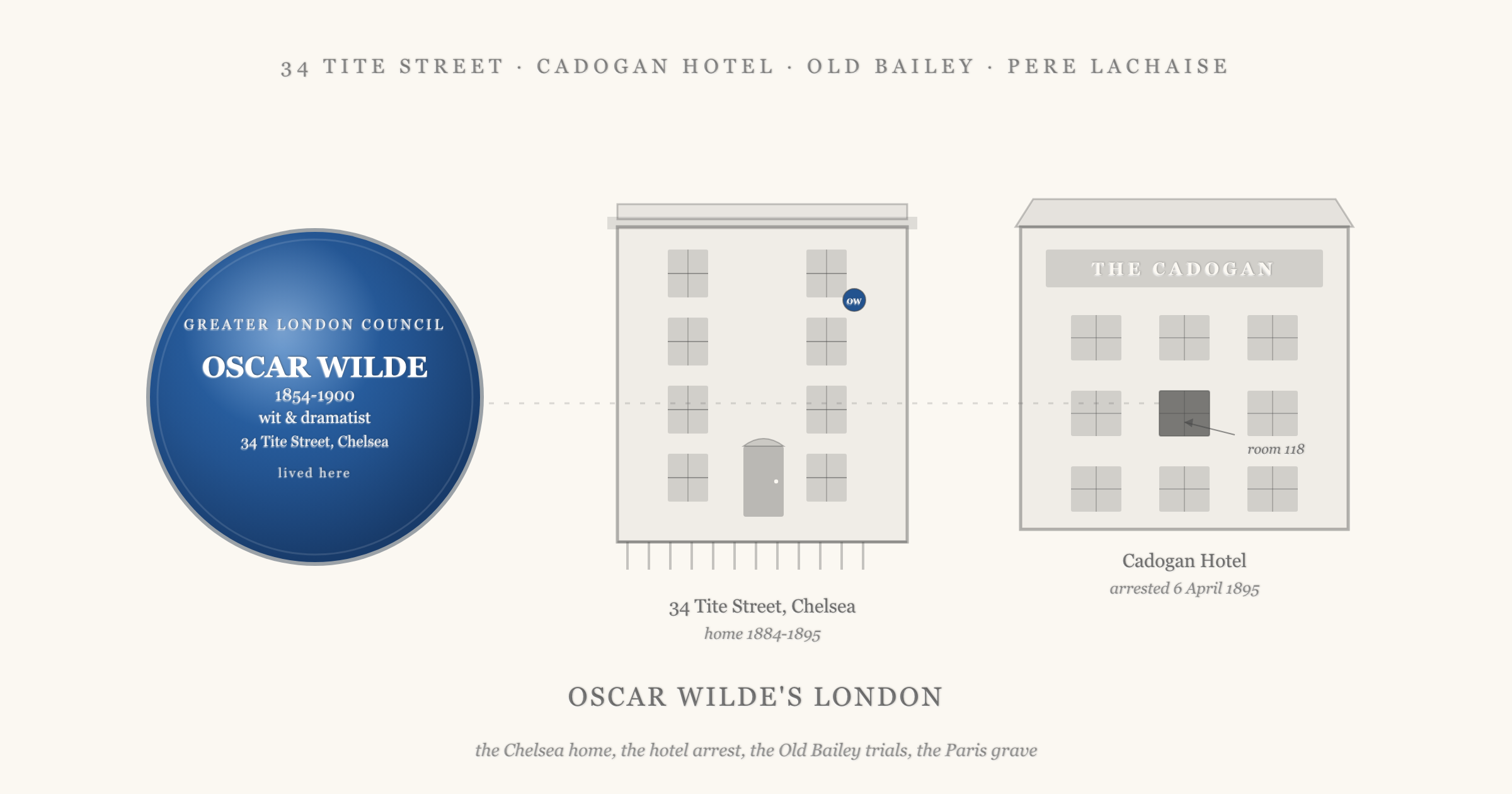
The blue-plaque scheme marks where notable Londoners lived, and the Tite Street plaque for Oscar Wilde is the marked address. The Greater London Council put it up at 34 Tite Street, the house Wilde rented from 1884 until his arrest. The Whistler house at 35 Tite Street is also plaqued. The two plaques face each other across a narrow Chelsea street, which is the geographical fact that anchors the rest of this article.
Stop One: 34 Tite Street, Chelsea, the Marital Home
Number 34 Tite Street is a four-storey terraced townhouse on the east side of the street, faced in red brick with white-painted window surrounds, with iron railings on the pavement and a small forecourt below the raised ground floor. Wilde took the lease in May 1884, two weeks after his marriage to Constance Lloyd at St James's Church in Paddington. The house cost him 65 pounds a year and a substantial sum to redecorate; Constance brought a dowry of 5,000 pounds, and the bulk of the redecoration came out of that.
The interior was a setpiece of the Aesthetic Movement. Wilde commissioned the architect Edward Godwin to design the rooms in collaboration with the artist James McNeill Whistler from across the street. The result was a series of rooms with white-painted woodwork, peacock-blue ceilings, walls hung with Japanese prints, and the famous "white drawing room" with its all-white walls, white furniture, and pale-yellow accents that was photographed and reproduced in the design press. Cyril Wilde was born here in 1885; Vyvyan Wilde in 1886.
The literary work matters more than the decor. Wilde wrote The Picture of Dorian Gray here in 1890, Lady Windermere's Fan in 1891, A Woman of No Importance in 1893, An Ideal Husband and The Importance of Being Earnest both in 1894, four plays in three years that made him the most successful dramatist on the London stage. The household by then was already strained: Wilde's friendship with Lord Alfred Douglas had begun in 1891 and intensified through 1892, and most of the writing was done in hotel rooms in Worthing and Goring rather than at Tite Street.
The blue plaque went up in 1954 and reads OSCAR WILDE 1854-1900 WIT AND DRAMATIST LIVED HERE 1884-1895. The house is privately owned and not open to the public, but the facade is unaltered enough that the address is immediately recognisable from period photographs. The walk west to the Embankment, two minutes, is one of the few stretches of central London where the Aesthetic Movement geography is still visible street-by-street.
Stop Two: The Cadogan Hotel, the Arrest
From Tite Street, walk north up Tite Street, cross Royal Hospital Road, continue up Cheltenham Terrace into Sloane Square, and turn right up Sloane Street. The Cadogan Hotel is on the east side of Sloane Street at the corner of Pont Street, an eight-minute walk. The hotel opened in 1887, was where Lillie Langtry kept a permanent suite, and was the hotel Wilde checked into on 5 April 1895 after the collapse of his libel case against the Marquess of Queensberry, the father of Lord Alfred Douglas.
The arrest is documented to the minute. The libel verdict came in at the Old Bailey on the afternoon of 5 April. Queensberry had been acquitted, which meant the evidence his counsel had assembled about Wilde's private life had become public record. The Director of Public Prosecutions issued a warrant for Wilde's arrest under the Criminal Law Amendment Act of 1885. Wilde had been advised by friends to take the boat train to France; he refused, and went to the Cadogan to wait. He spent the afternoon drinking hock and seltzer with Robert Ross and Reggie Turner in room 118. The detectives arrived at 6.30pm on 6 April with an Inspector Richards and arrested him there. He went quietly, taking nothing with him; the police did not let him pack.
The room number is the detail the Cadogan has preserved. The hotel was sold and refurbished in 2018, reopening as the Belmond Cadogan, but the link to Wilde's last evening before prison is documented in the lobby and survives the rebranding. The Pont Street side of the building still carries the original 1887 hotel facade. The arrest is also the subject of John Betjeman's poem "The Arrest of Oscar Wilde at the Cadogan Hotel," which sets the moment in exactly the period detail that the hotel still presents. The poem is the single most-quoted summary of the geography this walking tour is following, and Pont Street and Sloane Street look in May 2026 broadly as they looked in April 1895.
The arrest split Wilde's London life cleanly in two. Tite Street was packed up by Constance during the trials; the family belongings were sold at auction to pay creditors. Wilde never lived at Tite Street again.
Stop Three: The Royal Courts of Justice, the Libel Trial
From the Cadogan, walk north up Sloane Street to Knightsbridge, turn east along Brompton Road, then take the Piccadilly Line two stops to Holborn (or, in 1895, take a cab). The Royal Courts of Justice are on the Strand at the corner of Bell Yard, a five-minute walk from Holborn. The building is the Gothic-revival masterpiece designed by George Edmund Street and opened by Queen Victoria in 1882. It houses the High Court of Justice and the Court of Appeal.
This was where Wilde sued the Marquess of Queensberry for criminal libel. Queensberry, in February 1895, had left a card at Wilde's club, the Albemarle, with the words "For Oscar Wilde posing somdomite" (misspelled). The card was an act of public accusation that, if proven false, would have been libel; if proven true, would have ended the libel case and opened the door to a criminal prosecution of Wilde under the 1885 Act. Wilde, against the advice of his friends, his counsel Edward Carson, and his lover Bosie's elder brother, brought the libel case anyway.
The trial began on 3 April 1895. Carson, who had been at Trinity College Dublin with Wilde, cross-examined him over two days. The transcript is in the public domain and reads as one of the most studied courtroom cross-examinations in English legal history; Carson took Wilde line by line through The Picture of Dorian Gray, the early epigrams, the letters to Bosie, and the introductions Wilde had made to a series of young men whose evidence Queensberry's solicitors had assembled. On the second morning Wilde's counsel Sir Edward Clarke withdrew the prosecution, the jury found Queensberry not guilty, and the Director of Public Prosecutions issued the warrant within hours.
The Royal Courts of Justice are open to the public; the Great Hall is freely accessible during sitting hours, and most courtrooms admit observers when sittings are open. The plaque trail around the building does not single out the Wilde case (court cases are not commemorated in the same way residences are), but the building itself, the Great Hall, and the steps facing the Strand are the unchanged setting for the legal turning point in the four-stop walk.
Stop Four: The Old Bailey, the Criminal Trials
From the Royal Courts of Justice, walk east along the Strand into Fleet Street, then north up Old Bailey, a six-minute walk. The Central Criminal Court, universally known as the Old Bailey, is the criminal court that tried Wilde for "gross indecency between males" under section 11 of the 1885 Act. The current Edwardian-baroque building, with the gilt bronze figure of Justice on its dome, replaced the older Newgate site in 1907. Wilde was tried in the older building that stood on the same site.
There were two criminal trials. The first opened on 26 April 1895, ten days after the libel collapse. The jury could not agree; the trial ended on 1 May with the jurors discharged after long deliberation. The Crown elected to try again, and the second trial began on 20 May. Wilde was convicted on 25 May 1895 and sentenced to two years' hard labour, the maximum the 1885 Act allowed. The trial judge, Mr Justice Wills, described the offences as "the worst case I have ever tried" before passing sentence. Wilde was taken from the dock to Holloway, then to Wandsworth, then to Reading Gaol, where he served the bulk of the sentence.
The two-year sentence broke him physically. He spent the first month in solitary confinement, was put to picking oakum (separating hemp from old rope), then walked the prison treadmill at Wandsworth. The conditions of Victorian hard labour are the explicit subject of his post-prison poem The Ballad of Reading Gaol (1898), and the unsent letter De Profundis was written in his cell at Reading in the winter of 1896 and the spring of 1897. He left prison on 19 May 1897 and never returned to England.
The Old Bailey runs public viewing galleries above the working courts; the Lord Mayor sits as a Justice of the Peace and welcomes visiting judges in the public ceremonial areas. The Wilde trial is not commemorated inside the building (criminal trials are not), but the central courtroom retains the layout he stood in. The Newgate Prison wall fragment that Wilde would have known is preserved in the rebuilt structure and visible from the courtyard.
The Paris Final Year, Pere Lachaise, and the Constance Question
The walking tour stops at the Old Bailey. The biographical line continues to Paris.
After his release in May 1897, Wilde lived in France under the pseudonym Sebastian Melmoth (taken from the Melmoth the Wanderer of his great-uncle Charles Maturin's gothic novel). He stayed at the Hotel d'Alsace at 13 rue des Beaux-Arts in the Latin Quarter, paying with money raised by Robert Ross and a small annuity from Constance, who had moved with the children to Genoa and changed the family name to Holland. He saw Bosie briefly in Naples in 1897; the reunion collapsed, and they separated again. Constance died in Genoa in April 1898 after a botched spinal operation; Wilde was unable to attend the funeral, partly because of money and partly because the Holland family had asked him not to. He never saw his sons again after 1895.
He died at the Hotel d'Alsace on 30 November 1900 of cerebral meningitis, complicated by what may have been syphilis or by the long-term effects of an ear injury sustained in Wandsworth. He was forty-six. He was received into the Catholic Church on his deathbed by Father Cuthbert Dunne, an Irish Passionist priest, at the insistence of Robert Ross. He was buried first at Bagneux cemetery in the suburbs and then, in 1909, moved to Père Lachaise, where Jacob Epstein's modernist tomb (commissioned by Ross and unveiled in 1914) marks the grave. The tomb's sphinx-figure has been periodically vandalised, repaired, and protected; in 2011 a glass screen was installed to stop the lipstick kisses that visitors had been leaving on the stone for decades. Père Lachaise is not on this London walking tour, but it is on the Paris itinerary of anyone who follows the four-stop walk to its biographical conclusion.
Constance's grave is in Genoa, at Staglieno cemetery, and the inscription was changed in 1963 (after both sons had died) to add the line "wife of Oscar Wilde" that her family had originally omitted.
The Aesthetic Movement Walk: Side Stops Along the Route
The four primary stops are the Wilde-specific sites. The walking route also crosses several other Aesthetic Movement geographies that the Legacy app picks up automatically:
- Whistler's blue plaque, 96 Cheyne Walk. A short detour west from Tite Street brings you to the Cheyne Walk plaque for James McNeill Whistler, where he lived in the 1860s and 1870s before the move to Tite Street.
- The Sargent house, 31 Tite Street. Three doors down from Wilde's house, John Singer Sargent painted Madame X (1884) and the studio is plaqued.
- Carlyle's house, 24 Cheyne Row. Thomas Carlyle's residence is now a National Trust property, a five-minute walk south of Tite Street, and was a literary anchor for the wider Chelsea geography Wilde lived in.
- The Café Royal, Regent Street. The dining-and-drinking room Wilde used during the West End years stands at the south end of Regent Street, on the route from Sloane Square to the Strand if you take the surface route rather than the Tube.
- The Garrick Club, Garrick Street. The members' club where Wilde dined regularly during the productions of his plays, a short walk from the Royal Courts of Justice.
The Bloomsbury Group walking tour covers the slightly later literary-and-Aesthetic geography around Tavistock Square and Gordon Square; the Florence Nightingale Mayfair walk is to the north of the Wilde route and intersects at Sloane Square; and the Handel-Hendrix Mayfair walk covers the Brook Street geography that fed Wilde's West End theatrical life.
The Quotes and the Plays, Briefly
Wilde wrote nine plays, one novel, two volumes of fairy tales, a long poem, two volumes of essays, and a body of letters that runs to thousands of pages, most of it during the eleven years he lived at 34 Tite Street. The five plays that survive in the standard repertoire:
- Lady Windermere's Fan (1892). The first Society comedy and the play that established his West End reputation.
- A Woman of No Importance (1893). The second, with the most explicit moral-versus-social-class structure of the four society comedies.
- An Ideal Husband (1895). A comedy of public reputation and private blackmail.
- The Importance of Being Earnest (1895). Opened on Valentine's Day 1895, ran for 86 performances, closed when the trials broke the box office, and is the play that has held the stage every decade since.
- Salome (1891/1892). The biblical-symbolist tragedy written in French, banned by the Lord Chamberlain in 1892, premiered in Paris in 1896 with Sarah Bernhardt in the title role.
The Picture of Dorian Gray (1890) is the only novel and is the work that Carson used most aggressively in cross-examination, reading passages aloud to the jury and asking Wilde whether he stood by the moral position of the book. Wilde's answer (the well-known "There is no such thing as a moral or an immoral book. Books are well written or badly written. That is all.") is in the trial transcript and is the most-quoted single exchange of the libel case.
The quotes most readers know (the cigarette one, the temptation one, the gutter-and-the-stars one, the consistency one) are scattered across the plays, the essays, and the letters. Most of them were written, in some form, at the desk at Tite Street.
Practical Notes for the Walk
The four-stop walking tour, end to end, is a 3.5-mile route through Chelsea, Belgravia, and the legal district. Without diversions and without long stops it takes roughly ninety minutes on foot; with the Tube hop from Knightsbridge to Holborn it takes about an hour. The Royal Courts of Justice and the Old Bailey are open to the public on weekdays during sitting hours and free to enter; the Cadogan Hotel is a working hotel and the lobby is open to non-residents; 34 Tite Street is a private residence and viewable only from the pavement.
The blue plaques are at 34 Tite Street, 35 Tite Street (Whistler), 31 Tite Street (Sargent, in the same dense Aesthetic cluster), 96 Cheyne Walk (Whistler again, the earlier residence), and 24 Cheyne Row (Carlyle, a few streets south). The walk between them is the heart of the Aesthetic Movement geography that London has preserved. The Legacy app is the easiest way to see them on a map together with the wider Chelsea and Aesthetic Movement plaques and to drop in the side stops you want to extend the tour.
The walk does what most walking tours of literary London do not: it traces a single life across the four sites that mattered most to it, in the order they happened, in a geography compact enough to walk in an afternoon. The rise of the Aesthete from Tite Street, the arrest at the Cadogan, the libel trial at the Royal Courts, the criminal trials at the Old Bailey. Four sites, four months, the public arc of a life that wrote itself into the city's architecture before the city walled it up.