Before he was a painter, before the sunflowers and the cypresses and the starlit sky, Vincent van Gogh was a young art dealer in London, walking each morning from a lodging house in Brixton across the Thames to a gallery in Covent Garden. He lived in the city for the better part of three years, from 1873 to 1876, and the house where he was happiest still stands, marked by a blue plaque on a quiet south London street. Vincent van Gogh's London is one of the least expected chapters in the life of the most famous painter who never sold a painting, and you can walk it today. This is the story of the lodging at 87 Hackford Road, the art dealer's job that brought him here, the rejection that changed him, and the plaques that mark where it all happened.
For anyone who collects the city's stories, van Gogh sits in the same constellation of artists and writers as William Blake and Oscar Wilde, lives marked by plaques scattered across London. The Legacy app maps every one of them, with the inscription and the history behind each marker.
A Twenty-Year-Old Art Dealer in Covent Garden
Van Gogh did not come to London to paint. He came to sell art. In 1869, aged sixteen, he had started work at the Hague branch of Goupil & Cie, a successful firm of art dealers, where an uncle had connections. He was good at it, and in May 1873, at twenty, he was transferred to the firm's London branch on Southampton Street, just off the Strand in Covent Garden.
The London of the 1870s was the largest city on earth, the capital of an empire at its height, crowded and smoky and astonishing to a young man from the flat Dutch countryside. Van Gogh threw himself into it. He earned a good salary, more than his father the pastor made, and he dressed the part of a respectable young dealer in a top hat. He visited the galleries on his days off: the National Gallery, the South Kensington museums, and the Dulwich Picture Gallery, reachable on foot from where he lived. He read voraciously, especially Dickens and George Eliot, and he developed a lasting love of English illustration and the social-realist prints in magazines like The Graphic. None of this looked like the life of a future painter, but all of it was feeding the eye that would later become one.
87 Hackford Road: The Brixton Lodging
After a first set of lodgings, van Gogh moved in August 1873 to a boarding house at 87 Hackford Road, in Stockwell on the edge of Brixton, run by a widow named Ursula Loyer and her daughter Eugénie. It is this address that carries the plaque.
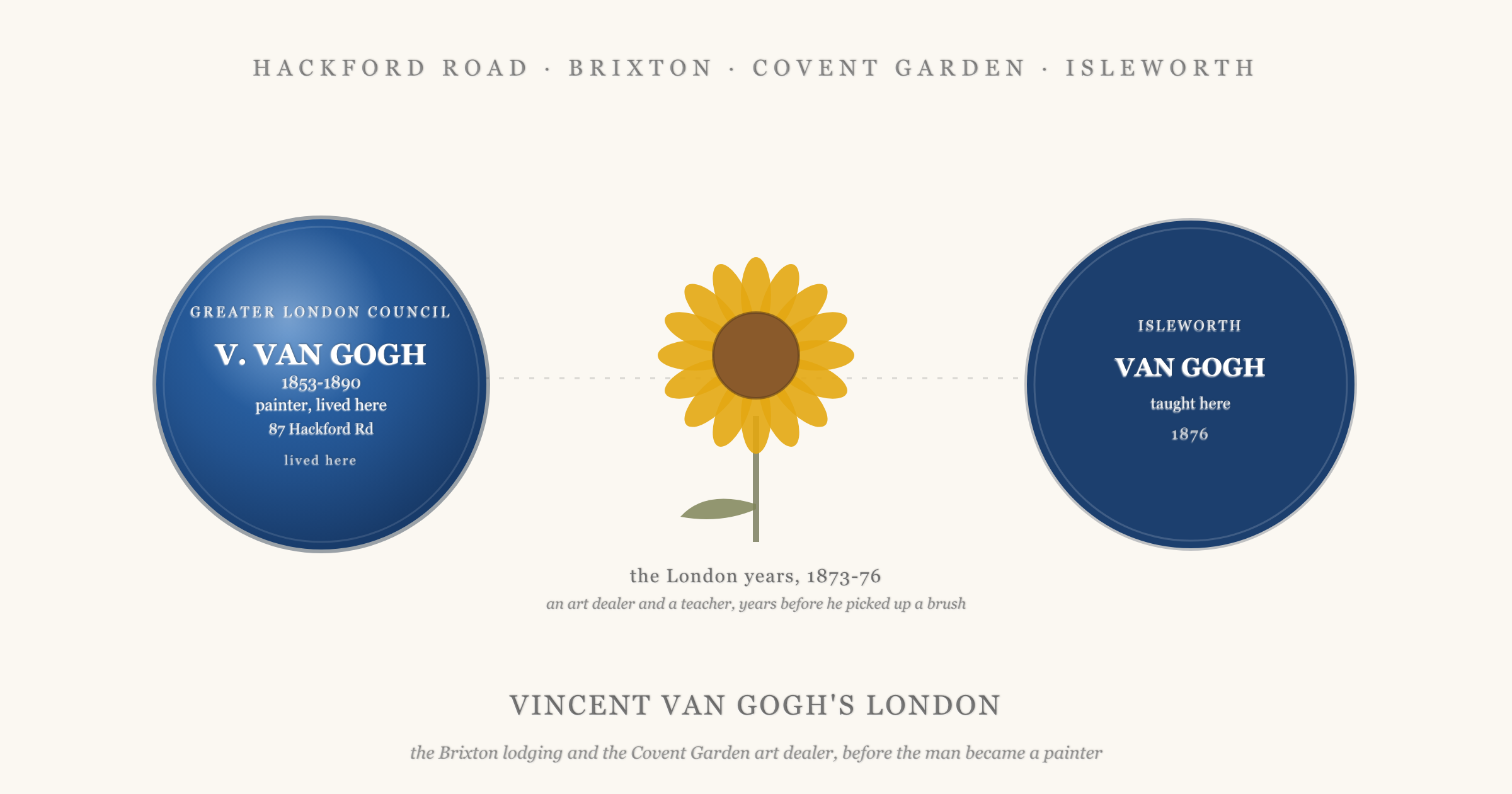
The Greater London Council put up the blue plaque in 1973, the centenary of his arrival, and it reads simply: "Vincent Van Gogh 1853-1890 painter lived here 1873-1874." There is a quiet irony in the wording. The plaque calls him a painter, which is how the world remembers him, but during the years he lived in this house he had never picked up a brush in earnest. He was a clerk in an art shop. The painter came later, and somewhere else.
For a long time the house was an ordinary private home, and the plaque was the only sign of who had once lodged there. That changed in recent years. The building was carefully restored and reopened as Van Gogh House London, an arts space that runs exhibitions, residencies, and small-group visits, letting people step inside the actual rooms where the young van Gogh lived rather than simply reading a plaque on the wall outside. It is one of the more unusual house-museums in the city, a working creative space rather than a frozen period room, which feels fitting for a man who valued the making of art above its preservation.
The Rejection That Changed Him
The year at Hackford Road began as the happiest of van Gogh's life and ended as one of the most painful. He fell in love with the landlady's daughter, Eugénie Loyer. By his own letters to his brother Theo, he believed his feelings were returned, and he built up the courage to declare himself.
When he did, in the summer of 1874, Eugénie turned him down. She was already secretly engaged to a previous lodger and had been the whole time. The rejection hit van Gogh hard. The cheerful, ambitious young dealer became withdrawn and intensely religious almost overnight. He gave away books, grew solitary, and began to read the Bible with the same hunger he had brought to Dickens. Biographers often mark this London heartbreak as the first turn away from the conventional career his family wanted and toward the restless searching that would define the rest of his short life.
His mood made him a worse salesman. He was unenthusiastic with customers, openly told people which pictures he thought were bad, and Goupil & Cie eventually transferred him to their Paris gallery in 1875, then dismissed him outright at the start of 1876. The art trade was finished with him. He was twenty-three and adrift.
Isleworth, 1876: The Teacher and the Lay Preacher
Out of work but drawn back to England, van Gogh returned in April 1876, this time not as a dealer but as a teacher. He took an unpaid post at a small school in Ramsgate run by a William Port, then moved with the school to Isleworth, on the western edge of London near the river at Twickenham. A second plaque, on Twickenham Road, marks this period, recording that van Gogh "taught here in 1876."
In Isleworth his religious feeling found an outlet. He became an assistant to a Methodist minister, the Reverend Thomas Slade-Jones, and in the autumn of 1876 he preached his first sermon, an event he described to Theo with enormous emotion, telling him he felt as though he were emerging from a dark cave into daylight. For a while he was set on becoming a clergyman like his father. London had turned the art dealer into a would-be preacher.
It did not last either. At Christmas 1876 he went home to the Netherlands and never returned to England. The path to painting was still years off; he would not commit to art until around 1880. But the city had shaped him: the galleries, the illustrators, the novels, the heartbreak, and the religious fervour were all picked up in London and carried into the work that came after.
What London Gave the Painter He Would Become
It is tempting to treat van Gogh's London years as a footnote, a false start before the real life began. But the eye that would later transform a wheat field or a night sky was trained in part on English ground. The social-realist prints he collected in London, images of the poor, of labourers and the destitute, fed directly into his early Dutch work, above all the dark, sympathetic paintings of peasants that culminated in The Potato Eaters. His love of Dickens never left him. And the emotional intensity that London first stirred, the swing from joy to despair and the search for something to believe in, became the engine of everything he painted.
That is why a sunflower belongs over the door of the Hackford Road house even though he painted no sunflowers there. The symbol stands for what the young clerk in the top hat would become, and the plaque quietly insists on it: not "art dealer," not "teacher," but "painter."
Visiting Van Gogh's London Today
Van Gogh's London is spread across the city, which makes it a walk in pieces rather than a single loop, but each stop is worth finding.
- 87 Hackford Road, Brixton. The blue plaque and Van Gogh House London, the restored lodging now run as an arts space. Check ahead for opening times and events, as access is limited and ticketed rather than a walk-in museum. The surrounding streets of Stockwell and Brixton are a side of plaque-hunting London well away from the usual Bloomsbury and Westminster routes.
- Southampton Street, Covent Garden. The site of the Goupil & Cie gallery where he worked, a few steps from the Strand and Covent Garden piazza. There is no plaque to the gallery, but standing on the street you can trace the daily walk he made across the river, roughly four miles each way, which he often did on foot.
- Twickenham Road, Isleworth. The second plaque, marking the 1876 school and his brief life as a teacher and lay preacher on the western edge of the city.
Walked together, these three points sketch the whole arc of his English years: ambition in Covent Garden, happiness and heartbreak in Brixton, and the religious turn in Isleworth. For the full map of the city's markers, our complete guide to London's blue plaques sets van Gogh's addresses alongside the hundreds of others, and the story of William Blake's London traces another visionary artist whose city shaped his vision.
To find every plaque near you, the streets they sit on, and the lives behind them, explore London with the Legacy app and turn an ordinary walk through Brixton, Covent Garden, or Isleworth into a chapter of art history hiding in plain sight.