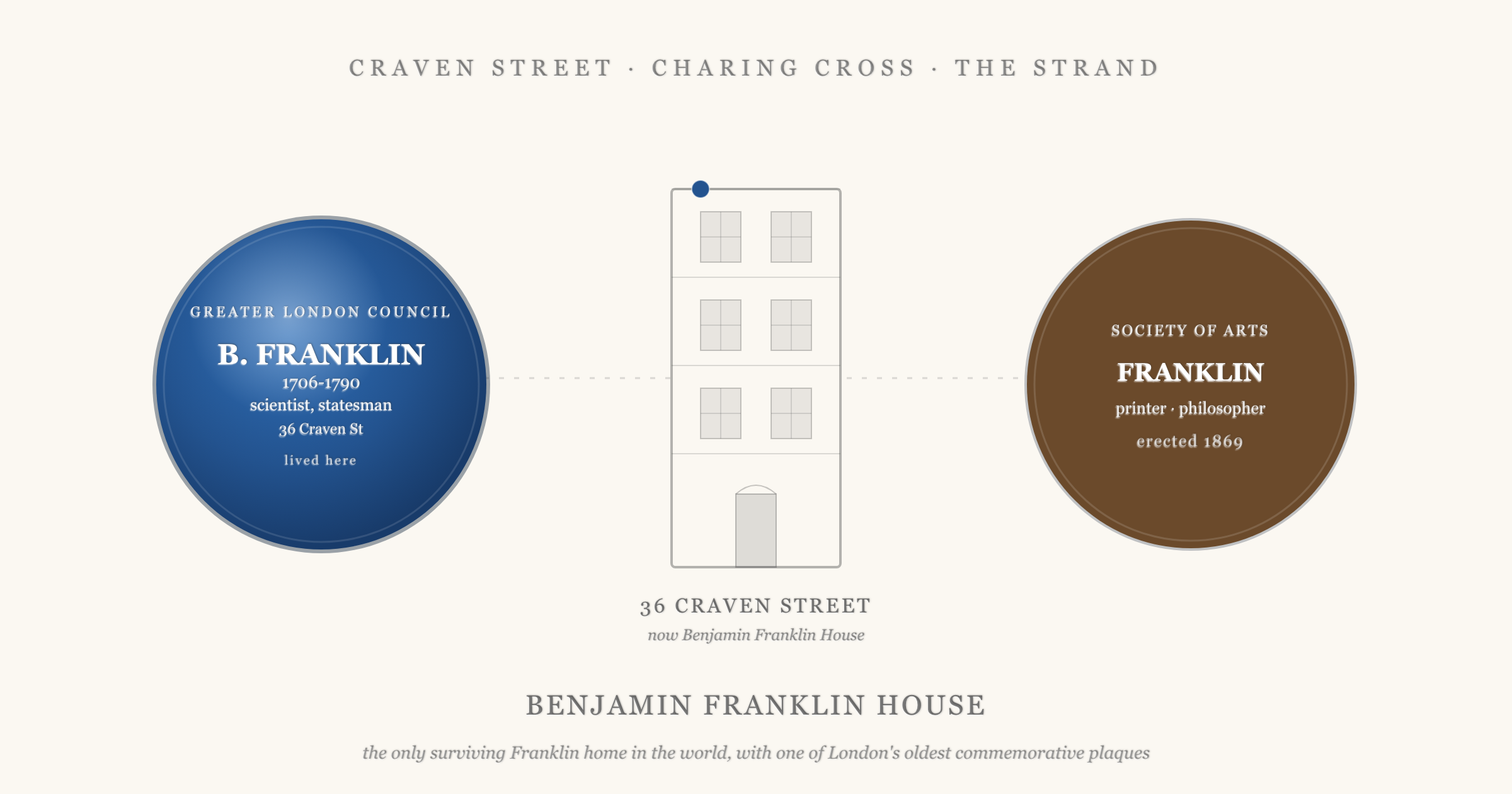
A narrow Georgian townhouse stands a few steps from Charing Cross, on Craven Street, the quiet road that runs down from the Strand toward the river. Number 36 looks like its neighbours: four storeys of brown brick, sash windows, a plain doorway. It is, in fact, the only surviving former home of Benjamin Franklin anywhere in the world. Every house he lived in across the Atlantic has been demolished; this one, where he spent some sixteen years as the colonies' man in London, survived. Today it is Benjamin Franklin House, a museum, and two plaques on its face record what happened inside. This is the story of the house on Craven Street, the strange discovery in its basement, and a short walk that puts it back in the London Franklin knew.
For anyone exploring the streets around Charing Cross, Benjamin Franklin House is one of the most surprising addresses in the city: an American founding father's London home, hiding in plain sight between Trafalgar Square and the Thames. The Legacy app maps it along with every other plaque in the neighbourhood, with the inscription text and the history behind each one.
Two Plaques, One of Them Among London's Oldest
Most houses on the blue-plaque trail carry a single marker. Number 36 Craven Street carries two, and the older of them is a genuine rarity. It is a brown plaque put up by the Society of Arts, the body that started the whole commemorative-plaque idea in 1866. Franklin's is one of the very earliest survivors of that original scheme, predating not just the familiar round blue ceramics but the bodies that later ran the programme: the London County Council took it over around 1901, the Greater London Council in 1965, and English Heritage in 1986. When you stand on Craven Street you are looking at a marker from the scheme's first years, before the convention of "blue" was even settled.
The second plaque is the blue one, added in 1914, reading simply that Benjamin Franklin lived here. Between the two of them they span the history of London commemoration itself: the Victorian experiment that began the practice, and the twentieth-century roundel that made it famous. It is a fitting thing for a house whose occupant spent his life experimenting.
Franklin's Sixteen Years on Craven Street
Franklin first took lodgings at Craven Street in 1757, and with two long stays either side of a return to America he was based here until March 1775: close to sixteen years, more of his adult life than he spent in any single house in Philadelphia. He came not as a private citizen but as a colonial agent, the lobbyist and representative in London first for Pennsylvania and in time for Georgia, New Jersey, and Massachusetts too. From a set of rooms in a rented house he argued the colonies' case to ministers and Parliament, wrote a torrent of letters and pamphlets, and became one of the best-known Americans in Britain.
His landlady was a widow, Margaret Stevenson, and the household became a kind of second family for him. Her daughter, Mary Stevenson, whom Franklin called Polly, was clever and curious, and the long correspondence the two of them kept up on scientific questions is one of the warmest records of Franklin's mind at work. He was already famous for the electrical experiments that had made his name, and at Craven Street he kept experimenting: he developed the glass armonica, the musical instrument of spinning glass bowls, in London in 1761, and he tinkered endlessly with the practical problems of heat, light, ventilation, and weather. He was fond of what he called an "air bath," sitting at an open window without his clothes for the good of his health, a habit his letters cheerfully record.
He also had a sense of fun about the household. In 1770, while Mrs Stevenson was away, Franklin wrote and "published" the Craven Street Gazette, a mock newspaper reporting the trivial domestic news of the house in the grand style of a court circular. It is a small, human thing, and it survives, and it tells you as much about the man as any treaty.
The Bones in the Basement
In 1998, during the restoration that turned the decaying house into a museum, conservators digging in the basement found something they did not expect: a pit containing more than a thousand fragments of human bone, from at least fifteen different people, some of them children. For a moment it looked like the makings of a very dark story.
The explanation, once the bones were studied, was strange but not sinister. They dated to Franklin's residence, and they belonged to the work of William Hewson, a gifted young anatomist who married Polly Stevenson and for a time ran a private anatomy school at the house. The bones showed the marks of dissection, the saw cuts and drilled holes of eighteenth-century anatomical teaching, and the most likely source was the grim but ordinary trade in bodies that supplied London's anatomy schools in an age before legal donation. Franklin, who lodged in the same house, would certainly have known what his landlady's son-in-law was doing under the same roof; in the Enlightenment circles he moved in, the study of the body was a respectable science. The basement, in other words, is a relic not of murder but of the period's restless, sometimes macabre, appetite for knowledge.
The House Today
Benjamin Franklin House opened to the public in January 2006, the three-hundredth anniversary of Franklin's birth. It is a Grade I listed building, an early-Georgian terraced house from around 1730, and what makes it unusual among London house-museums is that it was deliberately left largely unfurnished. Rather than fill the rooms with replica period pieces, the museum tells Franklin's story through a live "Historical Experience" in which an actor playing Polly Stevenson leads visitors through the rooms while projections and sound bring the house to life around them. It is a choice that suits the building: the point is less the furniture than the fact that these are the actual walls, floors, and staircase Franklin used.
That is the thing worth holding on to as you stand outside. London is full of plaques marking where someone "lived here," but the houses themselves have usually been rebuilt or replaced. This one has not. Of all the places Benjamin Franklin slept in his long life, on two continents, this single house off the Strand is the only one still standing.
Leaving London
Franklin's London years ended unhappily. By the early 1770s the quarrel between Britain and the American colonies was hardening, and Franklin, who had spent years trying to hold the two sides together, found himself increasingly the target of official anger. In January 1774 he was publicly humiliated before the Privy Council in the room known as the Cockpit, denounced for an hour while the assembled grandees laughed. It was, in effect, the moment Franklin the loyal British-American became Franklin the revolutionary.
He stayed a little over a year more, then sailed for home in March 1775, just weeks before the first shots at Lexington and Concord. He never returned to Craven Street, and never saw England again as anything but an enemy power, until he came back briefly years later as the representative of an independent United States. The house he left behind, and the household that had been his London family, stayed exactly where they were.
A Short Charing Cross Walk
Benjamin Franklin House sits in one of the densest corners of historic London, and it makes the natural centre of a half-hour wander. Here is a simple loop.
Start at the house itself, 36 Craven Street, and look up at the two plaques before you go anywhere. Craven Street runs downhill toward the river, and at the bottom you reach Victoria Embankment Gardens, the strip of green built on land reclaimed from the Thames in the 1860s. Tucked in the gardens is the York Watergate, a grand stone arch that once stood at the water's edge; the fact that it is now well back from the river shows you how much land the Victorian embankment added, and reminds you that in Franklin's day the Thames came much closer to his door.
Walk east along the Embankment and you reach Cleopatra's Needle, the ancient Egyptian obelisk on the riverside. Turn back up toward the Strand and you pass the Adelphi, the riverside development the Adam brothers built in the 1770s while Franklin still lived nearby. Then come up to Trafalgar Square, with the National Gallery along its north side, and finally to Charing Cross itself, the spot from which all distances to London are traditionally measured. Franklin lived a two-minute walk from the official centre of the city, which is exactly how it should be for the colonies' man in London.
For the longer version of this neighbourhood, and to see how Franklin's house connects to the wider map of scientific and political London, the complete guide to London's blue plaques lays out the routes.
Franklin and Scientific London
Part of what makes the Craven Street house resonate is the company it keeps on the map. Franklin was, before he was a statesman, a scientist, and London has a remarkable cluster of plaques to the people who made it the scientific capital of its age. A short distance and a couple of centuries away you can stand at the homes of Ada Lovelace, who wrote the first algorithm, and Charles Darwin, who worked out natural selection in a house in Bloomsbury before retreating to Kent. The reformer Florence Nightingale ran her public-health revolution from a Mayfair bedroom, and Alan Turing was born a few miles west. Franklin belongs in that company: a man whose plaque marks a working scientist as much as a founding father, set down in the same city that produced so many others.
Visiting
Benjamin Franklin House is on Craven Street, a minute's walk from Charing Cross station and a few minutes from Embankment. The plaques are visible from the pavement at any time; the house interior is open to visitors on a timed-ticket basis, so it is worth checking the museum's own opening hours before you go. Even if you only stand outside, it is worth the detour: there are not many places in the world where you can put your hand on the wall of a house an American founding father actually lived in, and this is the only one of its kind anywhere.
To find Benjamin Franklin House on the map, read the inscriptions on both its plaques, and plan a walk that links it to the other markers around Charing Cross and the Strand, open the Legacy app and start collecting the plaques of Franklin's London.