Sherlock Holmes lived at 221b Baker Street, London, from 1881 until his retirement to the Sussex Downs, and the address has been receiving letters addressed to him ever since, despite being entirely fictional. When Arthur Conan Doyle wrote A Study in Scarlet in 1887 and gave his consulting detective lodgings at 221b, Baker Street did not yet have a number that high. Houses on the original Georgian Baker Street ran to roughly 100 at the time of writing, and 221 only existed once the street was renumbered and extended in 1932. The address Holmes lived at was a piece of fiction designed never to be visited; it has been visited steadily ever since.
This is a walking guide to Sherlock Holmes and Baker Street: the four stops a Holmes fan can actually stand at in Marylebone, the strange history of the 221b address (which now sits on the Sherlock Holmes Museum at 239-241 Baker Street by special arrangement with the City of Westminster), the bronze statue outside Baker Street Tube, and the two plaques that mark the real Arthur Conan Doyle in London (one English Heritage blue plaque at 12 Tennison Road in South Norwood, one Green Plaque at 2 Upper Wimpole Street where his medical practice failed in 1891 and his writing career began). The walk takes about ninety minutes if you do it slowly, and unlike Holmes himself, it is real. The Legacy app maps every London plaque associated with the writers, scientists, and statesmen the city remembers in ceramic, including the Conan Doyle plaques and dozens of others within walking distance of this route.
The Address That Doesn't Exist: 221b Baker Street in 1881
When Conan Doyle wrote A Study in Scarlet in 1886 for publication in 1887, he gave Holmes and Watson lodgings at 221b Baker Street, Marylebone. The "b" indicated a flat above a ground-floor shop, a common Victorian London arrangement. The number 221 was chosen for the same reason novelists usually pick high house numbers: it was unlikely to exist. Baker Street at that time ran roughly half a mile north from Portman Square, with house numbers stopping in the high eighties at York Place (the section now called Baker Street north of Marylebone Road was then a separate street called Upper Baker Street). The 221 address could not exist in 1881 because Baker Street did not yet reach that number.
Two amalgamations changed this. In 1921, Upper Baker Street was renamed and renumbered as part of Baker Street. The new continuous Baker Street ran from Portman Square all the way to Regent's Park, and the renumbering pushed the highest house numbers to around 250. The address 221 Baker Street now existed for the first time, fifty years after Holmes was supposed to have moved in.
In 1932, Abbey Road Building Society (later Abbey National, later Santander) opened its head office at 219-229 Baker Street, a large Art Deco block. The Holmes address fell within their building. From that point until they moved out in 2002, Abbey Road / Abbey National employed at least one member of staff whose job was to answer letters addressed to Sherlock Holmes at 221b Baker Street. The volume was substantial: tens of thousands of letters over seventy years, in dozens of languages, from children asking Holmes to solve mysteries, adults asking for help, and tourists requesting autographs. The bank produced a standard reply explaining that Mr. Holmes had retired to Sussex to keep bees, but thanking the correspondent for their interest in his cases.
Stop One: The Sherlock Holmes Statue at Baker Street Tube
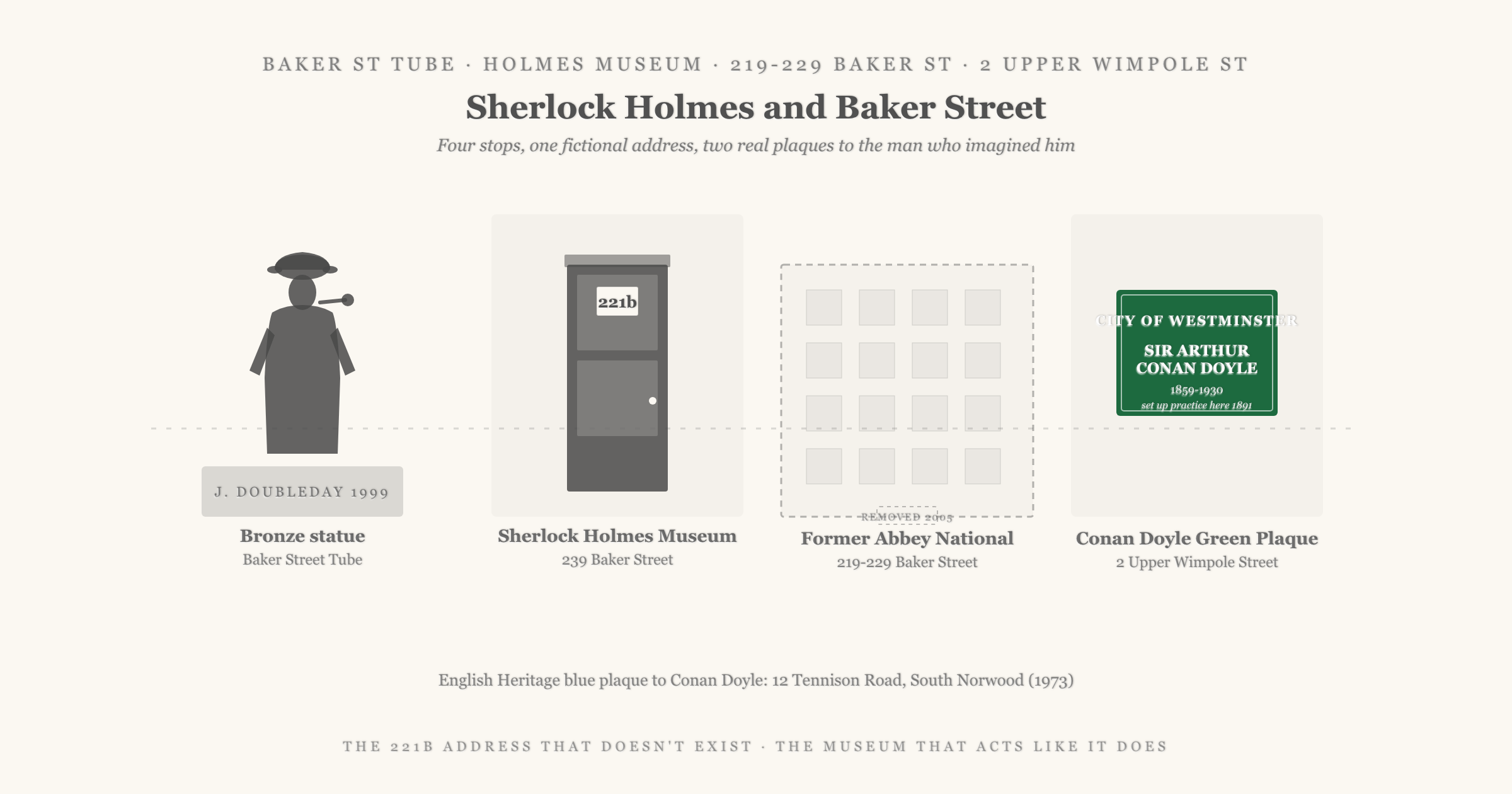
The walk starts at Baker Street Underground station, exit Marylebone Road. The London Transport bronze sculpture of Sherlock Holmes by John Doubleday, unveiled 23 September 1999 by the Lord Mayor of Westminster and the Norwegian ambassador (because Holmes survives the Reichenbach Falls by escaping to Norway), stands three metres tall on the pavement at the corner. Doubleday depicted Holmes in long coat and deerstalker, pipe in hand, looking south down Baker Street, on a stone plinth bearing the Holmes-Watson coat of arms.
The statue is the only piece of Baker Street that names Holmes and is genuinely civic rather than commercial. The plinth carries the relevant fictional dates and the Holmes silhouette is the most-photographed three-metre detective in Europe. The Norwegian connection is the kind of detail Conan Doyle would have approved of: it pleases the literalists who treat the Holmes canon as biography rather than fiction.
Stop Two: The Sherlock Holmes Museum at 239-241 Baker Street
Two hundred metres south of the Tube, on the east side of Baker Street, the Sherlock Holmes Museum occupies a four-storey Georgian townhouse with a black door bearing the number 221b in gold. The building's actual postal address is 239 Baker Street, but the City of Westminster granted the Museum special permission in 1990 to display 221b at street level. The decision was contested by the Royal Mail and Abbey National (who at that point still received the Holmes mail), and the legal compromise was that 221b was a "commemorative number" rather than the building's official address. Letters to 221b still went to Abbey National until 2002, when they switched to going to the Museum.
The Museum opened on 27 March 1990 and was designated by the Greater London Council as a building of architectural interest in the 1980s. Inside, the first floor is laid out as the Holmes-Watson sitting room from the canon: two armchairs by the fire, the Persian slipper containing tobacco, the violin, the VR cipher shot into the wall, the chemistry bench. The recreation is taken from the descriptions in the stories rather than from any historical original. The upper floors hold tableaux from the stories with waxwork figures.
The Museum's address arrangement is unique in London. No other property in the City of Westminster is allowed to display a commemorative number different from its postal one. The blue plaque outside the Museum is not an English Heritage plaque (Holmes does not qualify because he is fictional, and the English Heritage scheme requires the subject to be a real person who has been dead at least twenty years). The plaque is privately produced by the Museum.
Stop Three: 219-229 Baker Street and the Abbey National Letters
Walk a hundred metres south from the Museum to the large Art Deco building on the west side of Baker Street that runs from number 219 to number 229. This was the head office of Abbey National from 1932 to 2002. The 221 number falls within this single building, which is why the Royal Mail had no obvious recipient for Sherlock Holmes letters and routed them to the bank.
The Abbey National kept the answering job through three name changes (Abbey Road Building Society, then Abbey National, then Abbey), and through several waves of staff turnover. The position was filled by a series of "Secretaries to Mr. Holmes" whose actual job titles in HR records were obscured to maintain the fiction. When Abbey moved out in 2002, the bank donated its archive of Holmes correspondence (estimated at over ten thousand surviving letters out of perhaps eighty thousand total) to the Sherlock Holmes Museum, which now answers the post.
The building itself is being slowly redeveloped through the 2020s. A small Westminster City Council plaque commemorating "Sherlock Holmes, Consulting Detective, lived here" was installed in 1999 on the bank's facade and removed during the 2005 refurbishment; it has not been replaced. The exact spot is now anonymous office frontage. This is the most ghost-like stop on the walk: the place where Holmes received post for seventy years and where the only civic acknowledgement of the fiction was quietly removed twenty years later.
Stop Four: 2 Upper Wimpole Street, the Conan Doyle Green Plaque
Cross Marylebone Road and walk four streets east to 2 Upper Wimpole Street (sometimes given as Devonshire Place in older sources; the modern postal address is Upper Wimpole Street W1). On the corner of the building, at first-floor level, is a green rectangular plaque by the City of Westminster reading "Sir Arthur Conan Doyle 1859-1930 set up his practice here in 1891."
The story of this plaque is the story of how Sherlock Holmes became famous. Conan Doyle was a trained doctor (Edinburgh, MD 1885) who had set up a general practice in Southsea, Portsmouth, in 1882 and had spent eight years building a practice that barely paid its bills. In 1890 he came to London for an ophthalmology course at the Royal London Ophthalmic Hospital and decided to specialise as an eye doctor. In March 1891 he opened a consulting room at 2 Devonshire Place / Upper Wimpole Street and waited for patients. Famously, almost none came. He sat in the empty consulting room for weeks and used the time to write. The short stories that became The Adventures of Sherlock Holmes, beginning with A Scandal in Bohemia in the Strand Magazine in July 1891, were largely written during the unbilled hours at this address. By August 1891 the practice was abandoned and Conan Doyle was writing full-time. Within five years he was the highest-paid short-story writer in England.
The Green Plaque is what the City of Westminster awards (since 1991) to commemorate sites of interest that fall outside the English Heritage scheme. It is not blue, it is rectangular rather than round, and the criteria are looser than English Heritage's. The Conan Doyle Green Plaque went up in 2001, ten years after the scheme started.
The Conan Doyle Blue Plaque at 12 Tennison Road, South Norwood
Outside the Marylebone walking tour, but worth a separate journey for completeness, Arthur Conan Doyle's English Heritage blue plaque is at 12 Tennison Road, South Norwood SE25, where he lived from 1891 to 1894 with his first wife Louisa and worked on most of the early Holmes stories that made his name. The plaque reads "Sir Arthur Conan Doyle 1859-1930 Creator of Sherlock Holmes lived here 1891-1894." It was unveiled in 1973 by the London County Council scheme that later passed to English Heritage. South Norwood is twenty minutes by train from Victoria; the house is a substantial detached Victorian villa, still residential and not open to the public, but visible from the street.
The choice of Tennison Road over the more central addresses is the standard English Heritage logic: of all the places Conan Doyle lived in London (Norwood, Hindhead in Surrey, Bush Villas in Portsmouth, Devonshire Place, and a flat in Russell Square at various points), Tennison Road was the longest continuous residency in a single property, and the years 1891-1894 are the period of the highest-impact writing. Holmes's "death" at the Reichenbach Falls in The Final Problem was written at this house in 1893.
The Sherlock Holmes Pub at 10 Northumberland Street
A worthwhile post-walk detour: the Sherlock Holmes pub at 10 Northumberland Street, off the Strand, between Trafalgar Square and Embankment station. The building was originally the Northumberland Arms and is the hotel where Sir Henry Baskerville stays in The Hound of the Baskervilles. The pub is decorated as a Holmes shrine: a recreation of the 221b sitting room sits on the upper floor (assembled originally for the Festival of Britain in 1951 and donated permanently to the pub afterwards), and the bar displays props from the stories, including the supposed footprint of the gigantic hound and a stuffed snake referencing The Speckled Band. The pub has no plaque, but it has the densest concentration of Holmes paraphernalia anywhere outside the Museum.
Why Sherlock Holmes Has No English Heritage Blue Plaque
The English Heritage Blue Plaques scheme (which began as the Society of Arts scheme in 1866, passed to the London County Council in 1901, then the Greater London Council, and to English Heritage in 1986) has one rule that is rigidly enforced: the subject must have been a real person. Fictional characters are not eligible. This is why Sherlock Holmes will never have a proper English Heritage blue plaque, even though he is the most famous resident of Baker Street, more famous than any actual person who has ever lived there.
The exclusion has produced a workaround culture. The Sherlock Holmes Museum has its own non-English-Heritage blue plaque. Westminster City Council had a plaque on the Abbey National until 2005. The Sherlock Holmes statue is civic but not part of the plaque scheme. The Conan Doyle blue plaques (English Heritage at Tennison Road, Westminster Green at Upper Wimpole Street) are the closest the scheme comes to acknowledging the Holmes phenomenon, by commemorating the man who wrote him rather than the character himself.
If you want to see a real English Heritage blue plaque associated with Holmes on Baker Street itself, you will not find one; the closest English Heritage blue plaques to the Museum belong to William Pitt the Younger (120 Baker Street, the Prime Minister at the height of the Napoleonic Wars), and Edward Lear (30 Seymour Street, just south of Marylebone Road, where the nonsense poet lived briefly as a young man). Neither of them have anything to do with Holmes, which is the point: Baker Street's most famous fictional resident exists in commercial signage, museum acknowledgement, and a bronze statue, but not in the official scheme.
Walking the Route in Order
The full walk runs Baker Street Tube (start), south to the Sherlock Holmes Museum at 239, south again past the former Abbey National at 219-229, east across Marylebone Road to 2 Upper Wimpole Street, and (optionally) south through Marylebone Village to Northumberland Street for the pub. It is about two miles in total and takes ninety minutes at a slow pace with photographs. The Marylebone walking-tour format complements our walking tour using London's Blue Plaques for cross-neighbourhood routes, our Florence Nightingale Mayfair walk for the medical-history overlap, and the Bloomsbury Group walking tour for the literary cluster a mile to the east. The Legacy app plots all four routes against the underlying plaque dataset of 1,625+ London markers, with the inscription text and the historical context for each one.
Sherlock Holmes is the only London resident with a postal address, a Tube-station statue, and a museum, who has never officially existed. The walk through Baker Street is the closest you can get to the fiction without leaving Marylebone.