Shakespeare's Globe was a thatched, three-storey, open-air playhouse built on the south bank of the Thames in 1599 by the playing company Shakespeare belonged to (the Lord Chamberlain's Men, later the King's Men), burned to the ground in 1613 during a performance of Henry VIII when a stage cannon set the roof alight, was rebuilt on the same foundations within twelve months as a tile-roofed second Globe in 1614, was closed by the Puritan parliament in 1642, demolished in 1644, and lay buried under Southwark warehouses for three hundred and fifty-three years until the American actor Sam Wanamaker raised the money and the political support to reconstruct it on a site about two hundred yards from the original, opening the new Globe to the public in 1997. The current building, formally Shakespeare's Globe Theatre, is the only authentically thatched building in central London since the Great Fire of 1666 and the only working reconstruction of an Elizabethan playhouse in the world.
This is the Bankside walking guide that connects the five sites: the original Globe foundations on Park Street, the Rose Theatre archaeology a few minutes away, Southwark Cathedral's Shakespeare memorial, the Marshalsea Prison plaque on Borough High Street that ties the literary geography to Dickens, and the Sam Wanamaker memorial plaque on the wall of the modern Globe itself. The route is walkable in a long afternoon, sits inside one square kilometre, and is the densest piece of literary geography in London after Westminster Abbey's Poets' Corner. If you want to follow it with every plaque mapped and pinned, the Legacy app tracks all 1,625+ London plaques including the four sites covered below.
A Note on What "Shakespeare's Globe" Refers To
In strict usage, "Shakespeare's Globe" refers to one of three buildings. The 1599 first Globe (operational 1599 to 1613), the 1614 second Globe (operational 1614 to 1642), and the 1997 modern Globe (operational 1997 to present). The first two are gone; only their foundations remain, marked by a pavement outline at the corner of Park Street and Porter Street. The third is the working theatre on Bankside that runs a full Shakespeare season every summer plus the indoor Sam Wanamaker Playhouse beneath it. When tourist materials say "Shakespeare's Globe," they almost always mean the 1997 building. When academic materials say it, they almost always mean the 1599 first Globe. This guide walks the geography that holds all three.
Stop One: The Original Globe Site on Park Street (1599)
The first stop is the actual site of the 1599 Globe, which is not where the modern theatre stands. The original Globe foundations sit underneath a row of buildings on Park Street, between the Anchor Terrace block and Porter Street, about two hundred yards east of the modern Globe. Most of the foundation footprint is buried beneath the listed Anchor Terrace Georgian houses, but the visible portion (about a third of the original Globe's circumference) is outlined in dark paving stones set into Park Street's pavement and marked by a Southwark Council plaque on the wall above. The inscription reads "Here stood the Globe Playhouse of Shakespeare 1598-1644," which is a slightly loose dating (the first Globe opened in 1599, the second closed in 1642 and was demolished in 1644).
The Globe was built from the timbers of an older playhouse called The Theatre in Shoreditch. The Lord Chamberlain's Men, the playing company Shakespeare had bought a share in, had been performing at The Theatre but lost the lease in 1597. In late December 1598, the company dismantled the building in a single night, carried the timbers across the frozen Thames, and used them as the structural frame of the new Globe rising in Southwark. The cross-river move was both a property-rights manoeuvre (the landlord owned the land, not the building) and a commercial repositioning: Bankside in the Liberty of the Clink sat outside the City of London's jurisdiction, where the Lord Mayor's hostility to playhouses was most acute. The first performance at the new Globe was probably in mid-1599; Henry V is the most likely candidate for the opening play, based on its prologue's reference to "this wooden O."
Shakespeare wrote, performed, and held a small share in the Globe through its first decade. The plays that premiered there include Julius Caesar, Hamlet, Twelfth Night, Othello, King Lear, Macbeth, Antony and Cleopatra, and The Tempest. The original Globe was a polygonal building (probably twenty sides, often rendered as a perfect circle in popular illustration), about thirty metres in diameter, with three roofed galleries surrounding an open yard where the cheapest tickets (one penny) bought standing room. The roof of the galleries was thatched, the stage projected into the yard, and the company performed in afternoon daylight without artificial lighting.
Stop Two: The 1613 Burning, the Henry VIII Cannon
The first Globe burned down on 29 June 1613 during a performance of Henry VIII (then called All Is True). The fire is one of the most reliably-documented events in early modern English theatre, partly because three contemporaries wrote letters about it within a week. The cause: a stage cannon used as a special effect to mark King Henry VIII's entrance in a court scene misfired and ignited the thatched roof above the gallery. Sir Henry Wotton wrote that the cannon "wrapt round the building," and "within less than an hour the whole house to the very ground was consumed."
The fire spread through the thatch with extraordinary speed because the roof was a flammable network of rye straw and reeds, the timber frame was seasoned and dry after a hot June, and the open yard acted as a chimney that drew the flame upward. No one is recorded as killed; the most-cited near-miss is the man whose breeches caught fire and were extinguished by a bottle of ale. The audience escaped through the two main galleries' exits before the upper structure collapsed.
What was lost in the fire is materially significant. The Globe held the company's costumes, props, prompt-books, and possibly some manuscripts. The plays survived only because they had been published in quarto editions or held in the company's hand-copies stored elsewhere; the loss is part of the reason scholars treat the 1623 First Folio (the first collected edition, published seven years after Shakespeare's death) as the canonical text for plays we would otherwise have only fragmentary copies of.
The 1613 burning has its own memorial on Bankside: a plaque on the wall of the modern Globe theatre notes the date and the cause. It is one of the few plaques in London that commemorates a destruction rather than a residence.
Stop Three: The Rose Theatre Archaeology (Park Street)
A two-minute walk south from the original Globe site brings you to the Rose Theatre, the older Bankside playhouse whose foundations were excavated in 1989 during the construction of an office block on Park Street. The Rose, built in 1587 by the impresario Philip Henslowe, was the first purpose-built playhouse on Bankside and predates the Globe by twelve years. It hosted the early plays of Christopher Marlowe (Tamburlaine the Great, The Jew of Malta, Doctor Faustus) and the early career of Edward Alleyn, the leading tragic actor of the 1590s.
The Rose's archaeological remains are the most complete surviving Elizabethan playhouse foundations in London. The 1989 dig recovered about 60% of the building's footprint before construction proceeded over it, and the foundations are preserved in a viewing chamber underneath the office building (entrance from 56 Park Street, opening hours seasonal). The chamber shows the building's distinctive thirteen-sided polygon, the position of the stage, and a small lecture space where the Rose Theatre Trust runs short performances and academic events.
The Rose plaque on the building's facade reads "The site of the Rose Playhouse, built in 1587 by Philip Henslowe, was excavated in 1989," and it is one of the most accurate working-archaeology plaques in central London. The site of the Rose is a much smaller building than the Globe (about twenty-two metres across compared with the Globe's thirty), and the comparison gives a useful sense of how the Bankside theatre boom scaled up over the 1590s as the companies grew.
Stop Four: Southwark Cathedral's Shakespeare Memorial
Southwark Cathedral sits five minutes north of the Rose site, on the south bank of the Thames between London Bridge and Borough Market. The cathedral (formally the Cathedral and Collegiate Church of St Saviour and St Mary Overie) is the parish church Shakespeare's brother Edmund was buried in on 31 December 1607, and it contains the most significant Shakespeare memorial in London outside of Westminster Abbey.
The Shakespeare Memorial in the south aisle was installed in 1912, designed by Henry McCarthy. It shows a recumbent figure of Shakespeare in his thirties, head propped on one hand, surrounded by carved reliefs of Bankside as it would have looked in his lifetime. Above the memorial, a 1954 stained glass window by Christopher Webb depicts characters from twenty of his plays, with the Globe theatre at the centre of the lower panel. The combination of the memorial and the window is the closest London comes to a single coherent visual tribute to Shakespeare; the Westminster Abbey monument is older and grander but its Poets' Corner setting dilutes it amongst dozens of other writers.
The Edmund Shakespeare burial register entry is also on display in the cathedral's Lancelot Andrewes Chapel: "Edmonde Shakespeare, a player," buried in the church for the elevated fee of twenty shillings (the standard fee was about two shillings). The premium fee suggests William paid for a tolling of the great bell of the cathedral, a tribute reserved for significant burials. Edmund Shakespeare was twenty-seven, an actor with the King's Men like his older brother, and his exact burial location inside the church is not recorded; tradition places him under the floor of the choir.
Stop Five: The Marshalsea Prison Plaque (Borough High Street)
A ten-minute walk southeast through Borough Market and along Borough High Street brings you to the Marshalsea Prison plaque, set into the wall of the churchyard of St George the Martyr. The Marshalsea was a debtors' prison operational from the 14th century to 1842, and it sits at the intersection of two literary geographies: Shakespeare almost certainly knew the original Marshalsea building (Sir Walter Raleigh was held there in 1614 and Ben Jonson in 1597), and Charles Dickens spent the summer of 1824 visiting his father, who had been imprisoned for debt in the second Marshalsea building.
The plaque (a Southwark Council plaque, not English Heritage) marks the prison's outer wall, the only surviving fragment of the second Marshalsea. The wall faces a small public garden that was once the prison yard, and a Charles Dickens memorial bench sits under a plane tree in the garden's east corner. The proximity is the practical reason the Bankside literary walk is two walks in one: the Shakespeare geography from 1590 to 1620 sits about three hundred yards from the Dickens geography of 1824 to 1857, and both depend on Bankside's status throughout that period as the city's most concentrated zone of poverty, entertainment, and storytelling.
For a deeper Dickens walk that picks up from the Marshalsea, the Charles Dickens Museum article on this blog covers his Doughty Street years; for the Bloomsbury literary geography that picks up the thread in the early 20th century, the Bloomsbury Group walking tour starts about a mile north of here.
The Sam Wanamaker Reconstruction (1970 to 1997)
The current Shakespeare's Globe Theatre on New Globe Walk is the result of one of the longest single-project fundraising campaigns in English cultural history. Sam Wanamaker was an American actor and director, born in Chicago in 1919, who first visited London in 1949 and was startled to find that the city marked the original Globe with a small wall plaque on a brewery and no working memorial of any kind. Wanamaker raised the idea of a reconstruction with the Shakespeare Birthplace Trust in the late 1960s and registered the Shakespeare Globe Trust as a charity in 1970.
The campaign ran for twenty-seven years. Wanamaker raised funds from American and British donors, negotiated the lease of the New Globe Walk site from the London Borough of Southwark, commissioned the architectural research that worked out what the original Globe had actually looked like (the surviving evidence is a single panoramic sketch by Wenceslaus Hollar, the foundations excavated on Park Street in 1989, and a handful of contemporary text descriptions), and oversaw the design of the modern building by Theo Crosby of Pentagram. The frame was raised in 1992. Wanamaker died in 1993 of prostate cancer, four years before the building opened. His daughter Zoe Wanamaker, the actress, attended the opening on 12 June 1997 alongside Queen Elizabeth II.
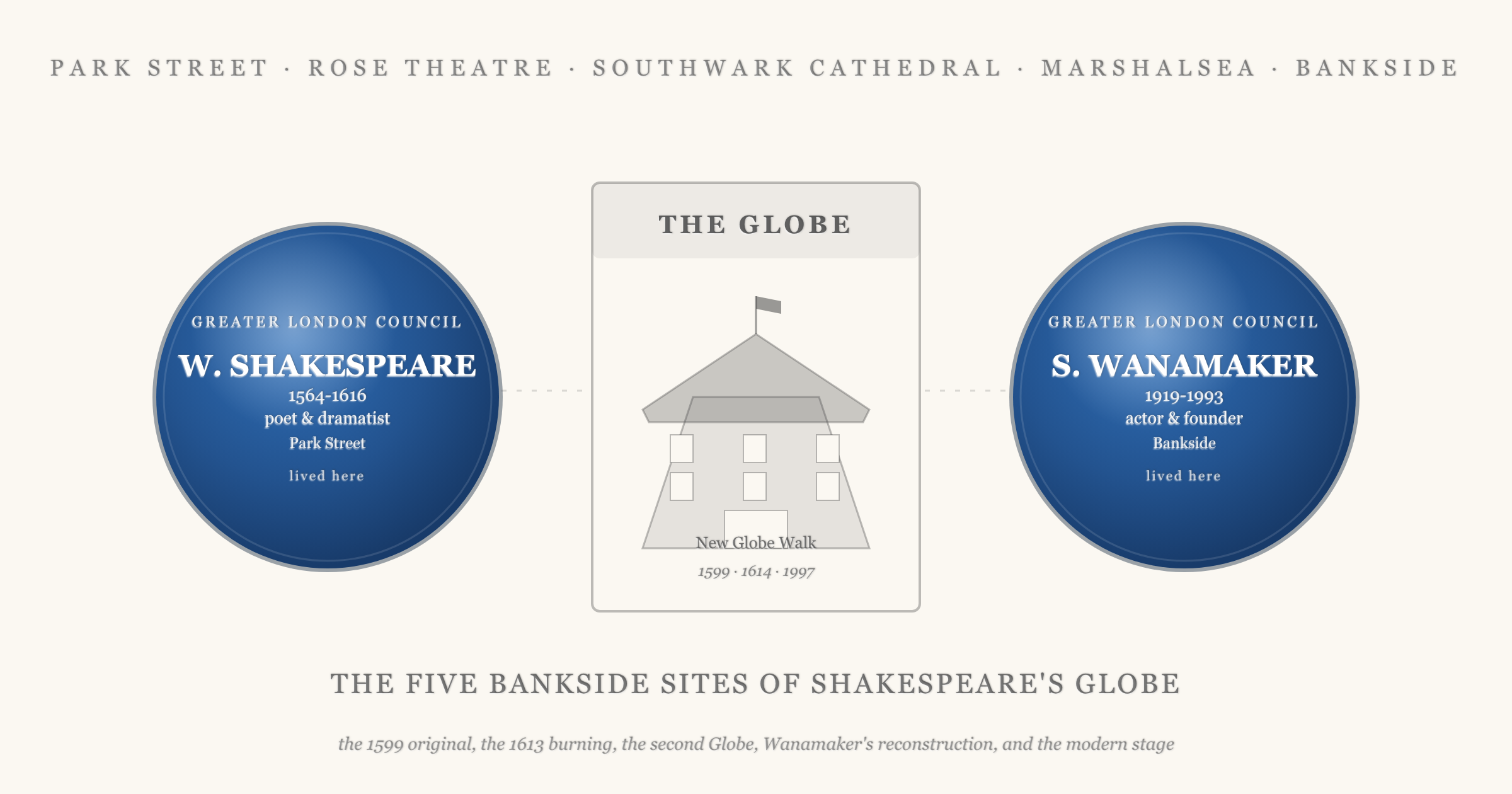
The Sam Wanamaker plaque on the wall of the modern Globe is a Southwark Council plaque rather than an English Heritage blue plaque, but it marks the achievement directly: "Sam Wanamaker 1919-1993, actor and founder of Shakespeare's Globe." The smaller, modern Sam Wanamaker Playhouse, an indoor candlelit reconstruction of a Jacobean-period theatre, sits underneath the open-air main stage and is named after him. It opened in 2014, seventeen years after the main theatre, completing the original Wanamaker plan in two stages.
What the Reconstruction Got Right (and Where It Hedged)
The modern Globe is an authentic reconstruction within the limits of the evidence and contemporary building codes. The frame is green oak, joined with wooden pegs in the medieval method. The walls are timber-framed and finished with lath-and-plaster in a lime mortar matched to the surviving Tudor recipes. The roof is genuine Norfolk water-reed thatch, applied by traditional thatchers, and is the only thatched roof in central London because the Great Fire of 1666 led to building regulations that banned thatching within the City; the modern Globe sits just outside the historic City boundary, in Southwark, which is the only reason the thatching was even legal to install in 1997.
The hedges, the places the reconstruction had to compromise on the original design, are mostly fire-safety: the building has more emergency exits than the original (six rather than the original four), the gallery seats include sprinklers concealed in the roof line, and the stage cannons are now compressed-air effects rather than gunpowder. The 1613 burning is the explicit historical reason for the sprinkler system. The other hedge is capacity: the modern Globe holds about 1,400 people, compared with an estimated 3,000 in the original; modern seat sizes and aisle requirements account for the difference.
How to Walk the Route
A practical Bankside Shakespeare walk fits comfortably into a single afternoon. Start at the modern Globe on New Globe Walk, walk east along the Thames Path to the original Globe site on Park Street (eight minutes), continue south on Park Street to the Rose Theatre archaeology (two minutes), turn back north and west to Southwark Cathedral via Bankside (six minutes), then walk south along Borough High Street to the Marshalsea plaque at St George the Martyr (twelve minutes). Total walking time: about thirty minutes, exclusive of stops. Add an hour for the Globe interior, half an hour for Southwark Cathedral, and the Rose Theatre is a fifteen-minute stop in its visiting hours.
For more London literary walks, the Bloomsbury Group walking tour covers the Gordon Square / Fitzroy Square / Tavistock Square triangle in Bloomsbury, the Florence Nightingale walking tour traces her three Mayfair and Highgate plaques, and the Ada Lovelace walking tour follows her four London plaques across Marylebone and St James's. All three pair naturally with this Shakespeare walk as part of a longer historical-London week.
The Legacy app maps the Bankside Shakespeare walk and the Marshalsea-Dickens link in a single route, with the inscription text and the historical context for each plaque. Open it at the modern Globe, walk the route, and the plaques tick off as you arrive at each one. A literary walk that took Sam Wanamaker twenty-seven years to make possible takes about ninety minutes to actually do.