Notting Hill is known around the world for its pastel terraces, the Portobello Road market, the romantic comedy that took its name, and the largest street carnival in Europe. But walk its streets looking up at the walls, and a different Notting Hill appears: one of the most plaque-dense corners of west London, where Jimi Hendrix wrote a song in a Bayswater hotel, the modern Carnival was dreamed up on Tavistock Road, and George Orwell lived above the shops on Portobello Road. This is a walking guide to the blue plaques of Notting Hill (W11 and the streets around it), the famous residents who made the neighbourhood, and a route that links them.
For anyone exploring the city's history on foot, Notting Hill rewards it more than almost anywhere: music, writing, social history, and reform all marked within a short walk. The Legacy app maps every blue plaque in London, with the inscription and the story behind each one, so you can build your own route.
The Music of Notting Hill
Notting Hill and the streets bordering it have an extraordinary musical history for so small an area.
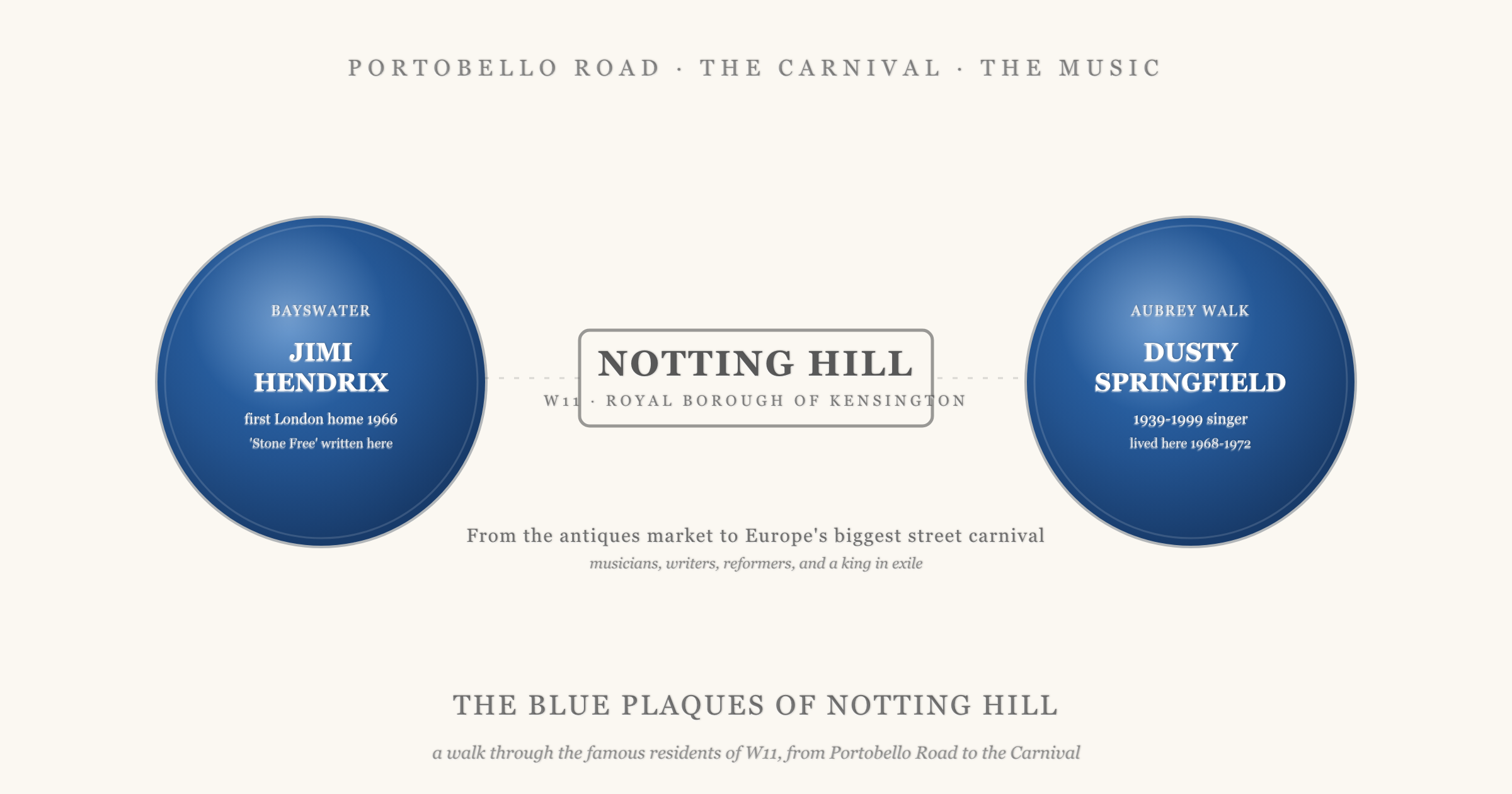
Jimi Hendrix made his first London home here. Newly arrived from New York in September 1966, he stayed at a hotel in Bayswater, on the edge of Notting Hill, and a plaque records that he wrote "Stone Free," his first original composition in Britain, there on 24 October 1966. Within weeks he would be the most electrifying new arrival on the London scene, but it began in a modest hotel room on the neighbourhood's eastern flank.
Dusty Springfield, one of the greatest British voices of the era, lived on Aubrey Walk from 1968 to 1972, the years around her landmark album "Dusty in Memphis." Her blue plaque marks the house on the quiet hillside street.
And the raw, political energy of punk has its roots here too: a plaque on Walterton Road remembers Joe Strummer of The Clash, whose music was shaped by the multicultural, sometimes turbulent west London of the 1970s. The Clash's Notting Hill was the same one that erupted into the riots and the Carnival of that decade, and it ran straight through their songs.
The Notting Hill Carnival
No part of Notting Hill's history matters more than the Carnival, and two plaques on Tavistock Road mark the people who built it. Born out of the Caribbean community that settled in the area after the Second World War, and as a response to the racial tensions and the 1958 race riots, the Carnival grew from indoor gatherings into a street event that is now the biggest in Europe.
Russell Henderson, a Trinidadian musician and pioneering steel-pan artist, led the first-ever Carnival parade on the streets of Notting Hill in 1965, the moment the modern street Carnival began. His plaque sits at 69 Tavistock Road. Next door, at number 70, a plaque honours Leslie Palmer, who in the 1970s pioneered the template for the modern Carnival, bringing in sound systems, mas bands, and the scale that transformed a local community celebration into a nationally recognized event. Between them, these two addresses are the birthplace of a festival that now draws millions.
Portobello Road
The Portobello Road market is the spine of Notting Hill, and two plaques record how its famous antiques trade began. One marks where Susan Garth launched what it calls "London's first antiques market," helping make Portobello Road the international institution it is today. Another, further along, remembers June Aylward, who established the first antique shop on the road. From those beginnings, Portobello grew into the largest antiques market in the world, the Saturday crush of stalls that defines the neighbourhood for most visitors.
And on Portobello Road itself, above the shops, lived one of the twentieth century's defining writers.
The Writers
George Orwell lived at 22 Portobello Road, where a plaque marks the home of the "novelist and political essayist." It was an early London address for the writer who would go on to "Nineteen Eighty-Four" and "Animal Farm," and it sits fittingly on the market street he would have known in its grittier, pre-fashionable days. For more on his city, see our guide to George Orwell's London.
Notting Hill drew other literary names. Siegfried Sassoon, the great poet of the First World War, lived at 23 Campden Hill Square from 1925 to 1932. A. E. Housman, author of "A Shropshire Lad," lived on Northumberland Place in the 1880s. And W. H. Hudson, the writer and naturalist, is commemorated on St Luke's Road, with a second plaque placed by an Argentine society honouring his South American birth, a reminder of how international this corner of London has always been.
Reformers, Scientists, and a King in Exile
The plaques of Notting Hill and its borders reach well beyond music and letters.
On Kensington Palace Gardens, a plaque records that King Haakon VII of Norway led the Norwegian government-in-exile from London during the Second World War, from 1940 to 1945, one of several European monarchs and governments who ran their resistance from the city while their countries were occupied.
At 7 Kensington Park Gardens, the Victorian scientist Sir William Crookes, the chemist and physicist who discovered the element thallium and pioneered the study of cathode rays, lived from 1880 until his death. And at 17 St Ann's Villas, a plaque marks the birthplace of Albert Chevalier, the celebrated music-hall comedian, a reminder that the neighbourhood's entertainment history stretches back long before Hendrix.
A Walk Through Notting Hill
You can trace the best of Notting Hill's plaques in a single afternoon, ideally finishing on Portobello Road:
- Aubrey Walk and Campden Hill Square. Start on the higher, quieter southern streets with Dusty Springfield and Siegfried Sassoon.
- Kensington Park Gardens. Drop down to the grand stucco terraces and Sir William Crookes's home.
- Tavistock Road. Stand between numbers 69 and 70, the two addresses where the modern Notting Hill Carnival was born.
- Portobello Road. Walk the market street, past the antiques-trade plaques and George Orwell's old address at number 22.
- Bayswater. Finish on the eastern edge where Jimi Hendrix wrote his first London song in the autumn of 1966.
It is a route that moves from the hush of the hill to the noise of the market, and takes in steel pans, war poetry, punk, and a Norwegian king along the way.
Discover the Plaques Yourself
Notting Hill's plaques are part of a far larger web of markers across London, recording where its musicians, writers, reformers, and scientists lived and worked. Tracing them turns a walk through W11 into a walk through a century and a half of culture, from the steel-pan parade that started the Carnival to the hotel room where Hendrix found his sound. The Legacy app maps every blue plaque in the city, with the full inscription and the history behind it, so you can plan your own route, collect the ones you visit, and follow the trail onward, perhaps to more of musical London or deeper into the complete guide to London's blue plaques. Start on Portobello Road, and see where the city takes you.