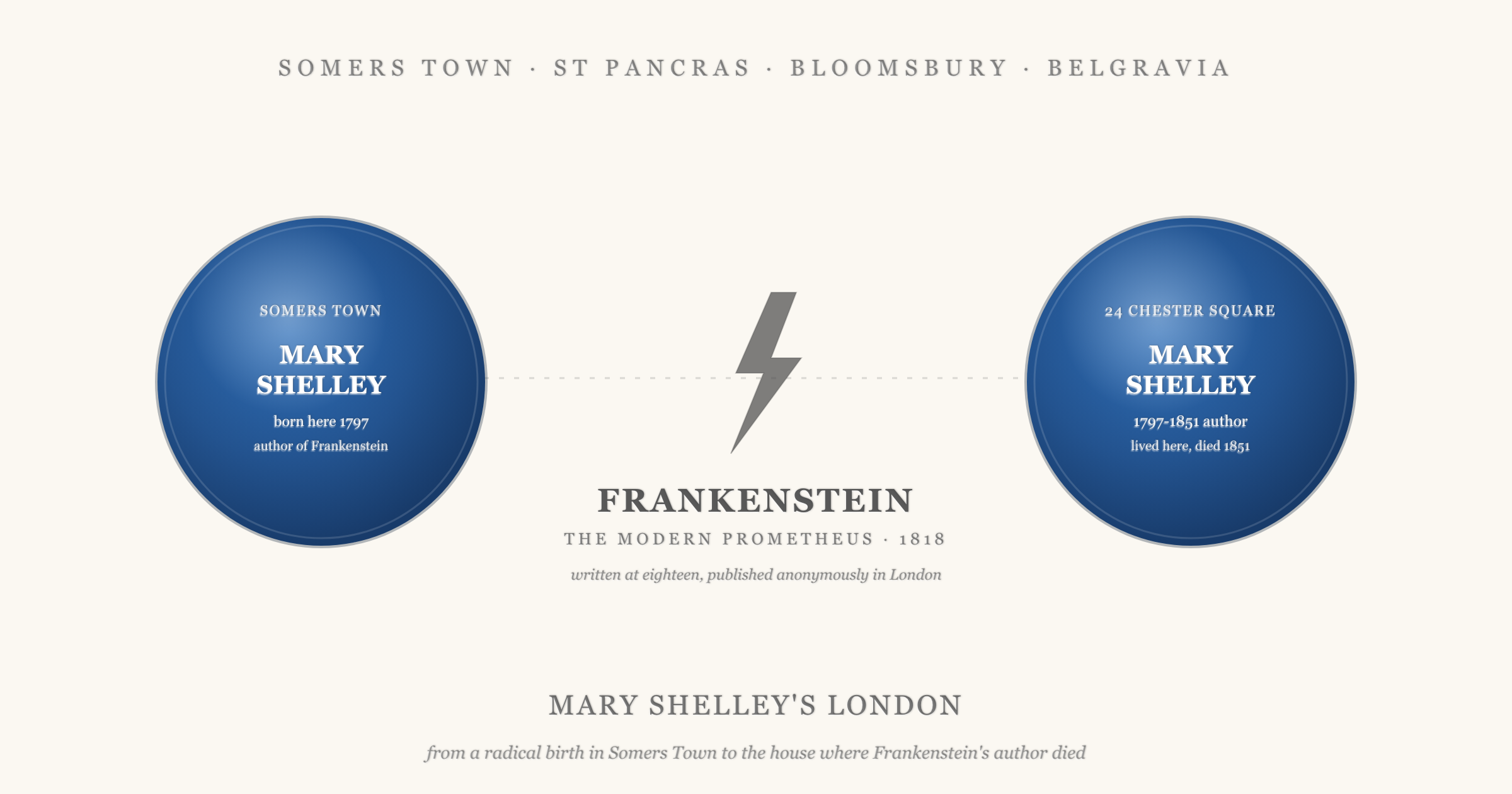
Mary Shelley wrote one of the most famous novels in the English language before she was twenty, and she did it as the daughter of two of London's most radical thinkers, carrying a grief that began the day she was born. The woman who wrote Frankenstein was a Londoner through and through: born in the north of the city, schooled in part at a graveside in St Pancras, and dead, decades later, in a quiet Belgravia square. Her London is a map of love, loss, and scandal, and a surprising amount of it can still be traced through the blue plaques that mark where she lived. This is a guide to Mary Shelley's London, from the Somers Town birthplace to the house where the author of Frankenstein died.
For the wider story of her remarkable family, our guide to Mary Wollstonecraft's London, her mother, is the natural companion to this one. Here, the focus is the daughter.
A Birth and a Death in Somers Town
Mary Wollstonecraft Godwin was born on 30 August 1797, at the Polygon, a ring of houses in Somers Town, just north of where the British Library and St Pancras station now stand. Her parents were as formidable a pair as London has ever produced: her mother was Mary Wollstonecraft, the pioneering feminist who wrote A Vindication of the Rights of Woman, and her father was William Godwin, the philosopher and novelist at the centre of London's radical intellectual circle.
The shadow over the whole of Mary Shelley's life fell within days of her first. Eleven days after the birth, her mother died of an infection contracted during the delivery. Mary grew up, therefore, with a famous mother she had never known, raised by a brilliant but emotionally distant father in a household full of ideas, books, and visitors. That absence, the mother who died giving her life, sits unmistakably at the centre of the novel she would later write about a creator and the being he brings into the world and then abandons.
Schooled at a Graveside: St Pancras Old Church
One of the most extraordinary facts of Mary Shelley's London is where she went to be close to her mother. Mary Wollstonecraft was buried in the churchyard of St Pancras Old Church, and the young Mary spent hours there at the graveside. By family tradition she even learned to read in part by tracing the letters of her mother's name carved on the headstone, a quietly astonishing image: a girl learning her letters from her dead mother's memorial.
The churchyard became important for another reason too. It was here, at her mother's grave, that the teenage Mary met in secret with the poet Percy Bysshe Shelley, a married disciple of her father's, and where, by most accounts, the two declared their love. In 1814, to the fury of Godwin, the sixteen-year-old Mary ran away with Percy. The scandal was enormous, and it set the pattern of exile and disrepute that would shadow the couple for years. St Pancras Old Church still stands, its churchyard quiet, and the Wollstonecraft memorial is still there, even though the body was later moved to be with the rest of the family in Bournemouth.
The Bloomsbury Years: Marchmont Street
After their elopement and Percy's first wife's death, the Shelleys lived at a series of London addresses among the radical and literary set. One of them, 87 Marchmont Street in Bloomsbury, carries a blue plaque to both Percy Bysshe Shelley and Mary Shelley, recording that they lived in a house on the site in 1815 and 1816. It is a short walk from the British Museum and the heart of literary Bloomsbury, which a century later would house another famous circle of writers and thinkers.
These were the years of the couple's deepest creative ferment and their hardest personal losses, including the death of their first child. They moved restlessly between London and the Continent, part of a brilliant, chaotic circle that included Percy's friend Lord Byron. And it was on one of those Continental journeys, in the summer of 1816, that the idea that made Mary Shelley immortal arrived.
The Summer That Made Frankenstein
Although Frankenstein was not written in London, no account of Mary Shelley makes sense without it. In the cold, wet summer of 1816, the Shelleys stayed near Lake Geneva alongside Lord Byron, kept indoors by relentless rain. To pass the time, Byron proposed that each of them write a ghost story. Out of that challenge, and out of a waking nightmare Mary later described, came the tale of Victor Frankenstein and the creature he assembles and then recoils from in horror.
She was eighteen. Frankenstein, or The Modern Prometheus was published in London in 1818, at first anonymously, and many early readers assumed a man had written it. It is now recognised as a foundational work of science fiction and one of the most resonant novels ever written about creation, responsibility, and abandonment, themes that reach straight back to the motherless girl at the graveside in St Pancras. When people ask who wrote Frankenstein, the answer is a teenage Londoner whose own life had already taught her everything the book is about.
A Widow's London and 24 Chester Square
Tragedy continued to follow her. In 1822, Percy Bysshe Shelley drowned in a sailing accident off the Italian coast. Mary, widowed at twenty-four with a young son, returned to London and supported them both the hard way: by writing. She produced novels, stories, travel writing, and editions of Percy's poetry, and she did the patient work of securing his literary reputation, all while managing money worries and fragile health.
Her final London home was 24 Chester Square, in Belgravia, where she lived from 1846 until her death in 1851, and where a blue plaque now records simply that "Mary Shelley 1797-1851 author of Frankenstein lived here." It is a calm, handsome address, a long way in spirit from the radical Somers Town of her birth and the graveyard of her girlhood, and a fitting place for the survivor of so much loss to have spent her last years. She died there at fifty-three, and was buried at Bournemouth, where her parents' remains were eventually brought to lie beside her.
The Family Thread
Stand back from the individual addresses and Mary Shelley's London tells a single, remarkable family story. Her mother, Mary Wollstonecraft, reshaped how the world thought about the rights of women and died bringing her into it. Her father, William Godwin, helped invent modern anarchist and radical thought. Her husband was one of the great Romantic poets. And she, the daughter at the centre of it, wrote a novel that outlived all of their fame and entered the imagination of the entire world. The plaques that mark their London addresses, often within a mile or two of one another, trace one of the most concentrated knots of literary and intellectual history the city holds.
A Mary Shelley Walk
You can follow the outline of her London in an afternoon.
- Somers Town and the Polygon area. Begin near St Pancras, in the district where she was born in 1797.
- St Pancras Old Church. Visit the churchyard and the Wollstonecraft memorial, where Mary read, mourned, and fell in love.
- Marchmont Street, Bloomsbury. See the plaque to Percy and Mary Shelley, in the literary quarter they shared.
- 24 Chester Square, Belgravia. Finish at her last home, where the author of Frankenstein died in 1851.
It is a route that runs from a radical birth to a respectable death, taking in the graveside that shaped her and the city that her family helped to think into the modern age.
Discover the Plaques Yourself
Mary Shelley's plaques are part of a far larger web of markers across London, recording where its writers, thinkers, and reformers lived and worked. Tracing them turns a walk through the city into a walk through a family saga and the birth of a literary form. The Legacy app maps every blue plaque in London, with the full inscription and the history behind it, so you can plan your own route, collect the ones you visit, and follow the trail onward, perhaps to her mother's story in Mary Wollstonecraft's London or deeper into the complete guide to London's blue plaques. Start at the graveside in St Pancras, and see where the city takes you.