Charlie Chaplin became the most famous person on earth in the 1920s, the bowler-hatted Tramp recognised in every country with a cinema, but the man who invented him was made by the poorest streets of south London. Chaplin was born in Walworth in April 1889, raised in and around Kennington through a childhood of music-hall lodgings, a vanished father, a mother taken into an asylum, and two spells in the Lambeth workhouse, and it was that exact geography, the pawnshops and the soup kitchens and the gaslit terraces of Lambeth, that he later poured into the Tramp. The London of Charlie Chaplin is not Mayfair or the West End. It is the half-mile around Kennington Cross, and almost all of it is still walkable.
This is the guide that connects the sites. Chaplin's London runs south of the river, from the Walworth street where he was born, through the Kennington Road addresses that include the blue plaque marking where he lived as a boy, past the workhouse on Renfrew Road that is now, with a symmetry he would have appreciated, the Cinema Museum, and finally across the river to the statue of the Tramp in Leicester Square, in the heart of the theatreland the Lambeth boy conquered. Walked in order, the route traces the whole arc from destitution to the bronze. If you want to follow it on the ground, the Legacy app maps every London plaque connected to Chaplin and the music-hall world he came from, with the inscription text and the history behind each one.
The Plaque, the Statue, and a South London Childhood
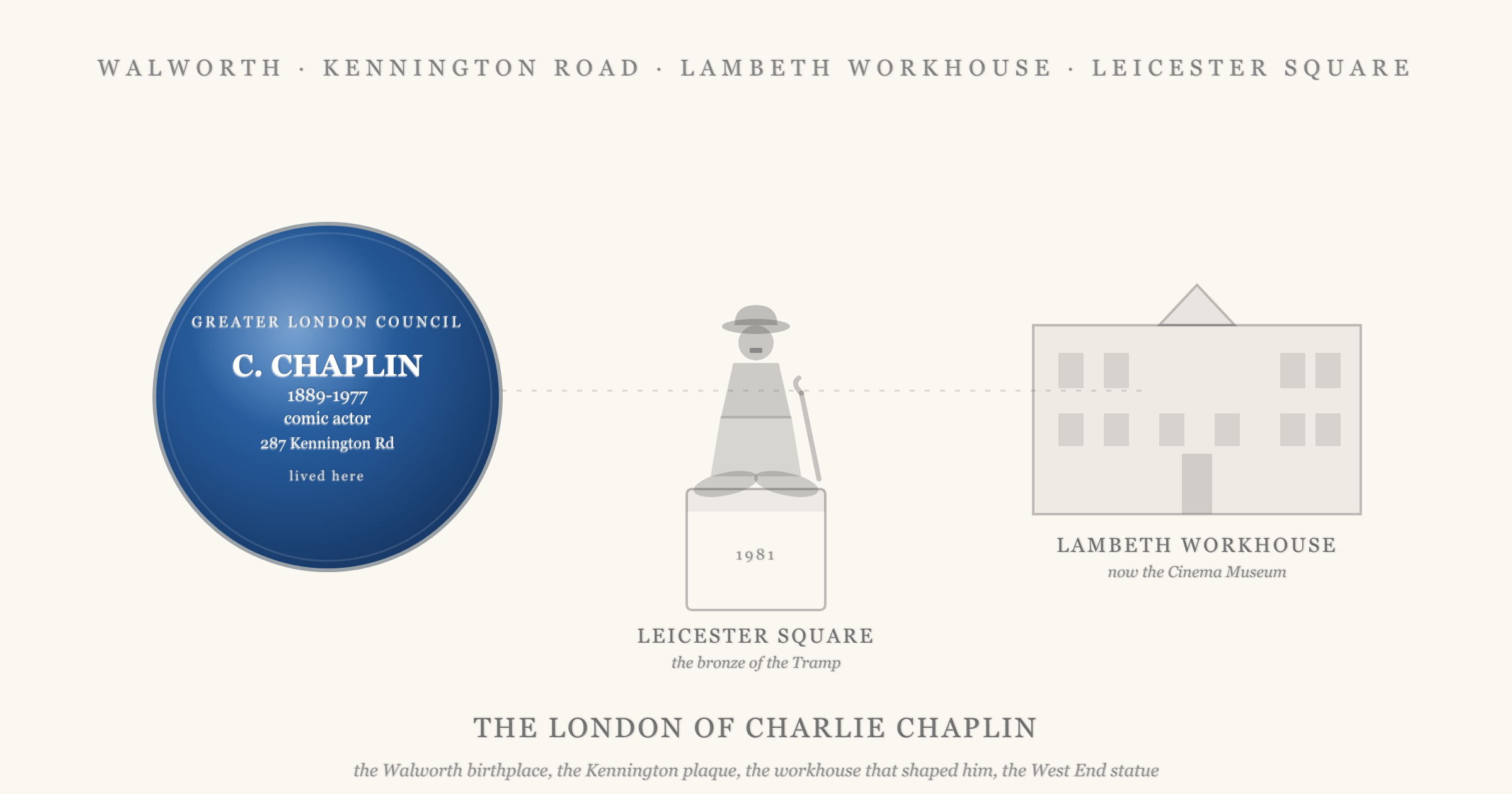
Two London memorials anchor the story at its opposite ends. The blue plaque at 287 Kennington Road marks the boyhood, the Lambeth years when Chaplin was an anonymous, half-starved child moving from one set of rooms to the next. The bronze statue in Leicester Square, unveiled in 1981, marks the fame: the Tramp, hat and cane and splayed boots, standing in the West End. Between the two lies the geography that turned the first into the second.
It is worth being clear about what makes Chaplin's London different from most blue-plaque trails. The famous-resident walks of Hampstead or Bloomsbury or Mayfair are stories of people who arrived somewhere comfortable. Chaplin's is the opposite. His south London is a map of poverty: the lodging houses the family was evicted from, the workhouse the children were sent to, the asylum his mother was committed to. He wrote it all down, with extraordinary precision, in My Autobiography (1964), and the book is the best walking companion there is, because Chaplin remembered the streets of his childhood the way only someone who escaped them could.
Stop One: East Street, Walworth (the Birthplace)
Charlie Chaplin was born on 16 April 1889. By the traditional account, the one he gave himself, the birthplace was in the Walworth area of south London, around East Street (then often called East Lane), the busy market street off the Walworth Road. No surviving building is firmly identified as the house, and there is no birthplace plaque, because the exact address was never definitively recorded, a fitting start for a man whose origins were as precarious as they were.
East Street is still a street market today, and it is the right place to begin because it sets the social register of the whole story. Chaplin's parents, Charles Chaplin Sr. and Hannah Chaplin (who performed as Lily Harley), were both music-hall entertainers, which in late-Victorian Lambeth meant a living that swung between modest success and outright destitution. The father was a singer of some reputation who drank himself to an early death in 1901, aged only thirty-seven. The mother had a lighter, sweeter voice and a fragile mind, and her decline shaped everything that followed. The Walworth of 1889 was a place where a music-hall family could be respectable one season and homeless the next, and the Chaplins lived the full range of it.
Stop Two: 287 Kennington Road (the Blue Plaque)
A short walk west and south brings you to Kennington Road, the spine of Chaplin's childhood and the location of his official London plaque. The English Heritage blue plaque at 287 Kennington Road commemorates Chaplin's years living in the area as a boy, and it is the single plaque in the London scheme that carries his name. The house is private, but the plaque is readable from the pavement, and Kennington Road is worth walking slowly, because the family lived at a string of addresses up and down it and the surrounding streets.
Kennington in the 1890s was a district of respectable terraces shading quickly into hardship, and the Chaplins were forever sliding down the scale. When his mother could find work, or when his half-brother Sydney brought in wages, they took rooms; when the money failed, they were evicted, pawned what they had, and moved on. Chaplin's autobiography names address after address in a few square streets, and the cumulative effect is of a childhood spent in perpetual motion within a tiny radius. The 287 Kennington Road plaque stands for all of them: not one home, but the whole churning Kennington geography of a poor theatrical family.
Stop Three: Pownall Terrace, Methley Street, and the Three Stags
The most vivid of the Kennington addresses is the garret at 3 Pownall Terrace, on Kennington Road, where Chaplin and his mother lived in a single attic room. He described it in unforgettable detail: the cramped space under the roof, the view over the chimney pots, his mother sewing by the window and acting out the life of the street below to entertain him. Pownall Terrace was demolished in the 1960s, so there is nothing to see but the spot, yet it is the emotional centre of the whole walk, because it is the room where Chaplin later said he first learned, watching his mother mime the neighbours, what comedy was.
Nearby are the other addresses the family passed through, among them 39 Methley Street in Kennington, one of the documented childhood lodgings. None of these need a plaque to matter; the point is the density, the way a dozen homes are folded into a few minutes' walk. And on the corner of Kennington Road stands the Three Stags pub, where, in one of the most quietly devastating passages of the autobiography, the young Chaplin glimpsed his ailing father for what proved to be one of the last times. The pub is still there. Standing outside it, with the autobiography in hand, is as close as London gets to stepping into the source material of the Tramp.
Stop Four: The Lambeth Workhouse (Now the Cinema Museum)
The hardest stop is also the most extraordinary. When Hannah Chaplin could no longer support her sons, Charlie and Sydney were admitted, in 1896, to the Lambeth workhouse on Renfrew Road, and from there sent on to the Central London District School for paupers at Hanwell. Chaplin was seven. The separation from his mother, who was herself later committed to the Cane Hill asylum as her mental health collapsed, is the wound at the heart of his childhood, and the workhouse is where the family finally hit the bottom of the Victorian welfare system.
The full-circle is almost too neat to be true. The surviving administrative building of that same Lambeth workhouse, just off Renfrew Road on Dugard Way, is today the home of the Cinema Museum, a collection devoted to the history of the moving pictures that Chaplin did more than almost anyone to define. The building that took in a destitute seven-year-old in 1896 now holds the artefacts of the industry he conquered. It is open to visitors, and standing in the rooms of the former workhouse, surrounded by the apparatus of cinema, is the single most resonant moment on the walk. South London broke the boy and then, a lifetime later, the same walls came to celebrate the man.
Stop Five: From Camberwell to Leicester Square
The escape route ran through the music hall. As a teenager Chaplin found his way into stage comedy and, around 1908, joined the company of Fred Karno, the impresario whose "Fun Factory" was based in Vaughan Road, Camberwell, a short way south of Kennington. Karno's troupe of physical comedians was the finest training ground in the country, and it was as a Karno player that Chaplin first toured the United States. On the second American tour he was signed by Mack Sennett's Keystone studio, made his first films in 1914, and there, almost at once, assembled the bowler hat, the cane, the toothbrush moustache, the tight jacket and the baggy trousers into the Tramp. Within a few years the Lambeth workhouse boy was the most recognised human being alive.
He came back. In September 1921, at the height of his fame, Chaplin returned to London to vast crowds, and slipped away to revisit Kennington, Pownall Terrace, and the old streets, walking his own childhood as a millionaire. The final stop on the walk crosses the river to mark the destination of that journey: the bronze statue of Chaplin as the Tramp, by John Doubleday, unveiled in 1981 in Leicester Square, in the middle of the theatreland the south London boy had once watched from the cheap seats. Knighted in 1975 and dead two years before the statue was raised, Chaplin is fixed there in bronze in the costume he built out of Lambeth: the most West End of locations, occupied by the most south London of figures.
Walking the Route
The heart of the walk, from Walworth through Kennington to Renfrew Road, is compact, an hour or so on foot through Lambeth, and best done with My Autobiography to hand, because Chaplin's own descriptions turn ordinary terraces back into the stage of his childhood. Kennington and Oval Underground stations bracket the Kennington Road section; the Cinema Museum sits between them off Renfrew Road. The Leicester Square statue is a separate, river-crossing coda, easily tacked on by Tube, and it works best as the last stop precisely because the contrast with the workhouse is the whole point of the story.
This is a different London from the literary Hampstead or the scientific Bloomsbury of the better-known plaque trails. It belongs with the city's other south-of-the-river stories, the Bankside and Southwark world across the river, and it adds the working-class, music-hall layer that most blue-plaque walks miss entirely. For the wider context of how the scheme works and what the colours and councils on the plaques mean, the complete guide to London's blue plaques is the place to start, and for more routes that string plaques into a day on foot, the alternative walking tour of London collects several.
Charlie Chaplin spent his whole career making audiences laugh at a poor man with dignity, a figure cobbled together from the exact streets this walk covers. To trace his London from the Walworth market to the Kennington plaque to the workhouse-turned-cinema-museum is to watch the Tramp being assembled out of real hardship, street by street, before he was ever put on film. The Legacy app maps the whole route and the music-hall London around it, so you can follow Chaplin's south London with the plaques, the addresses, and the history in your pocket.