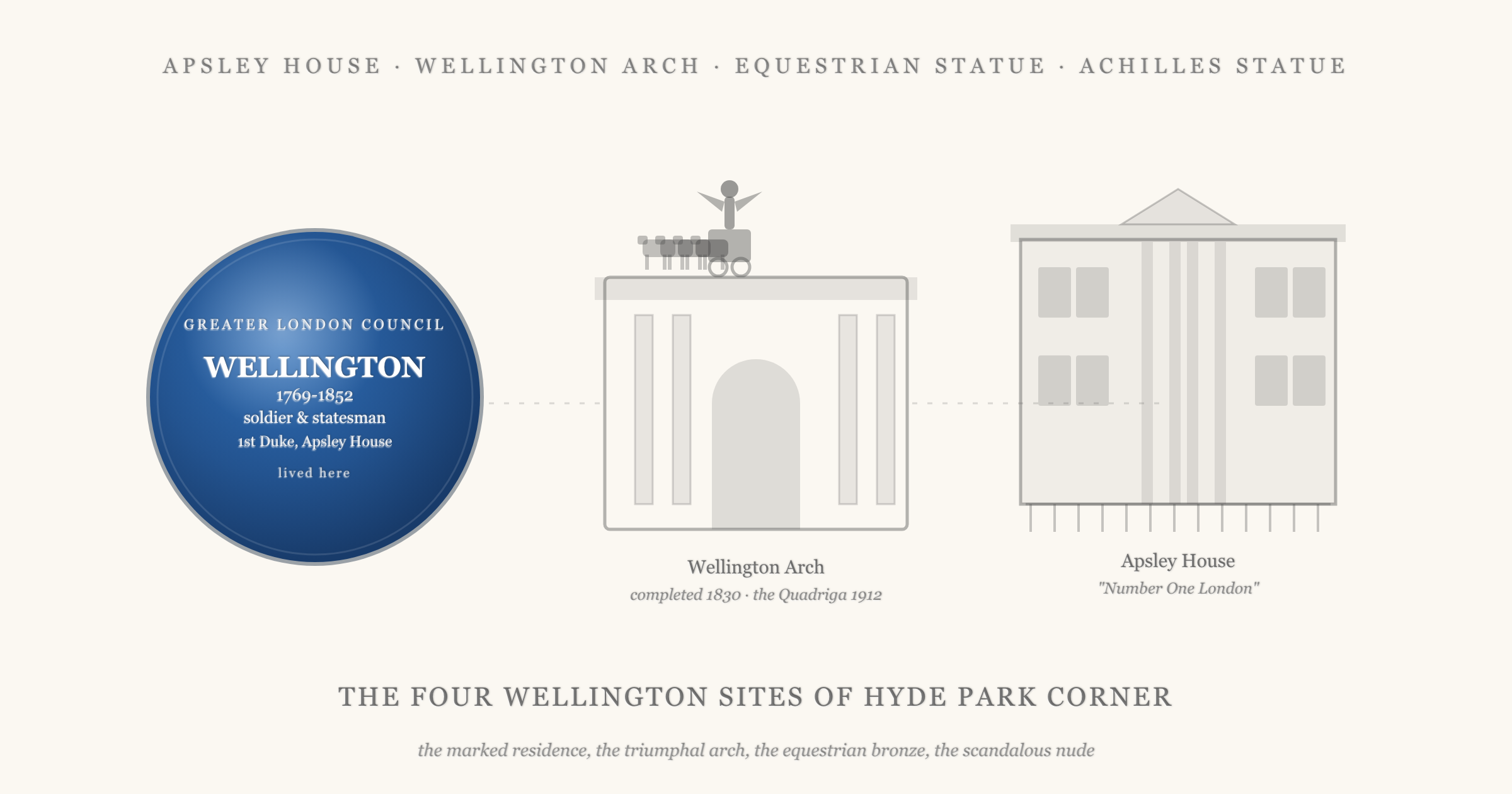
Apsley House is the London home of the first Duke of Wellington, and it is the only aristocratic townhouse in the city still part-lived-in by the family it was built around while also open to the public as a museum. It stands at Hyde Park Corner, on the north side of the busiest road junction in central London, and it carries the address that became its nickname: Number One London, because it was the first house a traveller passed after the Knightsbridge tollgate on the way into town. Around it, within a two-minute walk, sit three more Wellington monuments: Wellington Arch with its vast bronze Quadriga, the equestrian statue facing the house, and the Achilles statue just inside Hyde Park. Four sites, one road junction, the whole of a national life.
This is the walking guide that connects them. The Duke of Wellington was born in Dublin in 1769, beat Napoleon at Waterloo in 1815, served twice as Prime Minister, and died in 1852 to the largest state funeral London had seen. Hyde Park Corner is where London chose to remember him, and it did so four times over: a house, a triumphal arch, an equestrian bronze, and a scandalous nude. The sites are so tightly clustered that the walk between all four takes less than fifteen minutes, which makes this the most compact major walking tour in the city. If you want to follow the route and see how it joins the wider map, the Legacy app plots Hyde Park Corner alongside every plaque in the Mayfair and Belgravia streets that fan out from it.
Why Hyde Park Corner Is the Wellington Junction
Hyde Park Corner was, in the early nineteenth century, the grand western gateway to London. The road in from the west passed the tollgate at Knightsbridge, then arrived at a junction where Hyde Park met Green Park and the route into Mayfair and on to Buckingham Palace began. It was ceremonial ground, and after Waterloo it became the natural place to honour the man who had won the war.
The honouring happened in stages across the nineteenth century rather than all at once. Apsley House was already there, bought by Wellington in 1817, two years after Waterloo. The Achilles statue went up in Hyde Park in 1822. Wellington Arch was completed in 1830, though not in its current position or its current form. The equestrian statue arrived in 1888, replacing an earlier and widely mocked one. By the end of the century the junction had four separate Wellington monuments, accumulated over seventy years, which is why Hyde Park Corner reads less like a planned memorial and more like a city returning to the same spot again and again to mark the same man.
The blue-plaque scheme marks where notable Londoners lived, and Apsley House is the Wellington residence the scheme's logic points to. Because the house is run by English Heritage as a museum in its own right, it carries English Heritage's full interpretation rather than a single roundel on the wall, but the principle is the same: this is the marked London home. The other three sites are monuments rather than residences, which is the same pattern the Winston Churchill walking tour follows a mile to the south, where two blue plaques mark the homes and a statue and a bunker mark the public life.
Stop One: Apsley House, Number One London
Apsley House sits on the north-east edge of Hyde Park Corner, faced in honey-coloured Bath stone, set slightly back behind iron railings. It was built between 1771 and 1778 by Robert Adam for Lord Apsley, the Lord Chancellor, which is where the name comes from. Wellington's elder brother Richard, Marquess Wellesley, bought it first; the Duke acquired it from him in 1817 and made it the London base for the rest of his life.
The interior is the reason to go in. The Waterloo Gallery, added by Wellington in the 1820s, is a ninety-foot room built to hold the annual Waterloo Banquet, the dinner the Duke gave every 18 June for the officers who had fought with him. The walls carry one of the finest private picture collections in Britain, much of it with an extraordinary provenance: a large part of it was captured from the baggage train of Joseph Bonaparte, Napoleon's brother and the installed King of Spain, after the Battle of Vitoria in 1813. When Wellington offered to return the paintings, the restored Spanish crown told him to keep them. The collection includes works by Velazquez, Goya, Rubens, and Correggio, and they hang in Apsley House today because of a wagon abandoned in a Spanish field.
At the foot of the staircase stands the single most startling object in the house: Antonio Canova's marble statue of Napoleon, more than eleven feet tall, showing the Emperor nude and idealised as Mars the Peacemaker. Napoleon disliked it and kept it hidden in the Louvre; after Waterloo the British government bought it and gave it to Wellington, who installed his defeated enemy, naked and heroic, in his own front hall. Apsley House is English Heritage and charges admission; the Wellington family retains private apartments on the upper floors, which is what makes it a living house rather than a frozen museum.
Stop Two: Wellington Arch and the Quadriga
Cross to the traffic island in the centre of Hyde Park Corner and you reach Wellington Arch, also called Constitution Arch. It was designed by Decimus Burton and completed in 1830 as a grand outer entrance to the grounds of Buckingham Palace, paired with Burton's screen at the Hyde Park entrance opposite. It did not start in the spot it now occupies; it was moved a short distance in 1882 to ease the traffic, and it has stood on the island ever since.
For its first half-century the arch was topped by an enormous equestrian statue of Wellington by Matthew Cotes Wyatt, installed in 1846. The statue was the largest equestrian figure ever made at the time, and it was almost universally judged to be too big for the arch and faintly ridiculous on it. When the arch was moved, the statue was quietly taken down and sent to Aldershot, where it still stands. The arch waited bare-topped for nearly thirty years.
The replacement, installed in 1912, is the sculpture that crowns it now: Adrian Jones's Quadriga, a bronze of the Angel of Peace descending on the four-horse chariot of War. It is the largest bronze sculpture in Britain, and it turned the arch from a Wellington monument into a peace monument, which is a quietly pointed thing to put above the man who fought the largest war of his age. The arch is run by English Heritage and you can go inside; the upper floors hold exhibition space and the balconies give one of the best high views of the Hyde Park Corner junction and down toward Buckingham Palace.
Stop Three: The Equestrian Statue
Facing Apsley House from the traffic island stands the equestrian statue of Wellington by Joseph Edgar Boehm, unveiled in 1888. It shows the Duke on Copenhagen, the horse he rode for the entire sixteen-hour day of Waterloo, and it was deliberately sited so that the Duke, in bronze, looks across at the house he lived in.
What makes the Boehm statue worth pausing on is the base. At the four corners stand four infantrymen, each representing one of the nations whose soldiers made up the British Army of the period: an English Grenadier Guard, a Scottish Highlander, a Welsh Fusilier, and an Irish Dragoon. The four figures were modelled from serving soldiers, and they turn the monument from a portrait of a commander into a portrait of an army. The statue replaced the mocked Wyatt figure that had come down off the arch, so the 1888 unveiling was, in part, London getting the Wellington monument it had wanted the first time.
Stop Four: The Achilles Statue
Walk a short way north into Hyde Park itself, just inside the park boundary near Hyde Park Corner, and you reach the oldest of the four monuments: the Achilles statue, properly the Wellington Monument, by Richard Westmacott, erected in 1822. It is an eighteen-foot bronze figure of a classical warrior, modelled loosely on a Roman statue, and it was cast from the metal of cannon captured from the French at Wellington's victories at Salamanca, Vitoria, Toulouse, and Waterloo.
It was paid for by public subscription, and the subscription was specifically organised by "the women of England," whose dedication is recorded on the plinth. It was also the first nearly-nude public statue in London, and it caused exactly the scandal that detail predicts: a fig leaf was added shortly after unveiling, and the statue has carried one ever since. The Achilles statue is the monument that shows London still working out how to commemorate a living hero, four years before the arch and twenty-six before the Wyatt statue, and the awkwardness is part of its charm.
The Walking Route in Practice
The four sites are the most compact major walking tour in central London, because they share a single road junction. The practical sequence:
Start at Hyde Park Corner Underground station (Piccadilly Line). The station exits put you within thirty seconds of Apsley House. Go into the house first, while you have the energy for the picture collection; allow ninety minutes inside if you want to do the Waterloo Gallery properly.
Cross to the central island by the pedestrian subways to reach Wellington Arch. Go up inside it if it is open; the balcony view is worth the climb and reframes the whole junction.
The equestrian statue is on the same island, facing back toward Apsley House. Two minutes.
Walk north into Hyde Park to the Achilles statue, just inside the park near the Queen Elizabeth Gate. Five minutes from the arch, and a good place to end because you are already in the park.
The whole loop, excluding time inside Apsley House and the arch, takes about fifteen minutes of walking. Combined with the two interiors it is a comfortable half-day. Hyde Park Corner is also a junction, not a destination, so the walk extends naturally in three directions: east into Mayfair, south to Belgravia, and south-east toward Buckingham Palace and Westminster.
How Hyde Park Corner Connects to the Rest of the Map
Wellington's junction is the western hinge of several walks already on this blog. Walk east from Apsley House into Mayfair and you are minutes from the Handel and Hendrix house on Brook Street and the Florence Nightingale plaques around South Street and Mayfair. Walk south-east and you reach the Westminster sites of the Winston Churchill walking tour; the connection there is more than geographic, because Churchill's 1965 state funeral was explicitly the largest London had seen since Wellington's in 1852, and the two processions ran through overlapping ground.
Bundled with the Mayfair walks, Hyde Park Corner gives you a full day: the Wellington junction in the morning, the Brook Street and South Street plaques across the afternoon, ending in the heart of Mayfair. The Legacy app maps the connecting plaques street by street so you can build the route at your own pace.
The Bottom Line
Apsley House, Wellington Arch, the equestrian statue, and the Achilles monument: four memorials to the same man, accumulated across seventy years, gathered around one road junction. Number One London is the marked residence, with a picture collection captured from a Bonaparte baggage train and a naked marble Napoleon at the foot of the stairs. The arch carries a peace monument above the soldier. The equestrian statue gives him back the army. The Achilles statue shows a city still learning how to commemorate. It is the most compact serious walking tour in London, doable in a half-day, and it sits at the western gate of the Mayfair plaque map. The Legacy app plots Hyde Park Corner and every plaque in the streets around it, with the inscription text and the history for each one.