In a second-storey room of a hospital beside Paddington station, in the late summer of 1928, a Scottish bacteriologist came back from holiday to a messy bench and a dish of mould, and changed the course of medicine. Alexander Fleming's discovery of penicillin began as an accident he very nearly threw away. Two plaques in London mark the man: a maroon one on the wall of St Mary's Hospital, recording that he "discovered penicillin in the second storey room above this plaque," and a blue one across the river in Chelsea, on the house where he lived. This is the story of those two addresses, the discovery between them, and a walk through Fleming's London.
For anyone tracing the city's scientific history, Fleming sits alongside Charles Darwin, Ada Lovelace, and Florence Nightingale in the constellation of plaques that mark where modern knowledge was actually made. The Legacy app maps every one of them, with the inscription and the history behind each marker.
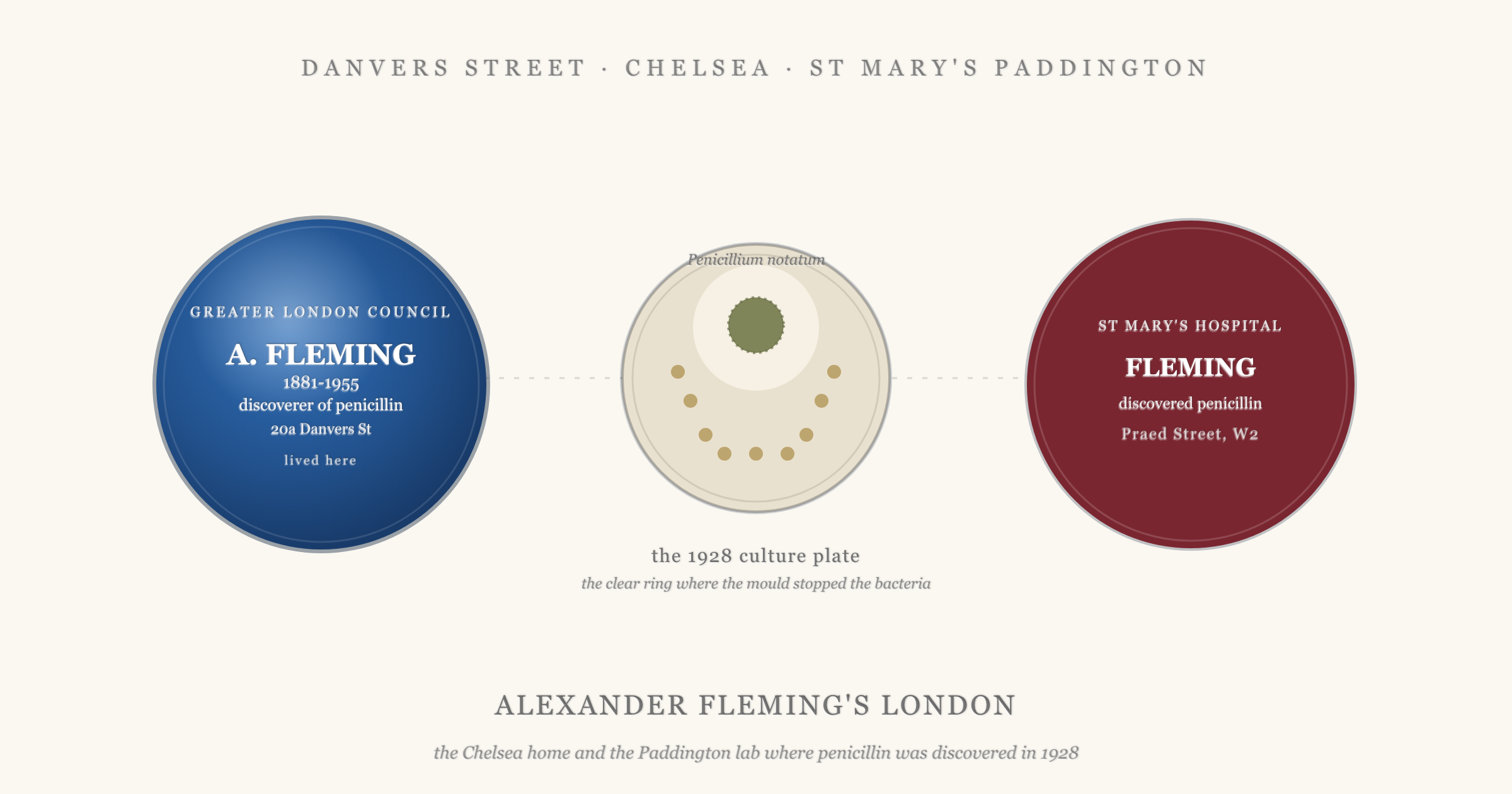
The Accident on Praed Street
By 1928 Fleming was an established bacteriologist at St Mary's Hospital in Paddington, working in a cramped laboratory on Praed Street. He was studying staphylococci, the common bacteria behind boils and wound infections, growing them on flat glass culture plates. He was also, by every account, an untidy worker, the kind who let plates pile up on the bench rather than clearing them away.
That untidiness is part of the legend, because it made the discovery possible. Fleming went away on a family holiday in late August and left a stack of staphylococcus plates by the window. When he returned in early September, he began sorting through them and noticed that one plate had been contaminated by a blue-green mould. That alone was unremarkable; airborne mould spoiling cultures was a daily nuisance. What stopped him was the ring around the mould. In a clear halo encircling the contaminant, the staphylococcus colonies had dissolved. Something the mould produced was killing the bacteria.
The mould was a species of Penicillium, and Fleming set about studying the "mould juice," as he first called it, that diffused from it. He found it could kill a range of dangerous bacteria, and crucially that it seemed not to harm animal cells or white blood cells in the way the harsh antiseptics of the day did. In 1929 he published his findings and gave the active substance a name: penicillin. The plate that started it has become one of the most famous objects in the history of science.
St Mary's Hospital, Paddington: The Lab Above the Plaque
The room where this happened still has a marker. On the wall of St Mary's Hospital, the maroon plaque reads that Sir Alexander Fleming "discovered penicillin in the second storey room above this plaque", one of the few plaques in London that points not at a building but at a specific window.
Inside, that laboratory has been recreated as the Alexander Fleming Laboratory Museum. The small room has been restored to look as it did in 1928, with the bench, the equipment, and the cramped clutter of a working bacteriology lab of the period, and the museum tells the story of the discovery and what came after. For a visitor, it is a rare chance to stand in the actual place a world-changing idea began, rather than at a plaque on an unrelated facade. St Mary's itself, founded in 1845, is one of the great Victorian London teaching hospitals, and Fleming spent almost his entire career there, first as a student, then for decades as a researcher.
Paddington is not on most plaque-hunting routes, which sit further east in Bloomsbury and Marylebone or south in Chelsea and Westminster. Fleming's lab is a reason to come west: the science-tourism equivalent of a pilgrimage, a short walk from the station that most people only pass through.
20a Danvers Street, Chelsea: The Blue Plaque at Home
Across the city, in Chelsea, is the other Fleming plaque. English Heritage put up a blue plaque in 1981 at 20a Danvers Street, a quiet road running down toward Cheyne Walk and the Chelsea Embankment, recording simply that "Sir Alexander Fleming, 1881-1955, discoverer of penicillin, lived here."
This is the domestic counterpart to the Paddington lab. Fleming lived at Danvers Street in his later years, by which time he was one of the most famous scientists in the world, a Nobel laureate and a knight. Chelsea in his day was already the artists' and writers' quarter it remains, and the riverside streets around Cheyne Walk carry a dense cluster of blue plaques to painters, authors, and engineers. Fleming's marker fits naturally among them, a reminder that the man who lived in this comfortable Chelsea house had spent his working life among the culture plates of a Paddington laboratory.
From Mould Juice to Medicine
Here the story takes the turn most people forget. Fleming discovered penicillin, but he did not make the drug. He could show that the mould juice killed bacteria in a dish, but he could not purify or stabilise it in any quantity, and by the mid-1930s he had largely set the problem aside. Penicillin might have remained a laboratory curiosity.
The breakthrough came at Oxford, more than a decade later. A team at the Sir William Dunn School of Pathology, led by the Australian pathologist Howard Florey and the German-born biochemist Ernst Chain, with the crucial production work of Norman Heatley, took Fleming's published observation and turned it into a usable medicine. Between 1939 and 1941 they purified penicillin, tested it, and in 1941 treated their first patients. Mass production was scaled up in the United States during the Second World War, in time to treat Allied wounded around the D-Day landings of 1944, and penicillin went on to save an incalculable number of lives.
In 1945 the Nobel Prize in Physiology or Medicine was awarded jointly to Fleming, Florey, and Chain. Fleming, generous about it, was always clear that he had made an observation and that others had made the drug. The popular story flattened the three of them into one heroic moment at a Paddington window, but the real history is a relay: an accidental discovery in 1928, picked up and finished by a different team in a different city more than ten years later.
The Man Behind the Plaque
Fleming was born in 1881 on a farm in Ayrshire, in the Scottish lowlands, the son of a hill farmer. He came to London as a young man, worked briefly as a shipping clerk, and then, with a small inheritance, enrolled at St Mary's Hospital Medical School, the institution he would never really leave. He joined its research department under the pioneering immunologist Almroth Wright and stayed for the rest of his career.
The First World War shaped him. Serving in the Royal Army Medical Corps in field hospitals in France, he saw soldiers die of infected wounds and showed, through careful experiments, that the strong antiseptics doctors poured into deep wounds often did more harm than good, killing the body's own defending cells faster than the bacteria. That insight, that an antibacterial agent had to spare the patient while killing the microbe, was exactly the property he would later recognise in penicillin. In 1922, before the famous mould, he made an earlier discovery: lysozyme, a mild antibacterial enzyme present in tears and saliva, found, in a very Fleming way, when a drop from his own runny nose landed on a culture.
He was knighted in 1944 and spent his last decade as a global celebrity of science. He died in London in 1955.
Where Fleming Rests: St Paul's Cathedral
Fleming's final London address is the grandest of them. He is buried in the crypt of St Paul's Cathedral, an honour reserved for figures of national importance, among the tombs of Nelson, Wellington, Christopher Wren, and J.M.W. Turner. A man born on a Scottish farm, who made his name in a cluttered Paddington lab, lies under Wren's dome in the company of admirals and architects. It is a fitting last stop on any walk through his London.
A Short Walk Through Fleming's London
The three Fleming sites are spread across the city, but they make a coherent route for a day that mixes science, history, and a good amount of London in between.
- St Mary's Hospital, Praed Street, Paddington. Start at the maroon plaque and the Alexander Fleming Laboratory Museum, the actual room of the discovery. Check the museum's opening times before you go, as it keeps limited hours.
- Across to Chelsea. Make your way south-west to 20a Danvers Street for the English Heritage blue plaque, then walk the few steps to Cheyne Walk and the Chelsea Embankment, one of the richest plaque-clusters in London, to see where Fleming lived out his fame among artists and writers.
- East to St Paul's. Finish in the City at St Paul's Cathedral, where Fleming is buried in the crypt, and where you can pay respects at the resting place of the man whose accidental observation became one of medicine's greatest gifts.
Fleming belongs to the same London story as the other scientists the city commemorates: Charles Darwin working out evolution at Down House and on Gower Street, Florence Nightingale reforming nursing from her Mayfair home, and the long line of discoverers whose markers are gathered in the complete guide to London's blue plaques. Each plaque is a door into a life, and Fleming's two markers, the lab and the home, between them tell the whole arc of his.
Plan Your Own Fleming Walk
Penicillin began in a single room above a plaque on Praed Street, and the city still marks the man who found it in three places: the Paddington lab, the Chelsea home, and the crypt of St Paul's. To find them, and the hundreds of other plaques that turn a London walk into a tour through history, the Legacy app maps every blue plaque in the city, with the inscription text and the story behind each one, so you can build a route around the people whose work you want to stand next to.