Sir John Soane's Museum sits on the north side of Lincoln's Inn Fields, in Holborn, behind a façade you could mistake for any other Georgian terrace until you notice the strange projecting stone front of number 13. Step inside and you enter one of the most extraordinary interiors in London: the home of the architect Sir John Soane, packed floor to ceiling with antiquities, casts, paintings, and architectural fragments, lit by hidden skylights and coloured glass, and preserved by Act of Parliament exactly as he left it on the day he died in 1837. Almost nothing has moved in nearly two centuries. This is the guide to the Sir John Soane Museum: the man who built it, the treasures inside, the law that froze it, and how to visit (entry is free).
It is a house museum unlike any other, because it was designed from the start to be a museum, by a man obsessed with light, illusion, and the fragments of the classical past. Soane was the architect of the Bank of England, the son of a bricklayer who climbed to the very top of his profession, and the museum is the most complete surviving record of how his mind worked. Nothing about it is accidental.
Who Was Sir John Soane?
John Soane (1753 to 1837) was one of the greatest and most original British architects of his age. Born the son of a bricklayer near Reading, he rose through talent and relentless work to become architect to the Bank of England, where his masterpiece, a vast and inventive complex of top-lit halls, stood for over a century before being largely demolished between the wars (a loss often called one of the worst architectural crimes of twentieth-century London). He also designed Dulwich Picture Gallery, the first purpose-built public art gallery in England, and his ideas about light and space influence architects to this day.
Soane was knighted, made a professor at the Royal Academy, and became wealthy, but his personal life was unhappy. His marriage was close, but he was bitterly estranged from his surviving son George, who attacked his father's work anonymously in print, a betrayal Soane never forgave. That family rupture is part of why the house exists as a public museum at all.
The House Frozen by Act of Parliament
Soane bought number 12 Lincoln's Inn Fields in 1792, then number 13 next door, and eventually number 14, rebuilding them over decades into a combined home, architectural office, and private museum. As he aged, he became determined that the collection should survive intact and pass to the nation rather than to his estranged son.
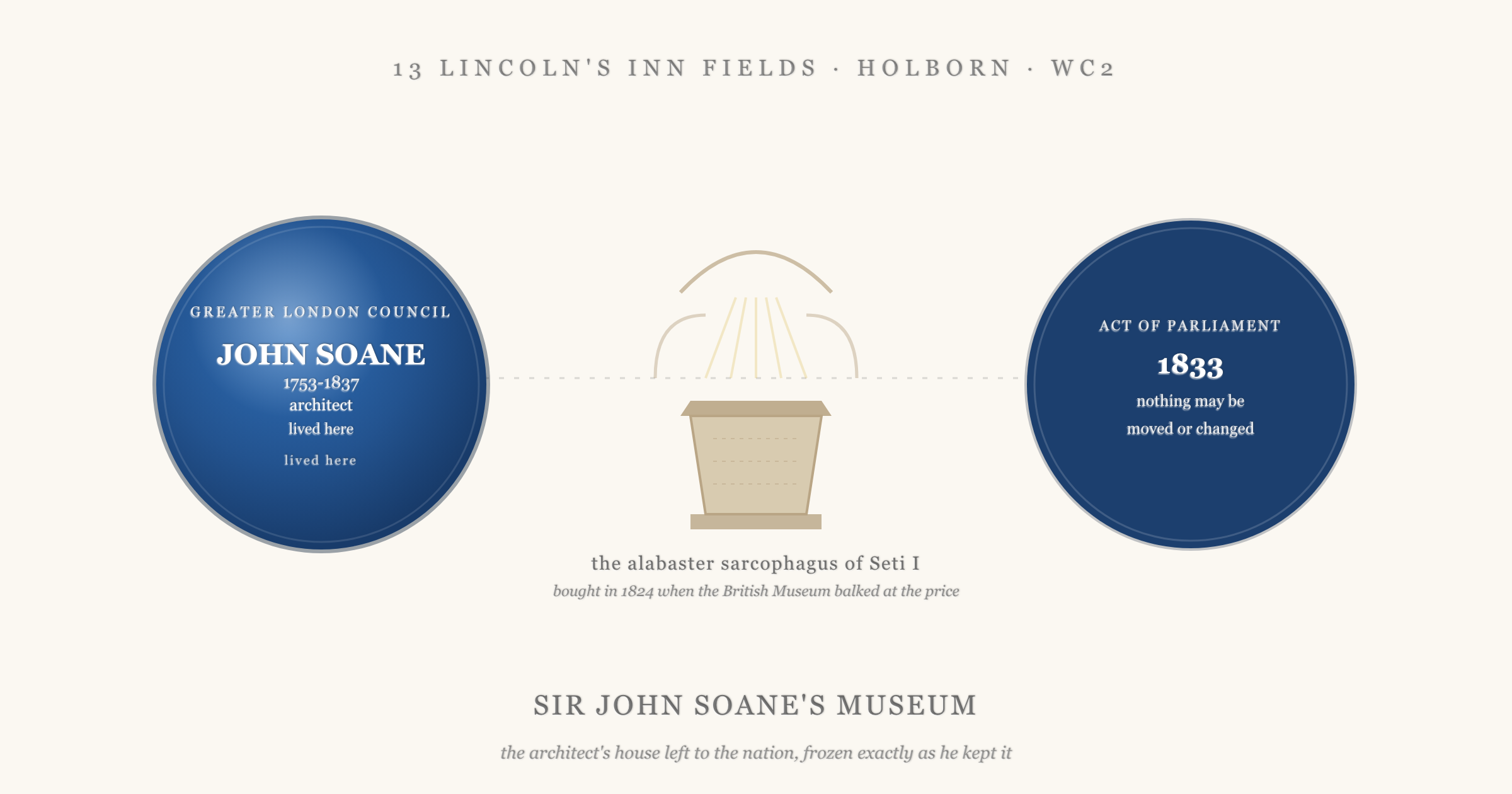
To make sure of it, he secured a private Act of Parliament in 1833, the Soane Museum Act, which on his death handed the house and everything in it to the public, with two remarkable conditions: that it be preserved "as nearly as possible" in the state he left it, and that it remain free to visit. Both conditions still hold today. The reason the museum feels like stepping into a sealed moment in 1837 is that, legally, it has to. Curators have spent the modern era painstakingly returning rooms to exactly how Soane arranged them, down to the position of individual objects.
It was, in part, an act of revenge. By giving the house to the nation, Soane ensured his son could never inherit or sell it. The result is one of the great accidental gifts in London's cultural history.
The Sarcophagus of Seti I
The single most famous object in the museum sits in the basement, in the part of the house Soane theatrically called the Crypt. It is the alabaster sarcophagus of the pharaoh Seti I, carved around 1370 BC, translucent and covered inside and out with finely incised hieroglyphs and figures. It had been discovered in the Valley of the Kings by the explorer Giovanni Belzoni in 1817.
The story of how Soane got it is pure Soane. The British Museum was offered the sarcophagus but balked at the asking price of £2,000. Soane stepped in, bought it in 1824, and when it arrived he threw a three-day party to celebrate, lit by candlelight, with hundreds of guests including poets, painters, and politicians filing through the house to see it glow. It remains exactly where he placed it, the centrepiece of a basement crammed with classical fragments.
The Picture Room and Its Folding Walls
If the sarcophagus is the most famous object, the Picture Room is the most ingenious space. Faced with the problem of hanging far more paintings than the walls could hold, Soane invented a solution that still delights every visitor: the walls are not solid but a series of hinged panels, "moveable planes," that swing open like the leaves of a cupboard to reveal yet more paintings hung on their backs and in the recess behind.
The room holds an astonishing collection for its size. Behind those folding walls are William Hogarth's two great satirical series, A Rake's Progress (eight paintings tracing a young heir's ruin) and the four canvases of An Election, along with works by Canaletto, Turner, and a wall of Piranesi drawings. Watching a guide open the panels to triple the room's hanging space is one of the small theatrical pleasures of visiting.
Light, Mirrors, and the Soane Effect
What ties the whole house together is Soane's obsession with light. He hated flat, even illumination. Throughout the museum he used concealed skylights, lanterns of coloured (often amber) glass, and an extraordinary number of mirrors, convex and flat, set into ceilings, walls, and the angles of rooms to bounce light around and dissolve the boundaries of small spaces.
The finest example is the Breakfast Room, with its shallow "canopy" dome seeming to float free of the walls, a top-light around its rim, and convex mirrors set into the corners and the dome itself, so the room appears to extend infinitely in every reflected direction. It is one of the most admired small interiors in British architecture, and it shows in miniature everything Soane spent his life pursuing: the manipulation of light to make a modest space feel boundless. The darker counterpart is the Monk's Parlour, a deliberately gloomy gothic basement room Soane built as a half-joke, complete with the invented backstory of a fictional monk, "Padre Giovanni."
Visiting Sir John Soane's Museum
The museum is at 13 Lincoln's Inn Fields, and thanks to the 1833 Act, admission is still free, one of the genuine bargains of cultural London. A few practical notes:
- Where it is. 13 Lincoln's Inn Fields, London WC2. The nearest Underground station is Holborn, about five minutes' walk away.
- Booking. Entry is free, but the house is small and can get busy, so timed tickets are advisable, especially at weekends. Check the official site before you go.
- When. The museum is usually closed on Mondays, and opening times can vary, so confirm hours in advance.
- The candlelit evenings. The museum periodically holds famous late openings lit by candlelight, recreating how Soane himself showed the house. They are atmospheric and popular, and worth watching the events calendar for.
For current opening times, ticketing, and events, the official Sir John Soane's Museum site is the place to check. And if you want to plan a wider day of London's house museums, our interactive map of London's blue plaques plots Soane alongside the city's other commemorated residents, so you can pair Lincoln's Inn Fields with grand interiors like Apsley House or the artists' palace of Leighton House in a single afternoon.
Sir John Soane's Museum is the rare place where the building, the collection, and the mind that made them are inseparable. Go for the sarcophagus, stay for the folding walls and the floating dome, and remember as you leave that the whole thing survives, free and unchanged, because one architect was determined his son would never get his hands on it.