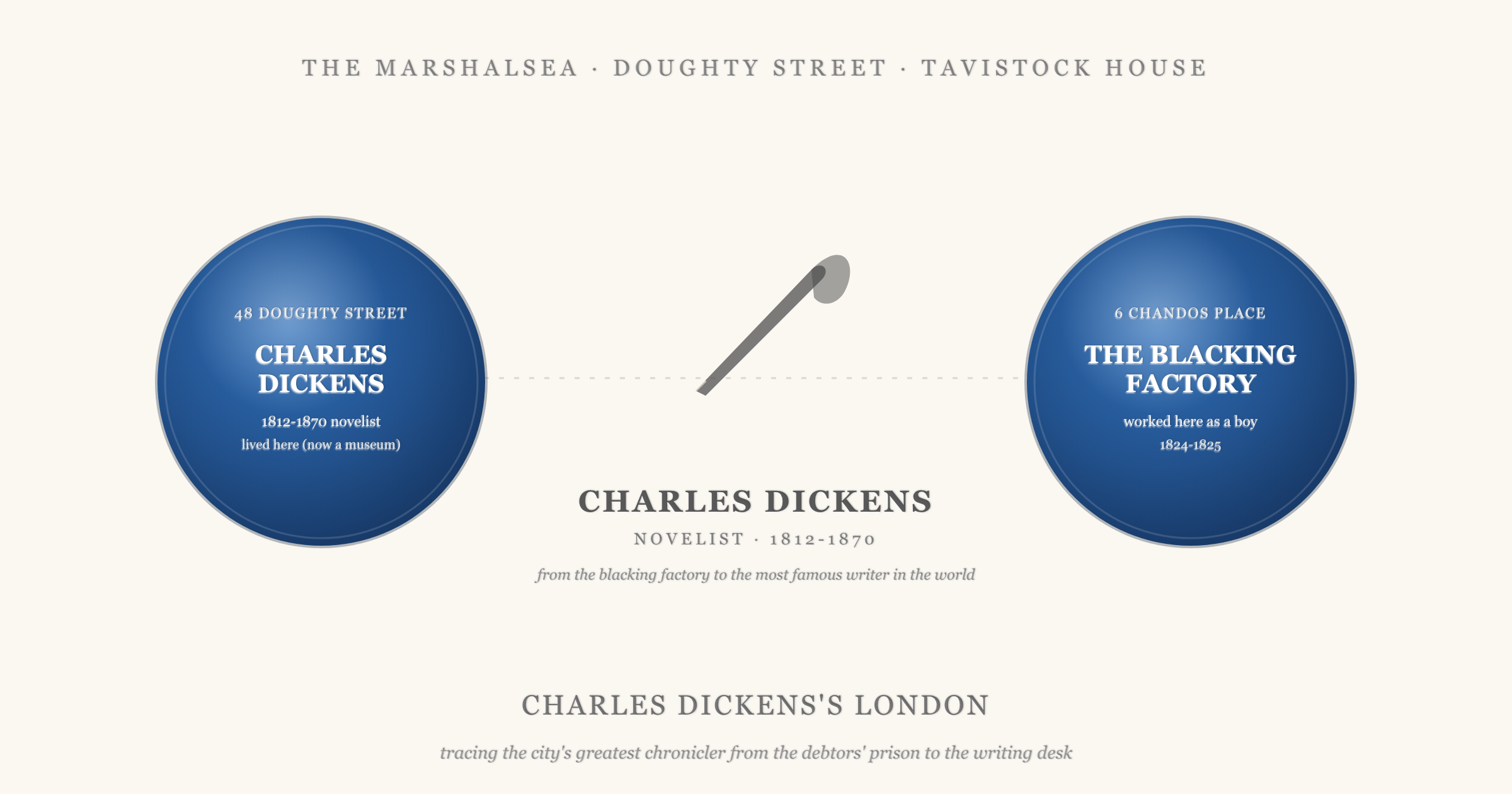
No writer is more bound up with London than Charles Dickens. The city is everywhere in his novels, its fog and slums and crowds and coaching inns, and it is everywhere in his life, from the childhood humiliation that scarred him to the grand houses where he wrote the books that made him the most famous author in the world. To walk Dickens's London through its blue plaques is to trace both the man and his material at once, because for Dickens the two were never separable: he turned his own London into fiction, and his fiction back into the London everyone now imagines. This is a guide to Charles Dickens's London, from the blacking factory and the debtors' prison that shaped him to the desks where he wrote.
For the house at the centre of it all, our guide to the Charles Dickens Museum covers the Doughty Street home in detail. Here, we follow the wider city.
The Childhood Wound: The Blacking Factory and the Marshalsea
Dickens's London begins in trauma, and you can stand on the spot. When Charles was twelve, his father, John Dickens, was imprisoned for debt in the Marshalsea Prison in Southwark, taking most of the family with him as was then the custom. A surviving wall of the Marshalsea still stands off Borough High Street, marked by a plaque, and the experience burned itself into Dickens so deeply that it surfaces, transformed, in Little Dorrit, much of which is set inside the prison.
Worse, in his own eyes, was what the family's poverty forced on the boy himself. While his father was inside, the young Charles was sent to work pasting labels on pots of boot-blacking at a riverside factory, lodging alone and miserable. A plaque at 6 Chandos Place, near Charing Cross, records that "as a boy Charles Dickens worked here." He told almost no one about this period for the rest of his life, but it never left him: the fear of poverty and abandonment, and the lost, working children, run straight through Oliver Twist, David Copperfield, and Great Expectations. He also lived as a boy at 22 Cleveland Street, near a workhouse that may have helped inspire the one in Oliver Twist. The childhood wound is the engine of the fiction.
The Making of a Writer: Furnival's Inn and Doughty Street
Dickens climbed out fast. He taught himself shorthand, became a parliamentary reporter, and began publishing comic sketches under the pen name "Boz." From lodgings at Furnival's Inn in Holborn he wrote The Pickwick Papers, the serial that made him a sensation almost overnight in 1836.
Success let him take a proper family house, and it is the one that survives. At 48 Doughty Street, in Bloomsbury, Dickens lived from 1837 to 1839 and wrote Oliver Twist and Nicholas Nickleby. It is the only one of his many London homes still standing, and it is now the Charles Dickens Museum, the essential stop on any Dickens walk. Standing in the rooms where he worked, with the desk and the everyday objects of his life, you can feel how quickly the frightened blacking-factory boy had become the rising star of English letters.
The Great Homes: Devonshire Terrace and Tavistock House
As his fame and family grew, so did his houses. At Devonshire Terrace, near Regent's Park (marked by a plaque on Marylebone High Street recording that he wrote six of his principal works while living nearby), Dickens spent the 1840s and produced an astonishing run: A Christmas Carol, The Old Curiosity Shop, Dombey and Son, and David Copperfield.
In the 1850s he moved to Tavistock House in Tavistock Square (a plaque near the site, at BMA House, records the years 1851 to 1860), where he wrote Bleak House, Hard Times, and Little Dorrit, and staged elaborate amateur theatricals in a household that was, by then, both a literary factory and a stage. These were the years of his greatest productivity and his greatest fame, and the addresses trace a man moving steadily up through the London he never stopped writing about.
Dickens at Work: The Magazines and the City
Dickens was not only a novelist but a tireless editor and public man, and the plaques mark that too. On Wellington Street, near the Strand, a plaque records the offices of his hugely popular weekly magazine All the Year Round, in which he serialised A Tale of Two Cities and Great Expectations and from which he ran a one-man media empire.
And then there is the London of the novels themselves, which is still findable. The George Inn on Borough High Street, the last galleried coaching inn in London and now in the care of the National Trust, is the kind of place Dickens knew and put into his fiction (he mentions it in Little Dorrit); we feature it in our guide to London's historical pubs. To walk Southwark, the Strand, and Holborn with Dickens in mind is to find the city of his imagination layered over the real one, which is exactly the trick his writing pulls.
A Dickens Walk
Dickens's London spans the centre of the city, and a walk can follow his life from wound to triumph.
- Southwark. Begin at the surviving wall of the Marshalsea Prison off Borough High Street, and the nearby George Inn.
- Chandos Place. Cross the river to the site of the blacking factory near Charing Cross, where the boy worked.
- Doughty Street. Walk up to Bloomsbury and the Charles Dickens Museum, his only surviving home.
- Tavistock Square and Marylebone. Finish near the sites of his great later homes, where the major novels were written.
It is a route that runs from a child's humiliation to the desk of the most famous writer in the world, all within a few square miles of the city he made his own.
Discover the Plaques Yourself
Dickens's plaques are part of a far larger web of markers across London, recording where its writers, reformers, and artists lived and worked. Tracing them turns a walk through the centre of the city into a journey through a single extraordinary life, and through the London he fixed forever in fiction. The Legacy app maps every blue plaque in the city, with the full inscription and the history behind it, so you can plan your own route, collect the ones you visit, and follow the trail onward, perhaps into the Charles Dickens Museum itself or deeper into the complete guide to London's blue plaques. Start at the Marshalsea wall, and follow the boy who became Dickens.