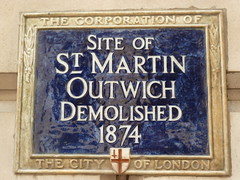
What did London St. Martin Outwich do at Threadneedle Street?
St. Martin Outwich, Threadneedle Street Standing on Threadneedle Street where the medieval Church of St. Martin Outwich once rose, you're standing at the heart of London's financial awakening—the very ground where merchants and moneychangers gathered for centuries, their transactions conducted in the shadow of this ancient parish church that gave its name to the surrounding community.
The church itself, with its distinctive name derived from its location "outwich" (outside the old Roman wall), served as a spiritual anchor for the bustling trading district from at least the 12th century, witnessing the rise of the nearby Royal Exchange and the establishment of London's banking empire. When the church was finally demolished in 1874, it marked the end of nearly seven hundred years of continuous worship and community life, swept away by the same financial forces that had once sustained it—progress that replaced sacred space with the imposing Victorian architecture of the City's expansion.
Discover more stories across London
Collect 1,625+ Blue Plaques with the Legacy app

Today, this modest blue plaque is your only evidence that something precious once stood here, a reminder that beneath every gleaming financial institution on Threadneedle Street lies the ghost of St. Martin Outwich, a church that was inseparable from London's transformation into the world's greatest trading centre.