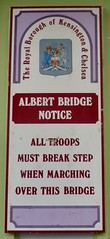
What did Albert Bridge do at Albert Bridge?
Bridge Standing at Albert Bridge and reading this peculiar military notice, you're witnessing one of Victorian London's most practical engineering lessons. When Albert Bridge opened in 1873, its elegant wrought-iron suspension design—beloved by Londoners for its graceful curves—proved fatally susceptible to resonance: the rhythmic footfalls of marching troops created vibrations that threatened to tear the structure apart, nearly causing catastrophic collapse during a cavalry crossing in the 1880s.
This notice, born from near-disaster, represents a pivotal moment when engineers realized that beauty and safety must dance together, and it became the template for similar warnings on suspension bridges worldwide. Today, as you cross this iconic Chelsea landmark spanning the Thames, you're walking through a living classroom where Victorian builders discovered that sometimes the most important innovations aren't visible—they're the invisible rules that keep us safe.
Discover more stories across London
Collect 1,625+ Blue Plaques with the Legacy app